


Hsiao-jung will be glad when Mid-Autumn Festival finally arrives, more so than most people. Like everyone else, he's been working eight hours a day, five days a week for a long time now and could use a break. Unlike most people, though, he's been busy making tens of thousands of mooncakes for the upcoming holiday. When Mid-Autumn Festival finally passes, Hsiao-jong can forget about mooncakes for a while.
His workload may not be different from most people's, but unlike most people, at 35-years-old Hsiao-jung has the mind of a child. "I'm tired of mooncakes," he said, "And it's not even Mid-Autumn Festival yet!"
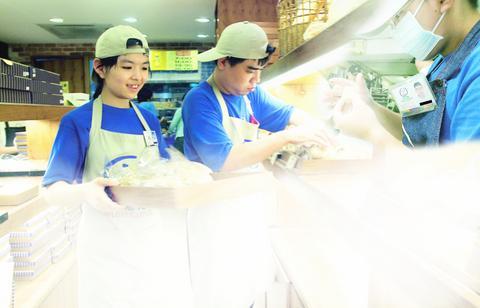
PHOTO: CHIANG YING-YING, TAIPEI TIMES
Hsiao-jung is gainfully employed thanks to the help of the Children Are Us Social Welfare Foundation (
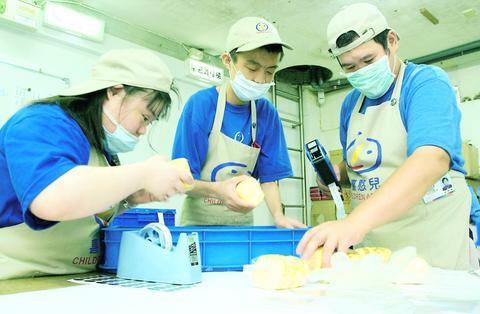
Established in 1995, the foundation has since opened a score of bakeries and restaurants in Kaohsiung, Taipei and Hsinchu that employ a number of persons with developmental disabilities, providing them with the skills they need in the workplace and the confidence they need outside it.
Despite its name, there are no children on the payroll at any of the Children Are Us bakeries or restaurants. "The name comes from the fact that these people will be children
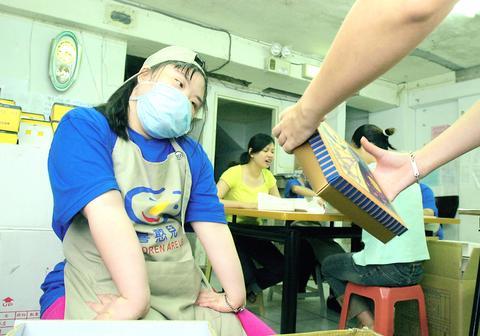
forever," said Wu Ting-fang (
They've made some headway. Since the foundation first began, it has not only employed dozens of persons with developmental disabilities at its own establishments, but helped several more find work at other service-industry companies like Pizza Hut and 7-11, where they usually prove to be model employees.
"A-hsien is on time to work every day and doesn't stop working until he goes home," said Chen Chao-te (

But as happy as Chen is to have A-hsien on staff, A-hsien himself is even happier. "I like working. I like to keep busy," he said without taking his eyes off the shelves he was stocking. "Sometimes I miss the bus and have to wait another 20 minutes. It's bad to be late."
His single-minded diligence to his work is what has made Children Are Us one of the most successful social welfare programs in Taiwan. Where traditional foundations might receive most of their funding through government subsidization, Children Are Us derives some 55 percent of its income from its own bakeries and restaurants. That's after paying salaries to the very employees the foundation works to assist.
Profits are then used to pay for various welfare programs. Children Are Us receives another quarter of its funding from private donations and another quarter from government assistance.
This principle of self-empowerment rather than dependence is even written into the foundation's mission statement: "We would rather give them a fishing pole and teach them how to fish than give them fish. However, the most important thing is that we lead them to the fishpond; that is the marketplace and community where they can get lots of fish."
Although the foundation has been successfulworking with people like A-hsien, bigger problems exists with societal perceptions of the developmentally disadvantaged, a government that doesn't provide enough assistance for them, and even parents of people with special needs who don't know how to best help their children.
A Kaohsiung woman made headlines last week for having sex with her two developmentally disadvantaged sons.
She first had sex with her elder son four years ago when he turned 16 and began having sexual urges. When her younger son learned of their arrangement, he became jealous and demanded the same.
The woman reasoned that, without a sexual outlet, the boys were in danger of hurting themselves or someone else.
It's sad and outrageous that the family didn't initially seek help, but it's even more outrageous that, when they finally did seek professional help, the physician they turned to felt it was his professional prerogative to tell the media rather than contact Kaohsiung City's social welfare department.
The case is an extreme example of how families, in their desire to provide for their children themselves, often end up compounding their problems. "There is a stigma that comes with having developmentally disadvantaged children," said Wu.
"Many families aren't willing to come forward to seek help, believing that, as long as they are alive, they can take care of their children themselves."
It's when the parents are gone, however, that caring for the developmentally disadvantaged can become a public issue. It's also at this time that government assistance proves glaringly insufficient.
"The difference between public programs for the disadvantaged in Taiwan and countries like America is vast," Wu said. "The support provided by our government simply isn't enough."
As an example, Wu cites a Bureau of Labor Affairs regulation requiring all companies with 50 to 100 employees to have at least one physically or developmentally disadvantaged person on staff or face a monthly fine of nearly NT$16,000.
Most companies, she said, choose to pay the fine. That money then goes toward subsidizing foundations like Children Are Us as well as various programs for the disadvantaged, including a monthly stipend, usually around NT$6,000 to NT$7,000, for people with disabilities.
Wu and others believe a better approach would be for the government to take the initiative to help the disadvantaged and reward companies and individuals who do the same rather than penalize them.
"There need to be training programs to teach these individuals and show them what they are capable of doing," Wu said, adding that once they're given the skills to be independent, disadvantaged youth can turn into adults that are contributing members of society.
Hsiao-jung agrees: "I've learned a lot from the foundation. I have a job. I'm not a child."
You can help support the Children Are Us Foundation by ordering mooncakes for the Mid-Autumn Festival on Sept. 11 at any Children Are Us Bakery or by visiting the foundation's Web site at http://www.c-are-us.org.tw.
Order before Sept. 6 and receive a 20 percent discount on your purchase. Children Are Us bakeries and restaurants can be found at the following locations in Taipei, Hsinchu and Kaohsiung.
BAKERIES:
Kaohsiung
365 Tashun 2nd Rd, Kaohsiung (07) 387-4095 (
Taipei
461 Kuangfu S Rd, Taipei (02) 2725-2759 (北市光復南路461號); 83 Yenping N Rd, Sec 2, Taipei (02) 2559-3597 (北市延平北路二段83號).
RESTAURANTS:
Taipei
2, Ln 80, Minsheng E Rd, Sec 4, Taipei (02) 2545-4379 (
Hsinchu
55 Chienchung Rd, Hsinchu (03) 574-8134 (
Kaohsiung
33 Shangli St, Kaohsiung (07) 223-4510 (
Children Are Us also seeks the help of volunteers both at their bakeries and restaurants and at their administrative offices. If you'd like to donate your time, in Kaohsiung call (07) 726-6096 or in Taipei call (02) 2325-7383.

In late October of 1873 the government of Japan decided against sending a military expedition to Korea to force that nation to open trade relations. Across the government supporters of the expedition resigned immediately. The spectacle of revolt by disaffected samurai began to loom over Japanese politics. In January of 1874 disaffected samurai attacked a senior minister in Tokyo. A month later, a group of pro-Korea expedition and anti-foreign elements from Saga prefecture in Kyushu revolted, driven in part by high food prices stemming from poor harvests. Their leader, according to Edward Drea’s classic Japan’s Imperial Army, was a samurai

Approaching her mid-30s, Xiong Yidan reckons that most of her friends are on to their second or even third babies. But Xiong has more than a dozen. There is Lucky, the street dog from Bangkok who jumped into a taxi with her and never left. There is Sophie and Ben, sibling geese, who honk from morning to night. Boop and Pan, both goats, are romantically involved. Dumpling the hedgehog enjoys a belly rub from time to time. The list goes on. Xiong nurtures her brood from her 8,000 square meter farm in Chiang Dao, a mountainous district in northern Thailand’s

Located down a sideroad in old Wanhua District (萬華區), Waley Art (水谷藝術) has an established reputation for curating some of the more provocative indie art exhibitions in Taipei. And this month is no exception. Beyond the innocuous facade of a shophouse, the full three stories of the gallery space (including the basement) have been taken over by photographs, installation videos and abstract images courtesy of two creatives who hail from the opposite ends of the earth, Taiwan’s Hsu Yi-ting (許懿婷) and Germany’s Benjamin Janzen. “In 2019, I had an art residency in Europe,” Hsu says. “I met Benjamin in the lobby
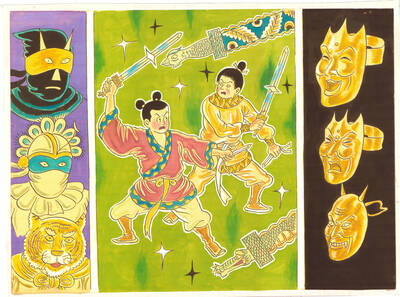
April 22 to April 28 The true identity of the mastermind behind the Demon Gang (魔鬼黨) was undoubtedly on the minds of countless schoolchildren in late 1958. In the days leading up to the big reveal, more than 10,000 guesses were sent to Ta Hwa Publishing Co (大華文化社) for a chance to win prizes. The smash success of the comic series Great Battle Against the Demon Gang (大戰魔鬼黨) came as a surprise to author Yeh Hung-chia (葉宏甲), who had long given up on his dream after being jailed for 10 months in 1947 over political cartoons. Protagonist


 RSS
RSS