


Matthew Grossman, a 38-year-old schoolteacher in Toronto with a bulging collection of about 700 DVDs, enjoys movies of all kinds. But, when it comes to buying discs, he -- like many DVD owners -- gravitates to action-packed adventure films with plenty of special effects like Die Hard and Terminator 2.
"You can really enjoy the impact of an action film on DVD, especially with a large screen and a powerful set of speakers," Grossman said. "And, you might want to watch it more than once. With a romantic comedy or something, you watch it and laugh and never look at it again."
Men like Grossman -- and it is men who are buying the most DVDs, studio executives say -- are an increasingly powerful influence on Hollywood. Home video sales accounted for more than 58 percent of Hollywood's income last year, more than twice as much as box-office revenues. Sales of DVDs to consumers are the biggest, most profitable and fastest-growing component of that revenue.
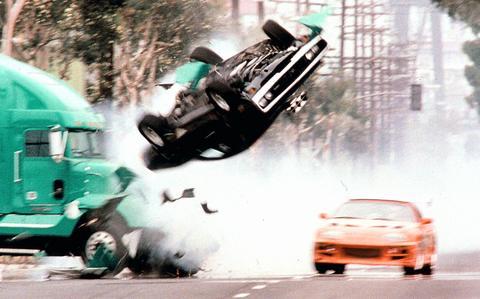
PHOTO: NY TIMES
For studio executives, that means the home video market is no longer the afterthought it was when renting videotapes dominated the business. "It is becoming, in a lot of ways, the primary market in determining whether to green light a movie or not," said Chris McGuirk, vice chairman of Metro-Goldwyn-Mayer Inc.
What the studios are finding so far is that DVDs are a man's world, where the films that get the biggest bounce from the box-office sales are movies like Rush Hour 2, The Bourne Identity and XXX. "The male-oriented action movies are the ones that have worked well on DVD," said Harvey Weinstein, co-chairman of the Miramax Films division of the Walt Disney Co. "It is almost like buying records when you were a kid and running out to get the new Led Zeppelin. Men tend to be a little more compulsive."
At MGM, Universal Pictures, New Line Cinema and other studios, executives in charge of home video sales now have formal roles in decisions about approving new projects. Some studio executives say the new math is already evident on the big screen, most notably in this summer's rush of sequels that help promote the DVDs of their predecessors (like Charlie's Angels 2: Full Throttle and 2 Fast 2 Furious) and the skyrocketing budgets for action films that bristle with stunts and special effects (SWAT).
The payoff of DVD sales benefits action-adventure blockbusters and sophomoric comedies far more than serious dramas or films aimed at adults. Some critics worry that DVD sales may in effect redouble Hollywood's longstanding incentive to cater to the broadest and most puerile audience. "I think there is a danger that studios could use DVDs to marginalize serious films for adults as this kind of boutique area, like a prestige line for a publisher," said Owen Gleiberman, a film critic at Entertainment Weekly.
But, the DVD boom has increased the gap between the most financially successful movie and the least. In the video rental business, stores typically buy at least one copy of almost every major theatrical release -- and sometimes up to five or more copies of hits, said Thomas J. Adams of Adams Media Research, which studies the home video market. But, since DVD players went on the market in the US in 1997, their better picture quality, retail prices of US$20 -- and often less -- and an assortment of extra features like alternate endings and extra footage have helped spur buying instead of renting. That, in turn, has ended that relatively equal spreading of the wealth from video rentals.
Instead of buying everything the way video stores do, consumers tend to buy millions of copies of the biggest hits. That has benefited blockbusters and hurt smaller films. Since 1997, the home video revenue of films that earned more than US$50 million at the box office has doubled, while the home video revenue of films earning less than US$10 million at the box office has fallen, according to a study by Adams Media Research.
The James Bond film Die Another Day, for example, has sold 3.41 million copies on DVD since its release in June, according to the trade publication Video Store Magazine. At the other extreme, Frida, a film about the artist Frida Kahlo starring Selma Hayek, sold just 250,000 since its release the same month.
"The successes are greater, and the failures are worse," Rick Finkelstein, president and chief operating officer of Universal Pictures, said.
Sales are also more profitable. A studio might make about US$12 profit from the US$20 price of a DVD, said Scott Hettrick, editor of the trade journal Video Business. In contrast, studios make about US$5 on the sale of a US$10 theater ticket and may make little or nothing from a video rental.
At first, like most new consumer electronics, DVD players sold mainly to men.
Now, however, half of the households with televisions now own DVD players. Animated family films that previously dominated VHS sales have begun to sell well on DVD, too. A handful of romantic comedies have broken through on DVD for the first time as well, most notably My Big Fat Greek Wedding, which was the second best-selling DVD of the first half of this year.
But even as DVD players have spread, executives say, action-adventure movies sell disproportionately well, even relative to their typically larger box-office receipts. And serious dramas lag behind.
"A US$40 million dollar art film versus a US$40 million action film, the latter will sell at least double on DVD," said Benjamin J. Feingold, president of home entertainment at the Columbia TriStar division of Sony. "That is where the purchasers are. Shakespeare in Love is one of my favorite movies of all time, but it is very hard to sell that on DVD, versus XXX, which is a monster."
The Hours, a literary film that was nominated for nine Academy Awards and earned US$41 million at the box office, has sold 350,000 DVDs since its release in May. In contrast, several action films or slapstick comedies with similar or lower box-office receipts -- including Tears of the Sun, Star Trek: Nemesis, The Transporter and Friday After Next -- have at least tripled those DVD sales in roughly the same period.
Studio executives say financial calculations about DVD sales never determine essentially creative decisions about which new films to make. But executives from several major studious agreed that the possibility of DVD sales are already affecting budgets for films, especially for action scenes and special effects.
Universal Studios' movie The Fast and the Furious, for example, sold US$144 million in tickets in 2001 and then sold US$132 million in DVDs in 2002, the sixth biggest seller in the format that year.
When the studio began planning its sequel 2 Fast 2 Furious, Finkelstein said the studio was "able to feel a little more comfortable knowing that if we spent even more money and had better action and better stunts we would sell even more DVDs."
Jeff Blake, vice chairman of Sony Pictures Entertainment, said the prospect of DVD sales helped it afford the hefty budget of its summer hit Bad Boys 2, with Will Smith and Martin Lawrence. "Clearly the economics of some of the big event pictures we are seeing probably would not work without DVD," he said.
DVDs make sequels more profitable because they promote sales of their predecessor on the discs. In a summer flooded with big-budget sequels that disappointed at the box office, like Charlie's Angels 2: Full Throttle, from Columbia Tristar, and Lara Croft: Tomb Raider 2, from Paramount Pictures, some in Hollywood wonder if the potential bounty from DVD sales may have led to hasty decisions.
"What may have happened was that some of these sequels got made faster and with less time and effort than people would have previously put into them because there was this big opportunity out there," said Finkelstein, of Universal Pictures. He said that he thought his own studio's 2 Fast 2 Furious and third American Pie movie -- both well-suited to the appetites of DVD buyers -- were exceptions to the norm.
DVD sales have begun influencing television, too, offering a new source of income to shows that might sell well as the networks and studios have begun selling past episodes of some shows on DVD after they have been broadcast even while new episodes are airing.
Some DVD fans, meanwhile, may be cognizant of their image. A "DVD Lexicon" on the Web site DVD Journal, for example, defines the terms "My Wife Moved Out" as "a common ailment" of audio-video consumers.

The year was 1991. A Toyota Land Cruiser set out on a 67km journey up the Junda Forest Road (郡大林道) toward an old loggers’ camp, at which point the hikers inside would get out and begin their ascent of Jade Mountain (玉山). Little did they know, they would be the last group of hikers to ever enjoy this shortcut into the mountains. An approaching typhoon soon wiped out the road behind them, trapping the vehicle on the mountain and forever changing the approach to Jade Mountain. THE CONTEMPORARY ROUTE Nowadays, the approach to Jade Mountain from the north side takes an

Last week Joseph Nye, the well-known China scholar, wrote on the Australian Strategic Policy Institute’s website about how war over Taiwan might be averted. He noted that years ago he was on a team that met with then-president Chen Shui-bian (陳水扁), “whose previous ‘unofficial’ visit to the US had caused a crisis in which China fired missiles into the sea and the US deployed carriers off the coast of Taiwan.” Yes, that’s right, mighty Chen caused that crisis all by himself. Neither the US nor the People’s Republic of China (PRC) exercised any agency. Nye then nostalgically invoked the comical specter

Relations between Taiwan and the Czech Republic have flourished in recent years. However, not everyone is pleased about the growing friendship between the two countries. Last month, an incident involving a Chinese diplomat tailing the car of vice president-elect Hsiao Bi-khim (蕭美琴) in Prague, drew public attention to the People’s Republic of China’s (PRC) operations to undermine Taiwan overseas. The trip was not Hsiao’s first visit to the Central European country. It was meant to be low-key, a chance to meet with local academics and politicians, until her police escort noticed a car was tailing her through the Czech capital. The
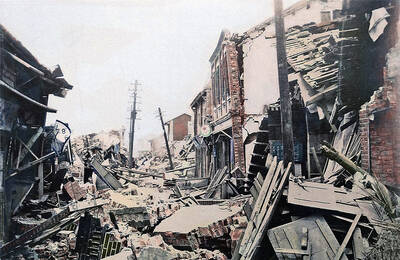
April 15 to April 21 Yang Kui (楊逵) was horrified as he drove past trucks, oxcarts and trolleys loaded with coffins on his way to Tuntzechiao (屯子腳), which he heard had been completely destroyed. The friend he came to check on was safe, but most residents were suffering in the town hit the hardest by the 7.1-magnitude Hsinchu-Taichung Earthquake on April 21, 1935. It remains the deadliest in Taiwan’s recorded history, claiming around 3,300 lives and injuring nearly 12,000. The disaster completely flattened roughly 18,000 houses and damaged countless more. The social activist and


 RSS
RSS