


Within the genre of nonfiction books that homes in on a particular substance or subject -- salt, maps, the color magenta -- it helps the writer to have an exceptional affinity with the material. Fiammetta Rocco certainly has the inside track on malaria. She has had it herself. Her father has had multiple recurrences. Her grandparents lived on a farm in Africa, where malaria was even more prevalent than tick fever, filariasis, beriberi, bilharzia, kwashiorkor or rinderpest.
And her great-grandfather was involved in the building of the Panama Canal, when tarantulas seemed like the worst menace around. Once the hospitals began placing the legs of beds in bowls of water to keep the tarantulas away, mosquitoes started hatching, and a new wave of malaria was born.
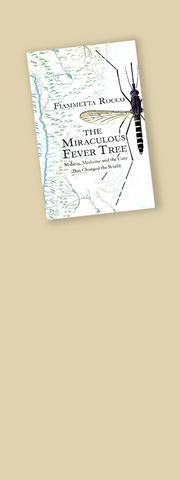
Thus equipped with family memories, Rocco sets out to explain everything you ever wanted to know about malaria (it resembles yellow fever, absent the black vomit) and more. She is quick to admit that this subject has often been dealt with before (most memorable malaria book title: Skeeter Beaters), but there is more than enough minutiae to go around. For those who never knew that the combination of gin and tonic originated as a way to make a malarial cure more tolerable, well, now you know.
Rocco, who is the literary editor of The Economist, makes the pursuit of quinine (an ingredient in tonic water) her book's primary focus. She cites early discoveries of the title tree, which would be named cinchona (with a bark that yields quinine) in Peru, where early Jesuit missionaries understood its importance. She also discusses how valuable this substance would have been in Rome, which at one time was "the most malarious city on earth."
In 1623, when the Sacred College of Cardinals was convened to choose a successor to Pope Gregory XV, malaria felled many of these clergymen. "Even the Borgias, who tried valiantly over the years to murder one another, could not kill each other or their enemies so regularly or so reliably as would malaria," she observes.
Rocco devotes considerable research to Jesuit records about how cinchona found its place in the pantheon of medicines. Though it is not clear how she knows about an ocean crossing of Jesuits to South America in 1605, that "gigantic waves hurled themselves onto the vessel, throwing up thick columns of spray that then collapsed upon the deck, drenching everything in a foamy swirl and threatening to drive the ship onto the jagged rocks," her information is mostly substantive.
But inevitably, in a book of this genre, the odd little details begin to seem as noteworthy as the major developments. So: in 1629 a shipment of three thousand pens was sent to the Jesuit College in Santiago, Chile. And for those unfamiliar with the Peruvian national emblem, it depicts a vicuna, a horn of plenty and a cinchona tree.
In much the same spirit, readers will learn that in 1683 the Royal Society examined subjects like the Arabic alphabet, the anatomy of the rattlesnake, the smell and color of wine, the genitals of the wild boar; in this atmosphere of research into natural history, cinchona bark naturally warranted further analysis. And when it became apparent that this substance could stop malaria, cinchona became a force in history. In 1809 Napoleon sabotaged the British army in Holland by flooding the countryside and letting malaria run rampant. "We must oppose the English with nothing but fever, which will soon devour them all," he said.
The Miraculous Fever-Tree goes on to chronicle the strategic cultivation and harvesting of cinchona in parts of the world to which its seeds were imported, including India. It follows the development of a widely marketable malaria remedy by entrepreneurs like Dr. John Sappington, who sold his own brand of fever pills. In the context of the book's other fine points, it is not surprising to learn that Sappington was also the great-great-great grandfather of Ginger Rogers.
Malaria currently kills one person every 15 seconds, according to a WHO statistic Rocco cites, and despite the development of synthetic remedies, quinine is still being used.
This book is filled with thumbnail sketches of many figures involved in scientific research. (Dr. Richard Spruce: "a tall north countryman who played the bagpipes, the soft-spoken bachelor was as renowned for his modesty as for his encyclopedic knowledge of mosses.") It is also full of increasingly grisly details as the investigation begins to involve mosquitoes as malaria carriers. "If I passed my hand across my face, I brought it away covered with blood and with the crushed bodies of gorged mosquitoes," Spruce wrote colorfully to a friend.
The most impressive scientist here, and the one who won a Nobel Prize in 1902 for research into mosquito-related matters, was Ronald Ross. His dissection of countless mosquito stomachs and thoraxes was instrumental in tracing a malaria-causing parasite to the mosquito's salivary gland. That kind of detail is life's blood to a book like this.

In late October of 1873 the government of Japan decided against sending a military expedition to Korea to force that nation to open trade relations. Across the government supporters of the expedition resigned immediately. The spectacle of revolt by disaffected samurai began to loom over Japanese politics. In January of 1874 disaffected samurai attacked a senior minister in Tokyo. A month later, a group of pro-Korea expedition and anti-foreign elements from Saga prefecture in Kyushu revolted, driven in part by high food prices stemming from poor harvests. Their leader, according to Edward Drea’s classic Japan’s Imperial Army, was a samurai

Located down a sideroad in old Wanhua District (萬華區), Waley Art (水谷藝術) has an established reputation for curating some of the more provocative indie art exhibitions in Taipei. And this month is no exception. Beyond the innocuous facade of a shophouse, the full three stories of the gallery space (including the basement) have been taken over by photographs, installation videos and abstract images courtesy of two creatives who hail from the opposite ends of the earth, Taiwan’s Hsu Yi-ting (許懿婷) and Germany’s Benjamin Janzen. “In 2019, I had an art residency in Europe,” Hsu says. “I met Benjamin in the lobby

April 22 to April 28 The true identity of the mastermind behind the Demon Gang (魔鬼黨) was undoubtedly on the minds of countless schoolchildren in late 1958. In the days leading up to the big reveal, more than 10,000 guesses were sent to Ta Hwa Publishing Co (大華文化社) for a chance to win prizes. The smash success of the comic series Great Battle Against the Demon Gang (大戰魔鬼黨) came as a surprise to author Yeh Hung-chia (葉宏甲), who had long given up on his dream after being jailed for 10 months in 1947 over political cartoons. Protagonist

Peter Brighton was amazed when he found the giant jackfruit. He had been watching it grow on his farm in far north Queensland, and when it came time to pick it from the tree, it was so heavy it needed two people to do the job. “I was surprised when we cut it off and felt how heavy it was,” he says. “I grabbed it and my wife cut it — couldn’t do it by myself, it took two of us.” Weighing in at 45 kilograms, it is the heaviest jackfruit that Brighton has ever grown on his tropical fruit farm, located


 RSS
RSS