


Long before Taiwan joined the WTO on Jan. 1 2002, big bike enthusiasts across Taiwan were gearing up for the day when they could cruise the nation's highways and byways on their mighty beasts legally.
Over a year since legalization, big bike owners and dealers such as Peterson Hsueh (薛文彬) are finding the road is not quite as smooth as they envisioned it would be.

PHOTO: GAVIN PHIPPS, TAIPEI TIMES
While motorcycles with an engine capacity of greater than 125cc can now be issued with license plates and ridden on the roads, additional taxes, numerous tests and questions about on-road regulations have left many bikers confused.
"When big bikes were illegal we knew where we stood," explained Hsueh. "But now nothing is clear. The laws pertaining to big bike purchase and use are somewhat, if not totally, muddled."
Popular hogs
The government banned the importation and registration of motorbikes greater than 125cc in 1982. Not that the ban stoppedpeople from purchasing big bikes. The large number of local motorbike enthusiasts willing to pay significantly more than the original retail price for a stolen bike meant that, along with Hong Kong, Taiwan was once one of the largest markets for hot hogs in Asia.
So popular were big bikes, in fact, that a report issued by the Ministry of Transportation and Communications (MOTC,
That figure has proved a gross overestimate. Since it became legal to sell bikes, Hsueh's garage -- which deals in Taiwan's most popular big bike brands BMW, Kawasaki, Suzuki as well Taiwan's most expensive hog, the Honda GoldWing GL1800, which costs over NT$1million -- has recorded sales of only 170 units per annum.
"Sure it's now legal, but it's still not easy to purchase a big bike. There's a 30 to 60 day importation period, after which the bike is sent for a series of tests," continued Hsueh. "All of which cost the buyer a substantial amount of time and money. When you finally get to hit the road it gets even worse. Traffic regulations aren't clear or are simply stupid."
Running his illegal big bike business out of a shared garage in Taipei's Shihlin district before hog legalization, dealer and mechanic, Jack Wang (
Now head of Triumph Taiwan, he initially expected to see sales skyrocket after the nation's entry into the WTO. Not so, however. So far this year only 30 bikes have rolled out of Triumph's glitzy Sanchung City-based showroom.
Though a wannabe biker can pick up a Triumph Daytona 955cc for NT$729,000, added costs will boost the price to somewhere in the region of NT$1million. Road tax costs a rider NT$7,000 per annum, registration sets the owner back another NT$23,000 and fully comprehensive insurance can cost upwards of NT$80,000 a year.
The damaging part of purchasing a new bike, however, is paying for the tests that need to be carried out before any big bike can take to the road. In all the emissions and noise tests, which are carried out by the EPA, and the safety and the fuel consumption tests, which come under to auspices of the Department of Motor Vehicles (DMV,
Finally there's more garage costs. The horsepower of any big bike needs to be reduced by 20 percent in order for it to be deemed legally road-worthy.
"It's as if the [government] doesn't want people to ride big bikes," said Wang. "Adding additional costs to the already costly machine is not going to attract people at all. I've had many would be customers on the verge of purchasing a bike only to balk at the idea when I mentioned the extra costs."
The MOTC's pre-WTO estimates in regards to the number bikers who would apply for the special license was also greatly overestimated. Taking about 8 days and costing NT$8,000, only 1,700 such licenses have been issued. A number far less than the thousands initially expected.
But then when you consider the conditions that are forced upon big bike owners when they get out of driving school and onto the open road, then it's hardly surprising that so few have bothered.
Confusing rules
As the law stands, big bike owners must adhere to the same regulations that govern the use of bikes under 125cc. Hogs must use the motorcycle lane and must also adhere to the two-stage left turn system used for smaller bikes. And riding on the freeway is strictly forbidden.
Such a state of affairs has left many riders outraged at the lack of forethought put into the legalization of big bikes.
"Have you ever tried to do a two-stage left turn on 950cc motorbike? It's impossible, yet you have to do it," said the Triumph dealer with a smirk. "I must admit, though, I don't always use the motorcycle lane. It's just ridiculous and it's dangerous too."
It's not only riding that has left bikers perplexed. By law big bikes cannot park in the same spots as scooters. They have to use car-parking facilities, which is something that, according to Hsueh very few people understand.
"You can't even park in some department store car parks," explained an exasperated Hsueh. "The parking guards just don't get it and tell you to move on. I mean, when I go shopping where am I meant to park?"
Chen Feng-yun (
On Aug. 28 over 300 bikers are expected to take to the streets of Taipei and demonstrate outside the Legislative Yuan against what they feel is a helter-skelter policy aimed at ensuring that there is no such thing as easy riding in Taiwan.
Regardless of the outcome, business-minded bikers such as Wang and Hsueh will continue to tow the line, albeit fuming and scratching their heads at what they see as the slapdash manner in which the government has dealt with the legalization of big bikes.
Other hog enthusiasts, however, gave up trying to comply long ago. Having owned his Suzuki GS1000 for almost 20 years, Mucha-based biker, Li Shi-hsiung (李世雄), has decided to continue as if Taiwan never joined the WTO.
"I'm not taking that stupid test and I'm certainly not going to go through the rigmarole of paying any extra tax," admitted Li. "Sure, it's stricter now in Taipei where they enforce the new laws. Along the east-coast and in the south its pretty much business as usual for big bike owners, though."
Although confident that Taiwan's big bike buffs will one day be able to take to the road while adhering to reasonable traffic regulations, Wang remains pessimistic when asked for a time frame in which the laws governing hog use will be clearly defined.
"I can't see the current problems disappearing overnight," admitted Wang. "I figure we won't see any great change in the laws surrounding the big bikes in Taiwan for at least four or five years."
In the meantime, however, the nation's hog owners will have to continue to enjoy their beasts as best they can, albeit by flouting the odd traffic regulation or two.

Last week Joseph Nye, the well-known China scholar, wrote on the Australian Strategic Policy Institute’s website about how war over Taiwan might be averted. He noted that years ago he was on a team that met with then-president Chen Shui-bian (陳水扁), “whose previous ‘unofficial’ visit to the US had caused a crisis in which China fired missiles into the sea and the US deployed carriers off the coast of Taiwan.” Yes, that’s right, mighty Chen caused that crisis all by himself. Neither the US nor the People’s Republic of China (PRC) exercised any agency. Nye then nostalgically invoked the comical specter

Relations between Taiwan and the Czech Republic have flourished in recent years. However, not everyone is pleased about the growing friendship between the two countries. Last month, an incident involving a Chinese diplomat tailing the car of vice president-elect Hsiao Bi-khim (蕭美琴) in Prague, drew public attention to the People’s Republic of China’s (PRC) operations to undermine Taiwan overseas. The trip was not Hsiao’s first visit to the Central European country. It was meant to be low-key, a chance to meet with local academics and politicians, until her police escort noticed a car was tailing her through the Czech capital. The
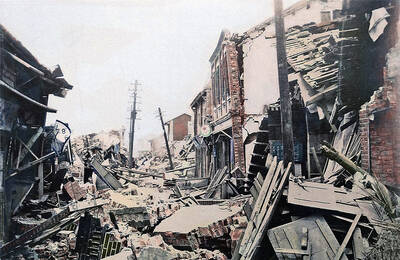
April 15 to April 21 Yang Kui (楊逵) was horrified as he drove past trucks, oxcarts and trolleys loaded with coffins on his way to Tuntzechiao (屯子腳), which he heard had been completely destroyed. The friend he came to check on was safe, but most residents were suffering in the town hit the hardest by the 7.1-magnitude Hsinchu-Taichung Earthquake on April 21, 1935. It remains the deadliest in Taiwan’s recorded history, claiming around 3,300 lives and injuring nearly 12,000. The disaster completely flattened roughly 18,000 houses and damaged countless more. The social activist and

Over the course of former President Ma Ying-jeou’s (馬英九) 11-day trip to China that included a meeting with Chinese Communist Party (CCP) leader Xi Jinping (習近平) a surprising number of people commented that the former president was now “irrelevant.” Upon reflection, it became apparent that these comments were coming from pro-Taiwan, pan-green supporters and they were expressing what they hoped was the case, rather than the reality. Ma’s ideology is so pro-China (read: deep blue) and controversial that many in his own Chinese Nationalist Party (KMT) hope he retires quickly, or at least refrains from speaking on some subjects. Regardless


 RSS
RSS