


Formed in 1973 by choreographer Lin Hwai-min (
Entitled Cloud Gate at 30 (
Named after a legendary dance that, according to scholars is the oldest known dance in China -- some 5,000 years old -- Cloud Gate was the first contemporary dance company to be established in Greater China. Establishing the troupe at a time when male modern dancers were unheard of in Taiwan, Lin's dance group initially shocked traditionalists.
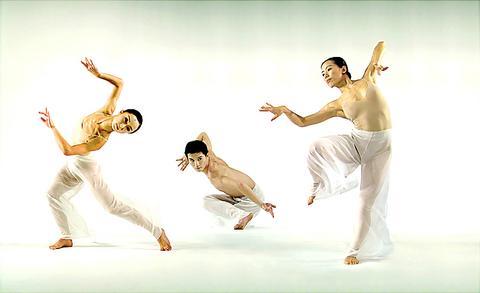
PHOTOS COURTESY OF LIU CHEN-HSIANG
Since then the 24-member dance troupe's shock value has disappeared and now Lin and his group receive both rave reviews and admiration when and wherever they perform.
Its groundbreaking dance styles, which see performers using tai chi, Chinese Opera, modern dance and ballet to create works that blend myths and folklore with religious aesthetics, have made it one of the world's most notable contemporary dance troupes.
It is at home in Taiwan, however, that Cloud Gate enjoys its largest following. Regardless of where it performs, be it prestigious venues, high-school auditoriums in remote villages or outdoor plazas -- at which the troupe performs free of charge several times a year -- Cloud Gate programs are guaranteed sell outs.
While residents of Taiwan's cities will have to wait until next week to catch Lin and his celebrated dance troupe in action, Cloud Gate's 30th anniversary performances have already played to packed-houses in Puli, Touli and Meinung. Each of these rural shows, which were free and staged outdoors, attracted crowds of upwards of 20,000.
The troupe will be kicking off their big city indoor leg of their birthday tour in Taipei on Thursday with a six-day run of performances of one its most prominent and groundbreaking productions, Legacy.
First staged on Dec. 16, 1978 -- the day the US severed diplomatic ties with Taipei in favor of Beijing -- Legacy raises questions about Taiwan's identity. Twenty-five years since its debut on the stage of Chiayi Gymnasium, the show is still considered by many as the watershed production that shaped the nation's contemporary dance scene.
For the special anniversary performances of Legacy, Cloud Gate will be joined on stage by its equally celebrated youth group, Cloud Gate II (
On Aug. 30, Cloud Gate will be bringing its newest production to the stage. Although based on the same calligraphic theme as last year's production, Cursive, the troupe's second show in its anniversary series, Cursive II (薪傳II), is, according to the troupe, "drastically different from its forerunner."
Whereas the original work explored the aesthetics of calligraphy through vigorous motions that portrayed the blackness of the calligrapher's ink, Cursive II sets out to bring a subtle hint of color to the age-old Chinese art form with more refined movements.
In what has been described as "a work of delicate lyricism" the troupe's latest production celebrates and explores the emptiness and lighter hues of calligraphy over a backdrop of music by progressive classical music guru, John Cage.
Cloud Gate will be performing Legacy -- Revival at the National Theater from Aug. 21 through Aug. 26. Performances begin at 7:45pm except those on Aug. 24, when an afternoon matinee begins at 4pm. The Aug. 21 premier of Legacy -- Revival will be simultaneously broadcast on a large screen in the plaza of the CKS Cultural Center.
From Aug. 30 through Sept. 6, Cloud Gate will perform Cursive II at the National Theater. The troupe will be performing Cursive II at the Chih-teh Hall in Kaohsiung on Sept. 12 and 13 and then at Taichung's Chungshan Hall on Sept. 19 and 20.
Tickets cost between NT$400 and NT$2,000 and are available form ACER Ticketing Outlets nationwide or direct from the CKS Cultural Center. Several of the performances have already sold out. In order to avoid disappointment, organizers' advise those wishing to attend Cloud Gate 30th anniversary shows to purchase tickets in advance.

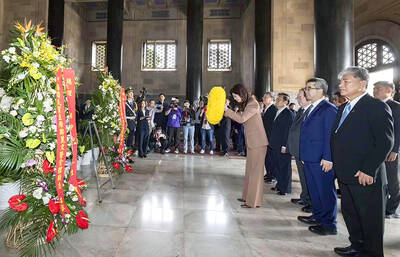
The problem with Marx’s famous remark that history repeats itself, first as tragedy, the second time as farce, is that the first time is usually farce as well. This week Chinese Nationalist Party (KMT) Chair Cheng Li-wun (鄭麗文) made a pilgrimage to the People’s Republic of China (PRC) “to confer, converse and otherwise hob-nob” with Chinese Communist Party (CCP) officials. The visit was an instant international media hit, with major media reporting almost entirely shorn of context. “Taiwan’s main opposition leader landed in China Tuesday for a rare visit aimed at cross-strait ‘peace’”, crowed Agence-France Presse (AFP) from Shanghai. Rare!

A recent report from the Environmental Management Administration of the Ministry of Environment highlights a perennial problem: illegal dumping of construction waste. In Taoyuan’s Yangmei District (楊梅) and Hsinchu’s Longtan District (龍潭) criminals leased 10,000 square meters of farmland, saying they were going to engage in horticulture. They then accepted between 40,000 and 50,000 cubic meters of construction waste from sites in northern Taiwan, charging less than the going rate for disposal, and dumped the waste concrete, tile, metal and glass onto the leased land. Taoyuan District prosecutors charged 33 individuals from seven companies with numerous violations of the law. This

What is the importance within the Chinese Nationalist Party (KMT) of the meeting between Xi Jinping (習近平), the leader Chinese Communist Party (CCP), and Cheng Li-wun (鄭麗文), the leader of the KMT? Local media is an excellent guide to determine how important — or unimportant — a news event is to the public. Taiwan has a vast online media ecosystem, and if a news item is gaining traction among readers, editors shift resources in near real time to boost coverage to meet the demand and drive up traffic. Cheng’s China trip is among the top headlines, but by no means

Sunflower movement superstar Lin Fei-fan (林飛帆) once quipped that the Democratic Progressive Party (DPP) could nominate a watermelon to run for Tainan mayor and win. Conversely, the DPP could run a living saint for mayor in Taipei and still lose. In 2022, the DPP ran with the closest thing to a living saint they could find: former Minister of Health and Welfare Chen Shih-chung (陳時中). During the pandemic, his polling was astronomically high, with the approval of his performance reaching as high as 91 percent in one TVBS poll. He was such a phenomenon that people printed out pop-up cartoon


 RSS
RSS