


Sri Lanka is the world's largest tea exporter, hosts the world's largest weekly tea auction and yet it is struggling to earn a name as an upmarket tea maker and become what France is to wine.
After a costly experiment in producing mass-market teas known as CTCs -- a nondescript tea used in cheap bags akin to table wine -- the country is going back to its British colonial roots to make "orthodox" teas.
Eleven years ago, the Tea Board gave cash subsidies to factories to give up making traditional teas and convert to CTCs (cut, tear and curl) and took away the romance of tea in a pot.
During the first year of the subsidy alone, the Tea Board gave NT$2.77 million to "modernize" 12 factories to make the cheaper CTC teas. The scheme is now acknowledged as a mistake.
At least 40 factories have reconverted to making the good old orthodox teas.
The laborious process of turning tender leaves and buds into aromatic black tea has been practiced for more than 135 years since Scotsman James Taylor introduced tea in this former British colony.
"It was a mistake to go into making CTC teas," says the chairman of the Colombo Tea Traders' Association, Mahen Dayananda. "We can't compete with East Africa in CTC teas and in any case our strength is in orthodox teas."
Lallith Ramanayake, director at John Keells Limited, a leading tea broking firm here agrees. Ramanayake says CTC production is good for a country like Kenya where the cost of tea production is low.
However, Sri Lankan tea is among the most expensive and to put it into the low-end of the market would be suicide for the island which depends on its green gold for foreign exchange.
Ramanayake notes that 75 percent of the tea made in India, the world's largest producer of black tea, is in the form of CTCs and Sri Lanka cannot compete with it either.
Trade association chief Dayananda says Sri Lanka should not just merely try to increase export volumes, but increase the value of its exports by trying to secure an international niche for its speciality teas.
At the top end are "silver tips" and "golden tips" which are claimed to boost the libido and are popular among Japanese and Arab connoisseurs who are willing to fork out 25 to 30 times more for the pleasure of drinking the exotic brew.
The more down-to-earth recent entrant has been "organic tea," made entirely without chemical fertilizer or pesticides.
Better known by the island's former name, Ceylon, the country's tea is identified in the industry for its unique aroma and character.
In recent times, several local companies have begun pushing a "single brand" of "Pure Ceylon Tea" tea as opposed to cheaper blends sold in Europe and Southeast Asia.
A typical blend will have a large percentage of cheaper Kenyan and Indonesian produce to give it body, Indian tea for appearance and Ceylon's to give it quality and character.
The tea industry here is also engaged in a perennial debate on the tea bag versus the traditional tea pot. The bags are usually filled with cheaper CTC teas while the pot requires higher quality tea.
It is not just the flavor of tea that is important. For the discerning drinker, the appearance of the black tea leaves and the color are important factors in his or her daily cuppa.
Those who argue against the bag point out that tea drinkers could squeeze out an extra cup from a bag and thereby reduce consumption. The traditional brewing method takes up more tea.
The industry is also plugging the health aspects of tea, noting that anti-oxidant properties in tea help prevent cancer.
It is also good for the financial health of Sri Lanka.
Tea is Sri Lanka's main export commodity, bringing in US$660 million last year from the export of 292 million kilograms. Nearly six million kilos of tea is sold at the weekly auctions here which make Colombo the world's largest tea auction centre.
After failing with its conversion to the mass market, the Tea Board is now pushing for a "specialitea" and "diversitea" campaign to encourage producers to export value-added tea rather than sell tea as a raw commodity.
Teas grown at different elevations between 600m to 1,800m above sea level have unique characteristics similar to the wine produced in different regions of France.
The Nuwara Eliya tea grown on picturesque mountain slopes at an elevation of 1,830m give a lighter color, but have a rich and unique aroma and are popular in Britain and Japan.
The thick-bodied low-grown teas are more popular among tea drinkers in the Middle East.
The Colombo tea traders association is organizing a competition to choose the best speciality tea of the year. Colombo is hosting two international tea meetings this month, all aimed at bringing cheer to a struggling industry.

In late October of 1873 the government of Japan decided against sending a military expedition to Korea to force that nation to open trade relations. Across the government supporters of the expedition resigned immediately. The spectacle of revolt by disaffected samurai began to loom over Japanese politics. In January of 1874 disaffected samurai attacked a senior minister in Tokyo. A month later, a group of pro-Korea expedition and anti-foreign elements from Saga prefecture in Kyushu revolted, driven in part by high food prices stemming from poor harvests. Their leader, according to Edward Drea’s classic Japan’s Imperial Army, was a samurai

Located down a sideroad in old Wanhua District (萬華區), Waley Art (水谷藝術) has an established reputation for curating some of the more provocative indie art exhibitions in Taipei. And this month is no exception. Beyond the innocuous facade of a shophouse, the full three stories of the gallery space (including the basement) have been taken over by photographs, installation videos and abstract images courtesy of two creatives who hail from the opposite ends of the earth, Taiwan’s Hsu Yi-ting (許懿婷) and Germany’s Benjamin Janzen. “In 2019, I had an art residency in Europe,” Hsu says. “I met Benjamin in the lobby
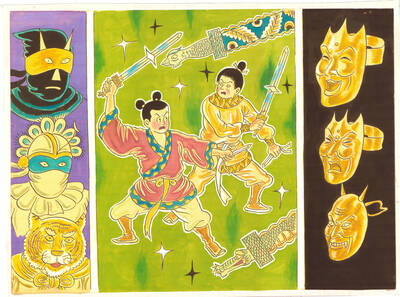
April 22 to April 28 The true identity of the mastermind behind the Demon Gang (魔鬼黨) was undoubtedly on the minds of countless schoolchildren in late 1958. In the days leading up to the big reveal, more than 10,000 guesses were sent to Ta Hwa Publishing Co (大華文化社) for a chance to win prizes. The smash success of the comic series Great Battle Against the Demon Gang (大戰魔鬼黨) came as a surprise to author Yeh Hung-chia (葉宏甲), who had long given up on his dream after being jailed for 10 months in 1947 over political cartoons. Protagonist

A fossil jawbone found by a British girl and her father on a beach in Somerset, England belongs to a gigantic marine reptile dating to 202 million years ago that appears to have been among the largest animals ever on Earth. Researchers said on Wednesday the bone, called a surangular, was from a type of ocean-going reptile called an ichthyosaur. Based on its dimensions compared to the same bone in closely related ichthyosaurs, the researchers estimated that the Triassic Period creature, which they named Ichthyotitan severnensis, was between 22-26 meters long. That would make it perhaps the largest-known marine reptile and would


 RSS
RSS