


As part of its second anniversary celebrations Taipei's Museum of Contemporary Art (MOCA, 台北當代藝術館) is currently holding the first installment of a special season of works by some of the nation's leading contemporary artists.
Entitled, "TAT@mocataipei -- Taiwanese Artists Today" (台灣藝術家個展), the series will run until mid-Nov. It will incorporate both solo and joint exhibitions by seven local artists whom the institute considers to be the brightest of the nation's younger generation of contemporary artists.
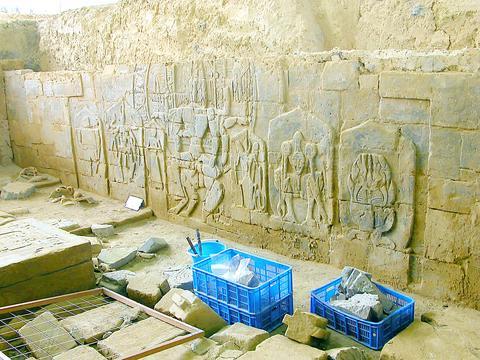
PHOTO COURTESY OF MOCA
The season began earlier this week with Su Meng-hung's (
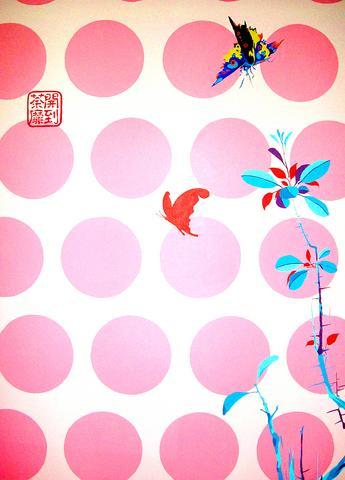
PHOTO COURTESY OF MOCA
Material Paradise sees Su undermining and recreating a selection of well-known Western still life works along with some better-known Chinese paintings of birds and flowers.
While undeniably eye-catching, Su's reworking of Western works is at times odd and at others crass.
What Su's Western-style art lacks in sense, his computerized revamped Chinese art makes up for in beauty. One of the most vibrant of these works is his computerized and pink spot speckled adaptation of the Ming Dynasty work by Chen Hung-shou Flower and Butterfly.
In stark contrast to Su's exhibition, Tu's The Beauty and Mystery of Bu Num Civilization Revealed sets out to humor viewers with a spoofy take on archeological finds and the way in which they are exhibited.
Tu's rather outlandish work begins in Tainan County, where, while building a new dormitory for the Tainan National College of the Arts in 2000, engineers unearthed remnants of a long lost civilization.
Known as the Bu Num, the ancient peoples walked the Earth some 30,000 to 50,000 years ago and created some rather interesting art works along the way.
Like all archeological exhibits, Tu's begins with an introduction to the history of the peoples and photographs of the dig itself with the artifacts in the places in which they were unearthed.
Including clay figurines in the form of Bu Num deities that look remarkably similar to those created by Egyptian and Persian stonemasons with the addition of artists mannequins, as well as rocks carved with Bu Num hieroglyphics that look remarkably like the wingdings, the artist's imagination has run riot.
Of course, none of what Tu leads viewers to believe is true. There never was a Bu Num civilization. And though it's all a complete spoof and viewers might be left scratching their heads as to why anyone would go to such lengths to create some nonsensical civilization, Tu's exhibit is guaranteed to amuse.
Material Paradise: Su Mung-hung Solo Exhibition and The Beauty and Mystery of Bu Num Civilization Revealed will run until Sept. 28 at the Museum of Contemporary Art (
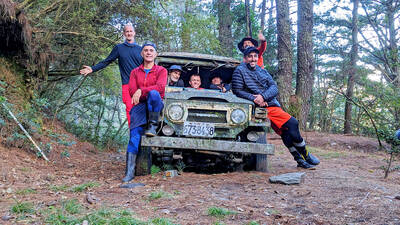
The year was 1991. A Toyota Land Cruiser set out on a 67km journey up the Junda Forest Road (郡大林道) toward an old loggers’ camp, at which point the hikers inside would get out and begin their ascent of Jade Mountain (玉山). Little did they know, they would be the last group of hikers to ever enjoy this shortcut into the mountains. An approaching typhoon soon wiped out the road behind them, trapping the vehicle on the mountain and forever changing the approach to Jade Mountain. THE CONTEMPORARY ROUTE Nowadays, the approach to Jade Mountain from the north side takes an

Last week Joseph Nye, the well-known China scholar, wrote on the Australian Strategic Policy Institute’s website about how war over Taiwan might be averted. He noted that years ago he was on a team that met with then-president Chen Shui-bian (陳水扁), “whose previous ‘unofficial’ visit to the US had caused a crisis in which China fired missiles into the sea and the US deployed carriers off the coast of Taiwan.” Yes, that’s right, mighty Chen caused that crisis all by himself. Neither the US nor the People’s Republic of China (PRC) exercised any agency. Nye then nostalgically invoked the comical specter

Relations between Taiwan and the Czech Republic have flourished in recent years. However, not everyone is pleased about the growing friendship between the two countries. Last month, an incident involving a Chinese diplomat tailing the car of vice president-elect Hsiao Bi-khim (蕭美琴) in Prague, drew public attention to the People’s Republic of China’s (PRC) operations to undermine Taiwan overseas. The trip was not Hsiao’s first visit to the Central European country. It was meant to be low-key, a chance to meet with local academics and politicians, until her police escort noticed a car was tailing her through the Czech capital. The
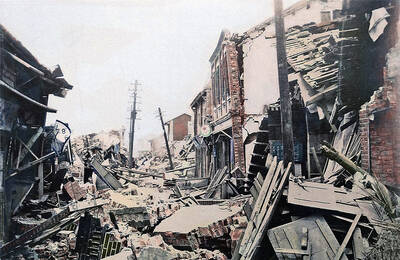
April 15 to April 21 Yang Kui (楊逵) was horrified as he drove past trucks, oxcarts and trolleys loaded with coffins on his way to Tuntzechiao (屯子腳), which he heard had been completely destroyed. The friend he came to check on was safe, but most residents were suffering in the town hit the hardest by the 7.1-magnitude Hsinchu-Taichung Earthquake on April 21, 1935. It remains the deadliest in Taiwan’s recorded history, claiming around 3,300 lives and injuring nearly 12,000. The disaster completely flattened roughly 18,000 houses and damaged countless more. The social activist and


 RSS
RSS