


"Money, I know, is not everything. Lust is an entirely different story."
So writes the narrator of The Book of Salt, a Vietnamese cook who is engaged by Gertrude Stein, the modernist poet, and her lesbian partner Alice B. Toklas in the Paris of 1929.
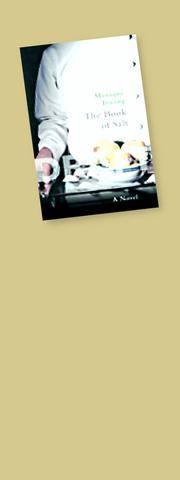
Several currents combine to make this an engaging novel. To begin with, the narrator, Bin, is also gay, so he observes his employers with extra insight.
Again, scenes of his childhood in Saigon under the French colonial power and his present life in Paris alternate. Monique Truong was herself born in Vietnam and now lives in New York, so describing both Saigon and the world of two Americans living in Paris comes relatively naturally to her.
But there's more to this delicate and perceptive book than this. Bin is a cook, and food is a major theme (as the title suggests it will be). It's not only that we read a great deal about crystallized ginger, coarsely crushed peppercorns, nutmeg, fried watercress, the structure of bananas, and duck cooked with figs soaked in port. We also observe two ancient civilizations, the Vietnamese and the French, each with distinctive and elaborate culinary traditions, side by side. (Both American and Chinese food are treated to displays of patronizing disdain).
More personal obsessions are also blended in with cooking and eating. Bin has a compulsion to cut his finger-tips so as to sauce the meat, fortify a soup, or enrich a blood orange sorbet. In one striking scene, hinting very delicately at sado-masochism, Alice B. (Babette) Toklas teaches Bin how to strangle pigeons. They taste so much better than if their throats had been cut, she instructs him. And indeed she herself is described as "an oyster with sand in its lips, a woman whose corset bites into her hips."
The Toklas (nicknamed "Pussy") and Stein ("Lovey") menage is deftly described. Both are in their fifties. For her admirers Stein is the personification of the 20th century. Cigar-smoking, wearing kimonos and prayer beads, this matronly figure may accept the devotion of Toklas, for whom every object she's touched acquires the status of a sacred relic, but she nonetheless also has a ready eye for other women, "following the curves snaking up their skirts." She refuses to have a phone, and instead entertains her devotees at Saturday afternoon tea where the couple are referred to as "the Steins."
Bin watches it all wryly. He considers himself to have a mixed nature, partly female, what the Vietnamese call "lai cai." He finds lovers for the night on a bridge over the Seine. They rarely tell each other the truth about themselves, though the truth does save time, he notes. Anyway, "pleasure for pleasure is an even exchange."
The main plot, in so far as there is one, involves the man Bin starts to see on his day off, one of the Steins' tea-party guests. He calls him his "Sweet Sunday Man" and, like the Steins's radiators, he's "smelly but warm." One Sunday he asks Bin to bring him one of Stein's notebooks, to be returned the following week. Toklas keeps them locked up in a drawer, but Bin knows where she keeps the key.
The book is awash with oriental exoticisms, but generally the sections set in Vietnam are less compelling than the Paris chapters. As a young man Bin worked in the kitchen of the French Governor General where he learnt such things as that it's next to impossible to whip up the white of eggs to a froth in the Saigon climate. We meet his mother, the ghost of his father, and an early European lover. Ancestor worship is interestingly described as possessing "no forgiveness ... only retribution and eternal debt." There are striking passages, but you're usually glad when the story gets back to France.
A particularly enjoyable section is when the three main characters go to Provence for the summer. Bin is strongly attracted to the muscular sons of the local farmers, but has to content himself with getting drunk with them (he drinks heavily throughout the book).
This is Monique Truong's first novel, but her short stories and essays have been so highly regarded that they're already being taught in American universities. And it's easy to see how this book will suit the current academic preoccupation with political correctness. Post-colonialists will enjoy Bin's controlled annoyance at Toklas calling him her "little Indochinese" and "thin Bin," and the later tragic meeting of the Americans and Vietnamese can be foreseen by those with an eye for such things, especially at the end of the novel when the Steins set sail back to the US.
The novel is most notable for its clusters of unforgettable sentences. Here is one typically memorable one: "When melted butter is brought to the color just moments after gold, it inexplicably acquires ... the taste of hazelnuts roasted over a wood-fed flame." Quinces, too, receive something approaching a eulogy. And the descriptions of how to make a perfect omelet (an art, Bin remarks, that separates the experts from the rest), or cook Vietnamese pineapple and beef, are likely to be cut out and pasted into readers' cookbooks.
This suggests a possible weakness. The strength of Truong's style lies in the detail. She is wonderful in vivid short passages, but less strong on cumulative effects. There's also little drama in the tale, even when elements of the plot, such as the filtching of the notebook, could easily have allowed it.
This nuanced tale is likely to become an established classic in literary circles, a success that will only be reinforced by its incorporation of an important modernist writer (limited though it makes her look) into the story. Its very subtlety, though, is unfortunately likely to prevent it from ever being a popular best-seller.

In late October of 1873 the government of Japan decided against sending a military expedition to Korea to force that nation to open trade relations. Across the government supporters of the expedition resigned immediately. The spectacle of revolt by disaffected samurai began to loom over Japanese politics. In January of 1874 disaffected samurai attacked a senior minister in Tokyo. A month later, a group of pro-Korea expedition and anti-foreign elements from Saga prefecture in Kyushu revolted, driven in part by high food prices stemming from poor harvests. Their leader, according to Edward Drea’s classic Japan’s Imperial Army, was a samurai

The following three paragraphs are just some of what the local Chinese-language press is reporting on breathlessly and following every twist and turn with the eagerness of a soap opera fan. For many English-language readers, it probably comes across as incomprehensibly opaque, so bear with me briefly dear reader: To the surprise of many, former pop singer and Democratic Progressive Party (DPP) ex-lawmaker Yu Tien (余天) of the Taiwan Normal Country Promotion Association (TNCPA) at the last minute dropped out of the running for committee chair of the DPP’s New Taipei City chapter, paving the way for DPP legislator Su

Located down a sideroad in old Wanhua District (萬華區), Waley Art (水谷藝術) has an established reputation for curating some of the more provocative indie art exhibitions in Taipei. And this month is no exception. Beyond the innocuous facade of a shophouse, the full three stories of the gallery space (including the basement) have been taken over by photographs, installation videos and abstract images courtesy of two creatives who hail from the opposite ends of the earth, Taiwan’s Hsu Yi-ting (許懿婷) and Germany’s Benjamin Janzen. “In 2019, I had an art residency in Europe,” Hsu says. “I met Benjamin in the lobby

It’s hard to know where to begin with Mark Tovell’s Taiwan: Roads Above the Clouds. Having published a travelogue myself, as well as having contributed to several guidebooks, at first glance Tovell’s book appears to inhabit a middle ground — the kind of hard-to-sell nowheresville publishers detest. Leaf through the pages and you’ll find them suffuse with the purple prose best associated with travel literature: “When the sun is low on a warm, clear morning, and with the heat already rising, we stand at the riverside bike path leading south from Sanxia’s old cobble streets.” Hardly the stuff of your


 RSS
RSS