


Three years after Sydney was hailed for staging the first "Green Games," environmental groups have accused the Olympic movement of taking a giant step backwards in Athens.
Dimitris Caravelas, head of Greece's Worldwide Fund for Nature (WWF), said Athens Organizers (ATHOC), the Greek government and the International Olympic Committee (IOC) had already won the Games' first gold medal -- "the award for missed opportunities in 2004."
"They dropped the ball in Athens. Lip service was paid to environmental protection and a golden opportunity has been missed," he said.
Greece won the bid to host the 2004 Games promising to address air and water quality, fragile natural and cultural areas, traffic and waste management but green groups said Athens, the IOC and the government had all failed.
"Sydney got six marks out of 10, Athens will only get one, even if everything changes over the next year, it's too late," Nikos Haralambidis, Greece's Greenpeace director said.
All sides have hailed the upgrading of the capital's troubled mass transit system with new metro lines, the purchase of a natural gas bus fleet and the reconstruction of the tram. But that is where agreement ends.
Critics say that basic environmental standards such as the use of solar power, non-toxic building materials, recycling and waste management have not been implemented in large complexes such as the Olympic village.
The IOC rewrote the Olympic charter in 1994 to enshrine sustainable development and responsibility on environmental issues.
But Haralambidis said the IOC had gone soft on environmental guidelines, failing to put pressure on Greek organizers.
First flashpoint
Lillehammer's Winter Olympics and Sydney's organizers were credited with involving environmental organizations from the planning stage.
"In Sydney NGOs (non-governmental organizations) were involved and planning began straight away. In Greece two years were lost deciding how the pieces of the pie would be divided up between ministries," said Haralambidis.
The first major flashpoint between eco-groups and ATHOC came in 2001 with the controversial decision to site the rowing complex on the coastal strip of Skinias, north of Athens.
The area, which witnessed fierce fighting between Greeks and Persians in the 490BC battle of Marathon, became the focus of a modern-day conflict.
Opponents of the venue said artificial lakes being created would damage a rare Mediterranean pine forest and an important wetland bird habitat.
"The problems began with the siting and Skinias was the spearhead of it all. There was no environmental planning, no consultancy with NGOs or residents," said Caravelas.
Pressure groups launched a campaign to stop the project but ATHOC said the work would help to preserve the area, leading to the creation of a national park.
ATHOC eventually won the backing of the European Union Environment Commissioner Margot Wallstrom after amending plans prior to a February inspection this year.
The rift was deep though and both the WWF and Greenpeace ceased meetings with Olympic planners in 2002, saying their input was being ignored.
Caravelas said the environmental component came to be considered a luxury after chronic delays in a string of projects led the IOC to warn organizers that they risked losing the Games.
Olive trees
Yiannis Pyrgiotis, executive director of ATHOC, pointed to limited successes in preserving natural habitats at venues such as the equestrian centre in Markopoulo.
"Approximately 600 ancient olive trees have been moved and prepared for transplantation as part of a pilot tree preservation programme, the first of its kind in Greece."
NGOs have criticized planners of the Olympic village in the northern suburbs, which will become a community of workers' flats for 20,000 people after the Games, for missing green opportunities.
Haralambidis said organizers should have used only green energy sources. "It's a major scandal not to have solar-powered boilers in the Olympic village."
With one year to go, tens of thousands of promised new trees, bushes and shrubs to soften the Athens urban sprawl have yet to appear.
More than 60 percent of greater Athens is concreted over and Environment Minister Vasso Papandreou admitted in February that Athenians had a negative image of their city.
Pyrgiotis insisted that a new awareness of green issues would be part of the Olympic legacy.
"One of the successes of the Athens 2004 Games has been the incorporation of environmental awareness into practices and planning and the dissemination of environmental expertise and information," he said.
But Greenpeace's Haralambidis was less optimistic, saying: "What Athens has to offer is a lesson in how things shouldn't be done."
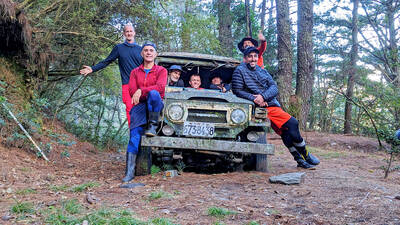
The year was 1991. A Toyota Land Cruiser set out on a 67km journey up the Junda Forest Road (郡大林道) toward an old loggers’ camp, at which point the hikers inside would get out and begin their ascent of Jade Mountain (玉山). Little did they know, they would be the last group of hikers to ever enjoy this shortcut into the mountains. An approaching typhoon soon wiped out the road behind them, trapping the vehicle on the mountain and forever changing the approach to Jade Mountain. THE CONTEMPORARY ROUTE Nowadays, the approach to Jade Mountain from the north side takes an

Last week Joseph Nye, the well-known China scholar, wrote on the Australian Strategic Policy Institute’s website about how war over Taiwan might be averted. He noted that years ago he was on a team that met with then-president Chen Shui-bian (陳水扁), “whose previous ‘unofficial’ visit to the US had caused a crisis in which China fired missiles into the sea and the US deployed carriers off the coast of Taiwan.” Yes, that’s right, mighty Chen caused that crisis all by himself. Neither the US nor the People’s Republic of China (PRC) exercised any agency. Nye then nostalgically invoked the comical specter

Relations between Taiwan and the Czech Republic have flourished in recent years. However, not everyone is pleased about the growing friendship between the two countries. Last month, an incident involving a Chinese diplomat tailing the car of vice president-elect Hsiao Bi-khim (蕭美琴) in Prague, drew public attention to the People’s Republic of China’s (PRC) operations to undermine Taiwan overseas. The trip was not Hsiao’s first visit to the Central European country. It was meant to be low-key, a chance to meet with local academics and politicians, until her police escort noticed a car was tailing her through the Czech capital. The
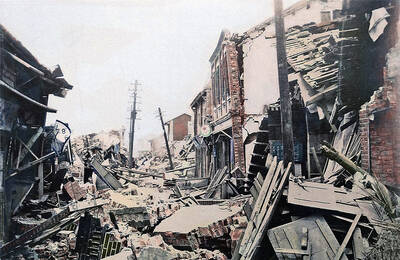
April 15 to April 21 Yang Kui (楊逵) was horrified as he drove past trucks, oxcarts and trolleys loaded with coffins on his way to Tuntzechiao (屯子腳), which he heard had been completely destroyed. The friend he came to check on was safe, but most residents were suffering in the town hit the hardest by the 7.1-magnitude Hsinchu-Taichung Earthquake on April 21, 1935. It remains the deadliest in Taiwan’s recorded history, claiming around 3,300 lives and injuring nearly 12,000. The disaster completely flattened roughly 18,000 houses and damaged countless more. The social activist and


 RSS
RSS