


When Cristalux SA went out of business three years ago, some 300 workers lost their jobs producing glassware strong enough to be hurled against a wall without breaking.
Vandals destroyed assembly line machinery in the company's abandoned factory, huge glassmaking ovens were carted away and rain started leaking through the roof.
But after the country's economy entered a Great Depression-style slump and no buyers emerged for the plant, a group of former employees joined a trend taking hold in Argentina by forming a cooperative and starting production again at their old workplace.

PHOTO: AP
The Cristalux workers figured they had nothing to lose. Job opportunities evaporated after Argentina's economy fell apart in 2001 and contracted 11 percent last year, leaving one out of every six Argentines unemployed and more than half the country in poverty.
Across this nation of 37 million, at least 10,000 laid-off workers have reopened their bosses' failed businesses over the last two years.
"They're not getting rich, but they are starting to make enough money to get by," said Hector Garay, who leads an association that advises 22 reopened cooperative businesses employing 2,000 workers.

PHOTO: AP
The government has helped the worker-run companies by passing a law giving employees the right to control the bankrupt businesses through cooperatives or state ownership.
Argentine workers now running the enterprises are churning out products as diverse as toilet paper, umbrellas and auto parts. One cooperative took over a bankrupt slaughterhouse; another reopened a debt-laden pizzeria.
The glass workers had no functioning modern equipment in the wrecked factory, but decided to start from scratch making everyday glass plates, bowls and water cups used by most blue-collar Argentine families. The company's former sales manager helped design the products and line up clients.
"We didn't have any work for years, so we weren't worried about failing," said Carlos Leiva, a mechanic under the old owners and now one of the cooperative's top administrators.
Over the past six months, about 100 Cristalux workers have returned to work at the 106-year-old brick complex spanning a city block in a working-class neighborhood.
They spent months building new ovens and making molds used to fashion handcrafted water glasses and blue and green tinted plates and bowls. Some learned to blow glass, and they make wine glasses.
Credit is virtually nonexistent in Argentina, so the cooperative doesn't have money for parts to repair the assembly line required to make the tougher glass the workers used to produce. With flames shooting from vents atop towering glass ovens and rain drizzling through holes in the roof, the plant's working conditions resemble 19th-century-England sweatshops.
As one worker extracted a glob of molten glass from an oven, an industrial fan aiming cool air at him fell from an empty oil barrel and shattered, sending shards of metal flying.
"Right now, we can't put in the safety precautions we'd like," Leiva explained. But only a handful of injuries have occurred, mostly minor burns, he said.
After being paid nothing the first few months, the cooperative's workers still don't have benefits but are making about US$13 (37 pesos) a day. While that's about the same salary they received from their old bosses, it's far less in dollar terms because the peso lost about 70 percent of its dollar value last year.
"I'm making enough to eat meat at home about once a week," said Ruben Massias, who builds and maintains the plant's new glass ovens. "But before this, I was just doing odd jobs, and now I think I have a future."
If Argentina's economy recovers, the owners of plants taken over by workers may mount legal battles to reassert property rights, said Daniel Funes de Rioja, a lawyer who represents corporations.
And the takeovers will only continue as long as Argentina's economy remains in the doldrums, said Luis de Lucio, a corporate restructuring expert at Alvarez & Marsal in New York.
"You know that shareholders and banks are going to come back when the economy gets better and say, `That company is ours,'" he said.
Leiva said his cooperative will fight in the courts to keep the glass factory, insisting the owners and their creditors had their chance to sell the factory or reorganize.
The cooperative also has its own ideas. For decades, Cristalux was known for producing a line of table glassware famous in Argentina because it was virtually unbreakable.
But the workers must first make enough money selling the cheaper glass so they can invest in repairs the plant's damaged machinery and obtain licensing rights to produce the brand.
"That's our dream," Leiva said.

Last week Joseph Nye, the well-known China scholar, wrote on the Australian Strategic Policy Institute’s website about how war over Taiwan might be averted. He noted that years ago he was on a team that met with then-president Chen Shui-bian (陳水扁), “whose previous ‘unofficial’ visit to the US had caused a crisis in which China fired missiles into the sea and the US deployed carriers off the coast of Taiwan.” Yes, that’s right, mighty Chen caused that crisis all by himself. Neither the US nor the People’s Republic of China (PRC) exercised any agency. Nye then nostalgically invoked the comical specter

Relations between Taiwan and the Czech Republic have flourished in recent years. However, not everyone is pleased about the growing friendship between the two countries. Last month, an incident involving a Chinese diplomat tailing the car of vice president-elect Hsiao Bi-khim (蕭美琴) in Prague, drew public attention to the People’s Republic of China’s (PRC) operations to undermine Taiwan overseas. The trip was not Hsiao’s first visit to the Central European country. It was meant to be low-key, a chance to meet with local academics and politicians, until her police escort noticed a car was tailing her through the Czech capital. The
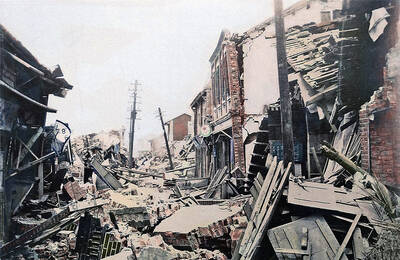
April 15 to April 21 Yang Kui (楊逵) was horrified as he drove past trucks, oxcarts and trolleys loaded with coffins on his way to Tuntzechiao (屯子腳), which he heard had been completely destroyed. The friend he came to check on was safe, but most residents were suffering in the town hit the hardest by the 7.1-magnitude Hsinchu-Taichung Earthquake on April 21, 1935. It remains the deadliest in Taiwan’s recorded history, claiming around 3,300 lives and injuring nearly 12,000. The disaster completely flattened roughly 18,000 houses and damaged countless more. The social activist and

Over the course of former President Ma Ying-jeou’s (馬英九) 11-day trip to China that included a meeting with Chinese Communist Party (CCP) leader Xi Jinping (習近平) a surprising number of people commented that the former president was now “irrelevant.” Upon reflection, it became apparent that these comments were coming from pro-Taiwan, pan-green supporters and they were expressing what they hoped was the case, rather than the reality. Ma’s ideology is so pro-China (read: deep blue) and controversial that many in his own Chinese Nationalist Party (KMT) hope he retires quickly, or at least refrains from speaking on some subjects. Regardless


 RSS
RSS