


As he journeys around Calabria, home of his forebears, Mark Rotella confronts any number of extraordinary meals. He evokes food so as to make any American despair at the prospect of his or her next dinner. But Rotella is not writing tourist or voyeur gastronomy; he is writing about food as life. And his Stolen Figs, with its travels and sights and encounters, goes beyond any of these things. It is about life: Calabrians' and ultimately his own.
Most of what we read as travel writing is tourist writing. Travel, relatively rare now, means finding yourself through a journey and letting it change you.
Tourism means making a journey, assured by a variety of filters that it won't change you, other than by acquiring an anecdote or pot that eventually bores or breaks back home, or a recipe for a dish that won't taste the same.
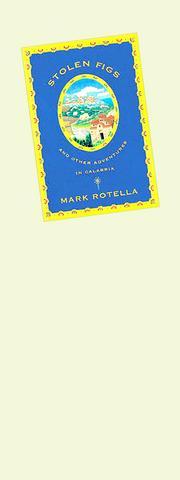
Rotella is unqualifiedly a traveler, and more. A New York editor, he was on a holiday trip years ago with his father. In Perugia, almost on impulse, he persuaded the older man to revisit the tiny town of Gimigliano whence his own father and mother had emigrated to Connecticut. Reluctantly the father agreed to a two-day blitz: three rail connections south, the last a cogwheel tram juddering up into the mountains. A few hours, a blinding detonation of aunts, uncles, cousins at no notice, an immense meal and, despite entreaties, an enforced instant return to the north.
It was all the father could take (though he returned for another visit). For the son it was unleashed urgency, a passion to discover, that over the next decade would take him back every other year to stay for weeks at a time.
"Come l'ulivo," a friend remarked: the two-year interval it takes olives to come to fruit.
Part of the time Rotella spent in Gimigliano hanging out, talking and eating with his relatives, and with late-night acquaintances at a local cafe. The rest of the time he went to villages and towns all over Calabria, driven, instructed and introduced by Giuseppe Chiarella.
Fortyish, stocky, white-haired, Giuseppe made his living photographing the sights of the region and visiting shops, restaurants, hotels to peddle the results as postcards. Everywhere there was a stop to make, a shopkeeper to be shown Giuseppe's latest cards along with his hand-drawn maps and to be nudged for payment and to gossip with. Virgil could have been no better a guide for Dante's infernal traveler, and certainly not as generous, lively and sometimes melancholy.
Melancholy. It is the wisps of hardness that distinguish Rotella's account from the easy evocations that many writers -- Peter Mayle, for instance -- draw up for their cozy portraits of bits of France and Italy, and that make his a true act of love.
Calabria, the boot heel and toe of Italy, is harsh, poor, rough; its beauty bare, not colorful; its people stubborn and hard-bitten; its dialect a hoarse throatful of pebbles that other Italians, barely understanding, suspect are being hurled at them. Even its Mafia goes by the unpronounceable name of 'ndrangheta. It is Greek, Saracen, Albanian Italy: economically neglected and looked down on by the north, where it was remarked that Garibaldi did not unite Italy, he simply divided Africa.
So Rotella tells us that his arrival with his father did not immediately bring the little town flocking in recognition; it took a while for his relatives to be located. Not all the Rotellas are cordial: Taken by Giuseppe to try his hand at a bocce game, he is given no leeway. An old player, introduced as a Rotella and possible kinsman, glowers at his performance and mutters: "I don't think we're related." One of a band of sweet young toughs at the cafe shows him his poems, speaks bitterly of unemployment, gets drunk and picks a violent fight with another man.
Later he apologizes to Rotella for embarrassing him. The delicacy he finds in the fierceness, the unstinting though not entirely easy hospitality, the clear-eyed dignity in hard times, the wild beauty of the mountains plunging near the sea, the emptiness of seaside tourist towns awaiting the season: these light up the book, along with the meals (the day after a prodigious Easter feast comes another one even more prodigious) and Giuseppe's traveling discourse.
Above all there is the sense of recognizing himself, two generations after his family emigrated, in an ancient, battered and resistant civilization. Pride and humility entwine all along the way.
A young man asks why Calabria should interest him. "We have nothing but sand and ocean." The author replies, "We have nothing but people and buildings and cars and terrible smells." Toward the end he writes of arranging to take Italian citizenship. What ensues is a far-fetched comic conspiracy with a woman at the Italian Consulate in New York, eager to help him get around a whole prickly string of Catch-22s to make it possible.
Rotella does not seem to be a practiced writer. There are awkwardnesses -- a prolonged comparison of oft-invaded Calabria to a prostitute -- but these are overcome by a determinedly seeking sensibility that lifts beyond determination into the inspired.
I like the quiet night scenes at the end of the packed days, when he seems almost literally to be putting his Calabrian villages to bed.
And what ordinary travel writer would stop to render a Good Friday Passion verse sung by shopgirls in Abereschsh, an Italo-Albanian dialect, and follow with Albanian, Italian and English translations? The last:
Christ heard rumblings
and could not rest
it was Judas the traitor
with all his host.

In late October of 1873 the government of Japan decided against sending a military expedition to Korea to force that nation to open trade relations. Across the government supporters of the expedition resigned immediately. The spectacle of revolt by disaffected samurai began to loom over Japanese politics. In January of 1874 disaffected samurai attacked a senior minister in Tokyo. A month later, a group of pro-Korea expedition and anti-foreign elements from Saga prefecture in Kyushu revolted, driven in part by high food prices stemming from poor harvests. Their leader, according to Edward Drea’s classic Japan’s Imperial Army, was a samurai

The following three paragraphs are just some of what the local Chinese-language press is reporting on breathlessly and following every twist and turn with the eagerness of a soap opera fan. For many English-language readers, it probably comes across as incomprehensibly opaque, so bear with me briefly dear reader: To the surprise of many, former pop singer and Democratic Progressive Party (DPP) ex-lawmaker Yu Tien (余天) of the Taiwan Normal Country Promotion Association (TNCPA) at the last minute dropped out of the running for committee chair of the DPP’s New Taipei City chapter, paving the way for DPP legislator Su

Located down a sideroad in old Wanhua District (萬華區), Waley Art (水谷藝術) has an established reputation for curating some of the more provocative indie art exhibitions in Taipei. And this month is no exception. Beyond the innocuous facade of a shophouse, the full three stories of the gallery space (including the basement) have been taken over by photographs, installation videos and abstract images courtesy of two creatives who hail from the opposite ends of the earth, Taiwan’s Hsu Yi-ting (許懿婷) and Germany’s Benjamin Janzen. “In 2019, I had an art residency in Europe,” Hsu says. “I met Benjamin in the lobby
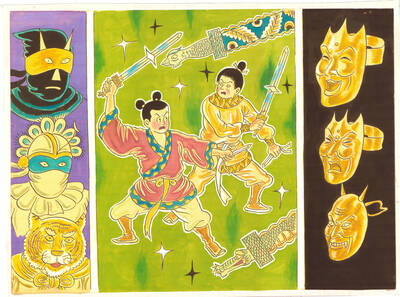
April 22 to April 28 The true identity of the mastermind behind the Demon Gang (魔鬼黨) was undoubtedly on the minds of countless schoolchildren in late 1958. In the days leading up to the big reveal, more than 10,000 guesses were sent to Ta Hwa Publishing Co (大華文化社) for a chance to win prizes. The smash success of the comic series Great Battle Against the Demon Gang (大戰魔鬼黨) came as a surprise to author Yeh Hung-chia (葉宏甲), who had long given up on his dream after being jailed for 10 months in 1947 over political cartoons. Protagonist


 RSS
RSS