


AT 26, Chen Zhong-ji (
Eleven years on, he is free, enrolled in a university course and the manager of a restaurant.
Chen's reversal of fortune is a result of his own change of heart and help from a group of people willing to give parolees a second chance.
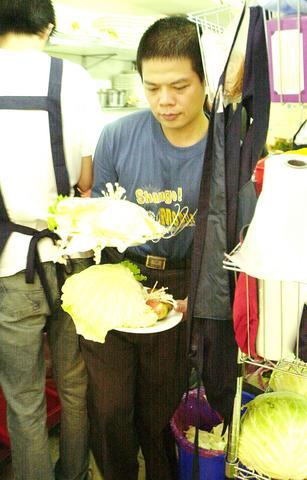
PHOTO: SEAN CHAN, TAIPEITIMES
The Taiwan After-care Association (台灣更生保護會) is a partly government-funded organization that supports convicts when they finish their sentences.
It was established as a charity in 1947 and is now supervised by the Ministry of Justice and works in association with 19 local prosecutors offices. Half of its funding comes from the government, the rest from donations.
Chen is in many ways typical of the sort of person the association feels it can help.

PHOTOS: SEAN CHAN, TAIPEITIMES
After leaving his hometown in Chiayi County to study at junior high school in Taipei, Chen quickly became involved in a gang that ran an underground casino.
At the age of 17, having dropped out of school, he was arrested along with his fellow gang members during a police raid on the casino. He was released because of his age, but many of his friends were jailed.
After completing his military service, many of his former gang colleagues had been released. When his old gang leader asked Chen to help, he felt there was little else he could do.
"I wasn't mature enough to know right from wrong. I didn't know how to say no," Chen said. "I started doing stupid things because my `big brother' wanted me to help him collect debts from people."
Chen's luck ran out in 1988, when one of the debtors died. Chen said he didn't know exactly what happened on that day when he and other gang members went to collect a debt from a Chinese medicine trader, only that the next day the man was found dead from suffocation.
He was sentenced to life in jail.
"Even though I was in my 20s, I still couldn't understand the consequences fully. Of course I regret it, but how will regrets help me," Chen said.
So rather than resign himself to a life on the fringes of society, Chen decided to turn his back on the criminal lifestyle and start afresh. He completed his junior and senior high school exams in prison but had to wait until he was paroled on Sept. 9 last year, having served 10 years of his sentence, to enroll in a land economics course at National Taipei University.
It was while he was searching for a part-time job out of school hours that he came into contact with the Taiwan After-Care Association.
Xu Cai-xia (
"I often went to the prisons to chat with people who were just about to come out," Xu said. "I would ask them: `Do you have problems? Would you like our help?'
"Some would say they needed a job, or a place to stay, or money. I would report to the association to help them find jobs."
At first the association tried to find employers who were willing to take former inmates. Unsupristngly, this proved difficult, so the Ministry of Justice last year approved a plan to allow the association to set up businesses specifically to hire parolees, such as beauty salons, cafeterias and shaved-ice snack shops.
As part of the scheme, Hsu secured an interest-free, NT$1.25 million loan to open a hot pot restaurant in Chungho. She can keep any profits, but is responsible for covering any losses.
When Chen approached the association looking for help finding work he had already made more progress than the majority of the former inmates the association deals with. He studied during the week and worked all day at the restaurant during the weekends.
He started with the simple things, like cleaning, taking out the trash and washing dishes. Then Xu taught him how to arrange the meat and vegetables on plates to give to customers.
Xu said business was so brisk at the restaurant that she decided to open another, in Hsintian, Taipei County, with a NT$2 million loan from the association.
She offered the job of managing the new store to Chen, who was the only one of the former inmates she hired who had stayed.
"She thought I was a responsible person and wanted to give me a chance to prove myself," Chen said. "It was a very good opportunity for me to learn. For example, I can learn how to work with the employees here, how to manage this place, how to attract customers. The experience is priceless."
But both of them admit that there are problems, the most acute of which is the high turnover of employees.
"They think it's too much work here," Hsu said, adding that more than 10 people had worked at the Chungho restaurant. "It is quite tiring. It's a lot more tiring than running a bookstore. I only needed to take care of stationery orders from companies, and pack things. But this place keeps me running around."
"Before they start, I always give them a prep talk, telling them it's hard work and very tiring. But if they do well, they'll have the chance to be a manager."
Chen said the problem was even worse at the new restaurant.
"There have been about a dozen of them that came and tried," he said. "Some couldn't handle it even for a day. The hours are not stable here."
"There are no difficult tasks, but there are many things to be done around here. If you don't try hard you might mess things up. And the pay is not that good. Those who can hang on to the job are admirable."
As part of her loan agreement with the association, Xu must hire at least three former inmates at the Hsintien restaurant, including Chen.
Bruce Yang (
"I've had quite a number of jobs since I got out," Yang said. "I was a delivery boy delivering lunch boxes; I tried being an ironsmith. I even did bad things like helping loan sharks. But then I didn't want to do that any more. My life is more real and solid here."
He said one of the main reasons he could handle the long and irregular hours at the restaurant was because of the support he got from Chen.
"I think he's a great guy, very different from the usual bosses or managers in stores," Yang said. "He's a very humorous too. We joke around sometimes. It helps me enjoy the job rather than just wanting to hurry home every day after work. Time passes quickly here. Working here is not painful at all, and I'm not just making money either."
Chen said that it could be difficult explaining to people fresh out of prison what they would have to do to succeed.
"The most important thing is your mind and your thoughts," he said. "I share with them what I have been through. But it depends on them whether they want to change. I'm willing to teach them everything, but if they can't control themselves, all my help will be a waste of time."
Chen has been putting in 16 hours a day at the new restaurant and says he has little time to enjoy his favorite pastime of table tennis.
Chen is also learning to cope with pressure, and the prospect of tough choices ahead.
"There are times I want to give up; the ideal and reality are different," he said. "So if I can't keep up the school and work at the same time, I will put work ahead of school. I only study in school, but I get valuable experience here. I can rest for a year and then go back next year."
Chen said that this time, he hasn't been in contact with his old friends from the gang. When asked if he has considered going back to the old life, he replied, "Impossible. Impossible."
"I've learned that it's not a road that should be traveled," he said. "It's not what I want now."
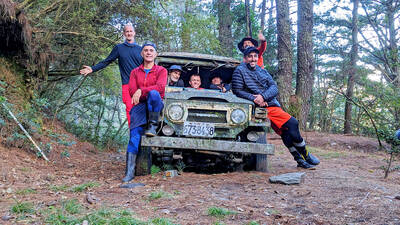
The year was 1991. A Toyota Land Cruiser set out on a 67km journey up the Junda Forest Road (郡大林道) toward an old loggers’ camp, at which point the hikers inside would get out and begin their ascent of Jade Mountain (玉山). Little did they know, they would be the last group of hikers to ever enjoy this shortcut into the mountains. An approaching typhoon soon wiped out the road behind them, trapping the vehicle on the mountain and forever changing the approach to Jade Mountain. THE CONTEMPORARY ROUTE Nowadays, the approach to Jade Mountain from the north side takes an

Last week Joseph Nye, the well-known China scholar, wrote on the Australian Strategic Policy Institute’s website about how war over Taiwan might be averted. He noted that years ago he was on a team that met with then-president Chen Shui-bian (陳水扁), “whose previous ‘unofficial’ visit to the US had caused a crisis in which China fired missiles into the sea and the US deployed carriers off the coast of Taiwan.” Yes, that’s right, mighty Chen caused that crisis all by himself. Neither the US nor the People’s Republic of China (PRC) exercised any agency. Nye then nostalgically invoked the comical specter

Relations between Taiwan and the Czech Republic have flourished in recent years. However, not everyone is pleased about the growing friendship between the two countries. Last month, an incident involving a Chinese diplomat tailing the car of vice president-elect Hsiao Bi-khim (蕭美琴) in Prague, drew public attention to the People’s Republic of China’s (PRC) operations to undermine Taiwan overseas. The trip was not Hsiao’s first visit to the Central European country. It was meant to be low-key, a chance to meet with local academics and politicians, until her police escort noticed a car was tailing her through the Czech capital. The

April 15 to April 21 Yang Kui (楊逵) was horrified as he drove past trucks, oxcarts and trolleys loaded with coffins on his way to Tuntzechiao (屯子腳), which he heard had been completely destroyed. The friend he came to check on was safe, but most residents were suffering in the town hit the hardest by the 7.1-magnitude Hsinchu-Taichung Earthquake on April 21, 1935. It remains the deadliest in Taiwan’s recorded history, claiming around 3,300 lives and injuring nearly 12,000. The disaster completely flattened roughly 18,000 houses and damaged countless more. The social activist and


 RSS
RSS