


Bob Hope's one-liners gently poked fun at presidents, blunted the sting of combat for American soldiers from World War II to the Gulf War, and ultimately made him the most revered of American comics.
Hope, who turned 100 on May 29, rode a genial wave of success in movies, radio and television to a position unique among entertainers. He died Sunday of pneumonia at his Los Angeles-area home, publicist Ward Grant said Monday. His family was at his bedside.
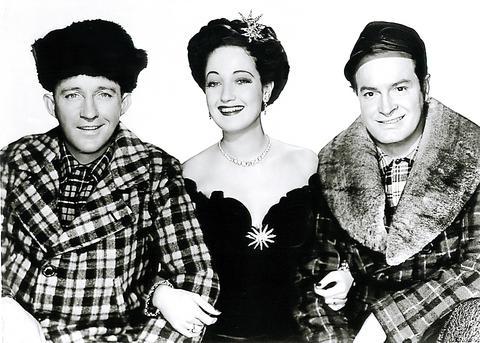
PHOTO: REUTERS
As the 20th century's good humor delivery man for US troops, Hope took his show on the road to bases, field hospitals, jungles and aircraft carriers around the world, peppering audiences with a fusillade of brief, topical gags.

PHOTO: AFP
Hope's humor lacked malice, and he made himself the butt of many jokes. His golf scores and physical attributes, including his celebrated ski-jump nose, were frequent subjects:
``I want to tell you, I was built like an athlete once -- big chest, hard stomach. Of course, that's all behind me now.''
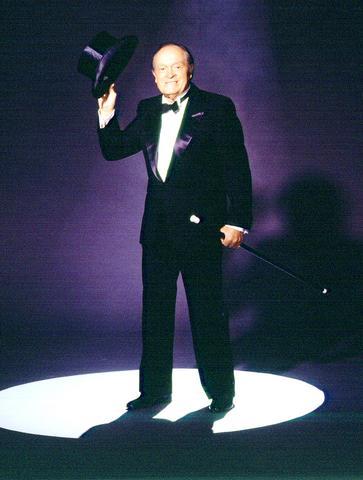
``It's hard for me to imagine a world without Bob Hope in it,'' said filmmaker Woody Allen, who cited Hope's 1942 film Road to Morocco for pointing him toward comedy.
``The nation lost a great citizen,'' President George W. Bush said after hearing of the comedian's death.
The English-born Hope began in vaudeville and ended up conquering every medium. When Hope went into one of his monologues, it was almost as though the world was conditioned to respond. No matter that the joke was old or flat; he was Bob Hope and he got laughs.
``Audiences are my best friends,'' he liked to say. ``You never tire of talking with your best friends.''
Along with family members, Hope's longtime caregivers and a priest were present when he died.
``I can't tell you how beautiful and serene and peaceful it was,'' daughter Linda Hope told a news conference. ``The fact that there was a little audience gathered around, even though it was family, I think warmed dad's heart.''
``He really left us with a smile on his face and no last words. ... He gave us each a kiss and that was it,'' she said.
Hope earned a fortune, gave lavishly to charity and was showered with awards, so many that he had to rent a warehouse to store them.
Though he said he was afraid of flying, Hope traveled countless kilometers to boost the morale of American servicemen. He headlined in so many war zones that he had a standard joke for the times he was interrupted by gunfire: ``I wonder which one of my pictures they saw?''
So often was Hope away entertaining, and so little did he see his wife, Dolores, and their four children, that he once remarked, ``When I get home these days, my kids think I've been booked on a personal appearance tour.''
On his 100th birthday, he was too frail to take part in public celebrations, but was said to be alert and happy -- and overwhelmed by the outpouring of affection. The fabled intersection of Hollywood Boulevard and Vine Street was renamed Bob Hope Square, and Bush established the Bob Hope American Patriot Award.
``He can't believe that this is happening and that he's made it to his Big 100,'' son Kelly Hope said at the time.
Leslie Towns Hope was born in 1903 in Eltham, England, the fifth of seven sons of a British stonemason and a Welsh singer of light opera. The Hopes emigrated to the US when he was four and settled in Cleveland. They found themselves in the backwash of the 1907 depression.
The boy helped out by selling newspapers and working in a shoe store, a drug store and a meat market. He also worked as a caddy and developed a lifelong fondness for golf.
Hope changed his name to Bob when classmates ridiculed his English schoolboy name.
He boxed for a time under the name Packy East -- ``I was on more canvases than Picasso'' -- and tried a semester in college before devoting himself to show business. He quickly veered from song and dance to comedy patter, and his monologue routine was born.
By 1930, he had reached vaudeville's pinnacle -- The Palace -- and in the 1930s he played leading parts in Broadway musicals. During Roberta, he met nightclub singer Dolores Reade and invited her to the show. They married in 1934.
After a few guest radio spots, Hope began working regularly on a Bromo Seltzer radio program. In 1938, he was hired by Pepsodent to create his own show, and that led him to Hollywood.
Paramount signed him for The Big Broadcast of 1938, in which he introduced the song that became his trademark, Thanks for the Memory.
Soon he was teaming with Bing Crosby in the seven ``Road'' pictures -- Road to Bali, Road to Morocco, and so on -- playing best friends who lie, cheat and make fun of each other in comedic competition for glory and Dorothy Lamour.
In all, he made 53 films from 1938 to 1972. In 1950, he entered television, and his successes continued. He also appeared more than 20 times at the Academy Awards between 1939 and 1978.
Hope started playing to troops well before the US entered World War II. He tried to enlist, but was told he could be of more use as an entertainer. He played his first camp show in California in May 1941, seven months before Pearl Harbor.
His traditional Christmas tours began in 1948 in Berlin. His 1966 Vietnam Christmas show, when televised, was watched by an estimated 65 million people, the largest audience of his career. But his initially hawkish views on Vietnam opened a gap between the comedian and young Americans opposed to the war, who sometimes heckled him.
Hope's awards included scores of honorary degrees and awards, including the Medal of Freedom from President Lyndon Johnson and an honorary knighthood in England in 1998.
He was the author or co-author of 10 books, including his 1990 autobiography, Don't Shoot, It's Only Me.
In the mid-1990s, Hope played charity dates but slowed his schedule. In recent years, his hearing eroded, although he refused to wear a hearing aid. He suffered recurring eye problems, and in recent years was unable to communicate.
Until increasing frailty slowed him down, Hope repeatedly pledged never to quit entertaining.
``I'm not retiring until they carry me away,'' he said. ``And I'll have a few routines on the way to the big divot.''
Hope is survived by his wife, sons, daughters and four grandchildren.
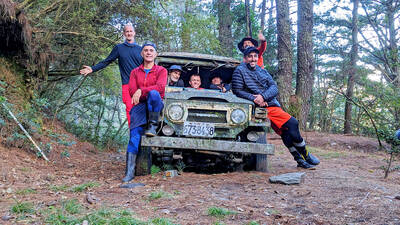
The year was 1991. A Toyota Land Cruiser set out on a 67km journey up the Junda Forest Road (郡大林道) toward an old loggers’ camp, at which point the hikers inside would get out and begin their ascent of Jade Mountain (玉山). Little did they know, they would be the last group of hikers to ever enjoy this shortcut into the mountains. An approaching typhoon soon wiped out the road behind them, trapping the vehicle on the mountain and forever changing the approach to Jade Mountain. THE CONTEMPORARY ROUTE Nowadays, the approach to Jade Mountain from the north side takes an

Last week Joseph Nye, the well-known China scholar, wrote on the Australian Strategic Policy Institute’s website about how war over Taiwan might be averted. He noted that years ago he was on a team that met with then-president Chen Shui-bian (陳水扁), “whose previous ‘unofficial’ visit to the US had caused a crisis in which China fired missiles into the sea and the US deployed carriers off the coast of Taiwan.” Yes, that’s right, mighty Chen caused that crisis all by himself. Neither the US nor the People’s Republic of China (PRC) exercised any agency. Nye then nostalgically invoked the comical specter
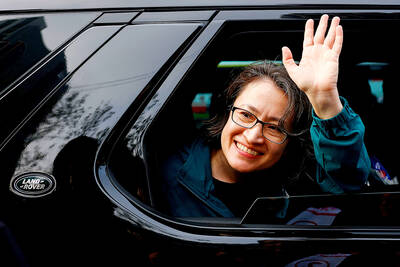
Relations between Taiwan and the Czech Republic have flourished in recent years. However, not everyone is pleased about the growing friendship between the two countries. Last month, an incident involving a Chinese diplomat tailing the car of vice president-elect Hsiao Bi-khim (蕭美琴) in Prague, drew public attention to the People’s Republic of China’s (PRC) operations to undermine Taiwan overseas. The trip was not Hsiao’s first visit to the Central European country. It was meant to be low-key, a chance to meet with local academics and politicians, until her police escort noticed a car was tailing her through the Czech capital. The
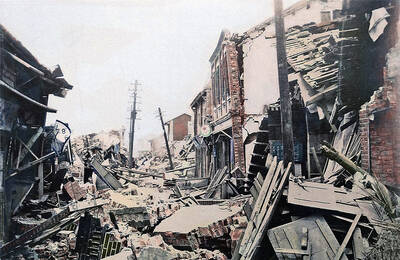
April 15 to April 21 Yang Kui (楊逵) was horrified as he drove past trucks, oxcarts and trolleys loaded with coffins on his way to Tuntzechiao (屯子腳), which he heard had been completely destroyed. The friend he came to check on was safe, but most residents were suffering in the town hit the hardest by the 7.1-magnitude Hsinchu-Taichung Earthquake on April 21, 1935. It remains the deadliest in Taiwan’s recorded history, claiming around 3,300 lives and injuring nearly 12,000. The disaster completely flattened roughly 18,000 houses and damaged countless more. The social activist and


 RSS
RSS