


Beneath Berlin's streets lies a forgotten world of bunkers and tunnels that tell tales of cruelty, suffering, escape and espionage.
Foreign visitors seeking remnants of the city's violent 20th century history search in vain for two of the main attractions -- the Wall and Adolf Hitler's bunker.
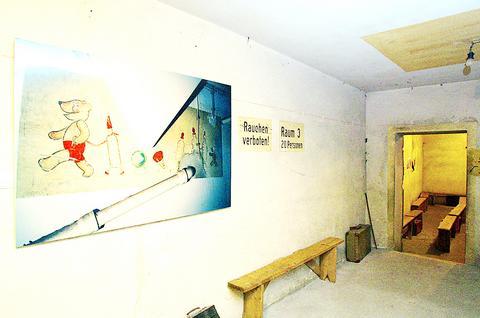
PHOTO: REUTERS
The Wall was torn down, save for a few short crumbling segments, and Hitler's bunker is covered by a car park.
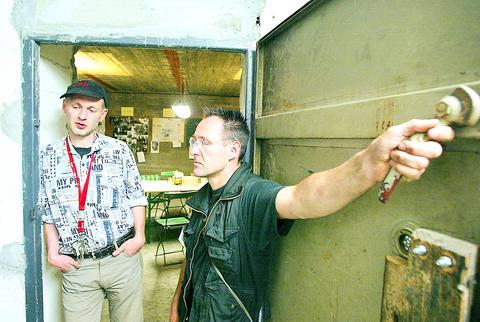
PHOTO: REUTERS
But some of the 1,000 World War II bunkers are intact and accessible, their echoing corridors, propaganda posters and instructions in Gothic script giving a sense of a past most Berliners would prefer to forget.
Luminous paint strips mark the way to emergency exits and cranks for manual air filters jut from the gray concrete. In one bunker, the walls are corroded by quicklime used to cover the dead from street fighting in the weeks before Berlin fell.
One bunker, next to the Gesundbrunnen underground station in central Berlin, contains suitcases, helmets, uniforms, bunk beds and a trove of items gathered from sites by members of the "Berlin Underground Association," which explores bunkers.
The Gesundbrunnen bunker was meant for ordinary citizens and is one of two sites where the association, made up of unpaid enthusiasts, conducts guided tours.
The bunkers of the Nazi elite, located under the city center between the Brandenburg Gate and Potsdamer Platz, in what used to be the Cold War wasteland between East and West Berlin, have been sealed for fear they may become neo-Nazi shrines.
"The city would rather not deal with its Nazi past buried in the ground," said Dietmar Arnold, a local historian who has explored the bunker system and leads tours.
"But we've noticed a lot of tourists come here and ask `Where is the Berlin Wall?' You can hardly show them anything. Then they ask, `Where was Hitler's bunker?'"
Arnold said it was "scandalous" that none of the city's bunkers had been placed under heritage protection. It would even be worth re-opening Hitler's bunker, he said.
The one-storey bunker measuring 15m by 20m lies underneath a car park in front of a modern block of flats close to the Holocaust memorial now under construction.
Communist authorities re-opened it in 1985, destroyed its 4m thick ceiling, and buried it again.
Opening the bunker would remove the mystery surrounding it, said Arnold. "If you combine it with a proper historical exhibition and have someone at the door to make sure only the right sort of people get in, it could be a significant site."
Petra Reetz, spokeswoman for the city's planning department, defended the decision to keep the bunker closed. She said, "We don't want a site where someone gets the idea to put up a candle on Hitler's birthday."
The so-called "Driver's Bunker" nearby, built for Hitler's chauffeurs, was uncovered in 1990 during a search for unexploded World War II bombs.
It contains giant wall paintings of SS troops holding large black shields to protect blonde women and children.
"Those SS comics are a curiosity and were documented and photographed. We consulted historians and concluded this was not of historic value," said Reetz. So the city filled the bunker with sand and sealed it.
Reetz denied Berlin's city government was ignoring its past by neglecting the bunkers.
"Bunkers make an important statement -- if you start a war don't be surprised if it comes back to you," she said. "But Berlin is penniless and has to make priorities. Besides, history stares you in the face above ground everywhere in this city."
By the end of the war the city, the most heavily bombed in Germany, could protect up to 800,000 people in its bunkers -- taking into account they were always three times overfilled.
Most of Berlin's more than 3 million people had to make do with less safe cellars. Bunkers were out of bounds to slave workers, of whom there were at least 200,000 in Berlin.
Civilian bombing victims during the war, estimated at between 18,000 and 50,000, were relatively low. Good air defense, strict Prussian building standards and wide boulevards prevented the firestorms that killed many tens of thousands in Dresden and Hamburg.
Crammed into bunkers as the bombs rained down, Berliners resorted to grim humor. "They would say Berlin was the only town in Germany where you could take the subway from the western to the eastern front," said bunker guide Juergen Mueller.
After the war, the Allies destroyed 80 percent of the bunkers under a program to demilitarize Germany.
But the Cold War brought new digging. Arnold knows of 30 escape tunnels from East to West Berlin, eight of them successful. Most were betrayed to East Germany's Stasi secret police.
Spies also built tunnels during the Cold War. The most famous, a US$30 million US-British project in 1954 to 1955, ran 443m from a US radar station in the Rudow district of Berlin to the Soviet sector.
Codenamed "Operation Gold," the aim was to tap Soviet telephone lines. It appeared to be a success initially, until it emerged that a British double agent, George Blake, had betrayed the project early on.

Last week Joseph Nye, the well-known China scholar, wrote on the Australian Strategic Policy Institute’s website about how war over Taiwan might be averted. He noted that years ago he was on a team that met with then-president Chen Shui-bian (陳水扁), “whose previous ‘unofficial’ visit to the US had caused a crisis in which China fired missiles into the sea and the US deployed carriers off the coast of Taiwan.” Yes, that’s right, mighty Chen caused that crisis all by himself. Neither the US nor the People’s Republic of China (PRC) exercised any agency. Nye then nostalgically invoked the comical specter
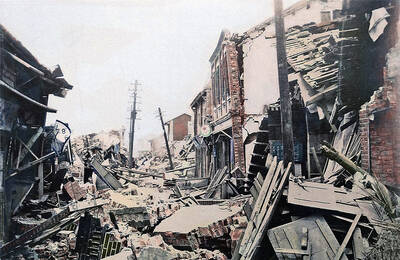
April 15 to April 21 Yang Kui (楊逵) was horrified as he drove past trucks, oxcarts and trolleys loaded with coffins on his way to Tuntzechiao (屯子腳), which he heard had been completely destroyed. The friend he came to check on was safe, but most residents were suffering in the town hit the hardest by the 7.1-magnitude Hsinchu-Taichung Earthquake on April 21, 1935. It remains the deadliest in Taiwan’s recorded history, claiming around 3,300 lives and injuring nearly 12,000. The disaster completely flattened roughly 18,000 houses and damaged countless more. The social activist and

Over the course of former President Ma Ying-jeou’s (馬英九) 11-day trip to China that included a meeting with Chinese Communist Party (CCP) leader Xi Jinping (習近平) a surprising number of people commented that the former president was now “irrelevant.” Upon reflection, it became apparent that these comments were coming from pro-Taiwan, pan-green supporters and they were expressing what they hoped was the case, rather than the reality. Ma’s ideology is so pro-China (read: deep blue) and controversial that many in his own Chinese Nationalist Party (KMT) hope he retires quickly, or at least refrains from speaking on some subjects. Regardless

Approaching her mid-30s, Xiong Yidan reckons that most of her friends are on to their second or even third babies. But Xiong has more than a dozen. There is Lucky, the street dog from Bangkok who jumped into a taxi with her and never left. There is Sophie and Ben, sibling geese, who honk from morning to night. Boop and Pan, both goats, are romantically involved. Dumpling the hedgehog enjoys a belly rub from time to time. The list goes on. Xiong nurtures her brood from her 8,000 square meter farm in Chiang Dao, a mountainous district in northern Thailand’s


 RSS
RSS