


The first collisions and explosions have already happened and the alarm bells are ringing: our planet is slowly walling itself in with a dangerous mass of speeding space junk.
Russian space debris experts and their US colleagues at NASA count up to 10,000 objects over 10cm in diameter that circle the earth, a silent armada of mankind's mess -- spent rocket stages and satellites, pieces of exploded and lost space equipment.
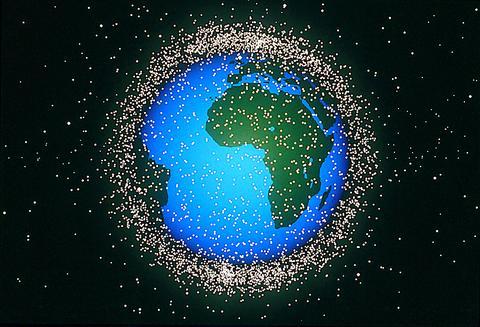
PHOTO: DPA
Then there are more than 100,000 objects between 1cm to 10cm, too small to be tracked by radar like the first category but potentially just as dangerous. These include nuts, bolts and other remnants.
Moving with an average relative velocity of about 10km a second they can wreck a satellite or, in the worst case scenario, rip into a manned spacecraft or even the International Space Station (ISS).
Even a tiny particle of a few millimeters will pierce an astronaut's space suit like a sniper's bullet if he is working outside.
"You essentially play the odds in this question of space debris -- it's part of the mission you have no control over," said William Johnson, an American radar designer and participant in NASA missions.
"Debris isn't an issue in interplanetary missions but in earth missions it is, especially on manned ones. What you worry about is paint flakes -- if one of those hits you, it'll make your day!"
Russian experts point out that for the time being, the odds are on our side, although freak incidents are occurring more often.
"For the most populated orbits the average probability is that a serious incident may happen once in 15 to 20 years, so the risk can still be considered acceptable," said Sergey Kulik, debris specialist at the Rosaviakosmos aerospace agency in Moscow.
He likes the comparison with a swimmer in the ocean -- he knows there are man-eating sharks out there somewhere but he can't fret about it every time he takes a dip.
But what if those sharks were to breed at an exponential rate?
At the current pace of cosmic littering, the coming years are predicted to bring our spacefaring species down to earth with a bump.
Called collisional cascading, or the Kessler effect (named after the former chief of the US orbital debris program, Donald Kessler), the process involves chunks of debris colliding and shattering into many smaller pieces that will hit others and so on.
"If his estimates prove to be true it could become impossible to fly in space. The probability that you'd get holed would increase drastically," says Kulik.
Kessler predicted the process will begin around 2030, although some scientists in the field believe it has already.
Another critical factor today is orbital explosions, often caused by chemical reactions in dregs of fuel in old spacecraft. More than 100 rockets and satellites have reportedly blown up in space.
The most debris created by one of these was when the upper stage of a US Pegasus rocket exploded in 1996, two years after it was launched. The burst generated a cloud of some 300,000 fragments larger than 4mm, 700 of which were over 10cm and large enough to be catalogued and tracked.
Other incidents in recent years show that the debris question isn't just the imaginary bogeyman of space exploration.
In the same year as the Pegasus blast, the French Cerise satellite was knocked out by a fragment of an exploded Ariane rocket stage in the first recorded debris collision.
The Hubble Space Telescope was also later found to have a hole punched in one of its solar panels. More worryingly, something struck a window on the ISS in February last year, leaving a sizeable impact mark.
Work is underway to fit the ISS with shields that will withstand impact by up to 1cm-big objects. In the case of 1cm to 10cm chunks, the ones not tracked by radar, the odds are the only protection.
Since it went into orbit in 1998, the outpost performed six evasive maneuvers as satellites and large pieces of debris came close to its flight path 400km above the earth.
A limited cleansing effect is observed in lower orbits of up to 600km, as gravitational pull and low aerodynamic drag slowly sucks debris into the atmosphere where it incinerates.
There is no such relief in higher orbits. One concern is our steady pollution of the geostationary orbit 36,000km from the planet, invaluable to mankind because satellites deployed here hold the same point above the earth's surface.
Since much of the overall clutter in space is caused by old satellites -- there are about 750 in operation, all of which will eventually become refuse -- one goal that is agreed upon by space agencies, is to dispose of them properly.

Last week Joseph Nye, the well-known China scholar, wrote on the Australian Strategic Policy Institute’s website about how war over Taiwan might be averted. He noted that years ago he was on a team that met with then-president Chen Shui-bian (陳水扁), “whose previous ‘unofficial’ visit to the US had caused a crisis in which China fired missiles into the sea and the US deployed carriers off the coast of Taiwan.” Yes, that’s right, mighty Chen caused that crisis all by himself. Neither the US nor the People’s Republic of China (PRC) exercised any agency. Nye then nostalgically invoked the comical specter

Relations between Taiwan and the Czech Republic have flourished in recent years. However, not everyone is pleased about the growing friendship between the two countries. Last month, an incident involving a Chinese diplomat tailing the car of vice president-elect Hsiao Bi-khim (蕭美琴) in Prague, drew public attention to the People’s Republic of China’s (PRC) operations to undermine Taiwan overseas. The trip was not Hsiao’s first visit to the Central European country. It was meant to be low-key, a chance to meet with local academics and politicians, until her police escort noticed a car was tailing her through the Czech capital. The
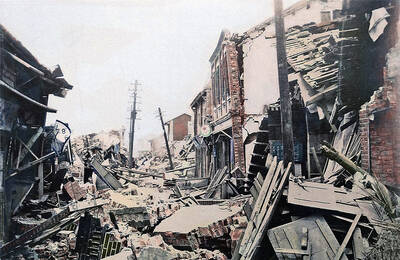
April 15 to April 21 Yang Kui (楊逵) was horrified as he drove past trucks, oxcarts and trolleys loaded with coffins on his way to Tuntzechiao (屯子腳), which he heard had been completely destroyed. The friend he came to check on was safe, but most residents were suffering in the town hit the hardest by the 7.1-magnitude Hsinchu-Taichung Earthquake on April 21, 1935. It remains the deadliest in Taiwan’s recorded history, claiming around 3,300 lives and injuring nearly 12,000. The disaster completely flattened roughly 18,000 houses and damaged countless more. The social activist and

Over the course of former President Ma Ying-jeou’s (馬英九) 11-day trip to China that included a meeting with Chinese Communist Party (CCP) leader Xi Jinping (習近平) a surprising number of people commented that the former president was now “irrelevant.” Upon reflection, it became apparent that these comments were coming from pro-Taiwan, pan-green supporters and they were expressing what they hoped was the case, rather than the reality. Ma’s ideology is so pro-China (read: deep blue) and controversial that many in his own Chinese Nationalist Party (KMT) hope he retires quickly, or at least refrains from speaking on some subjects. Regardless


 RSS
RSS