


Johann Strauss named an operetta after him, and Mozart fashioned a character like him in The Magic Flute. William Blake rhapsodized about him, and Alexandre Dumas immortalized him in a 10-volume historical romance. Thomas Carlyle and Walter Benjamin philosophized about him. Orson Welles and Christopher Walken went Hollywood with him, portraying him on the big screen. The Prince of Wales entertained him, while Catherine the Great hounded him out of Russia. Napoleon credited him with starting the French Revolution. Casanova spied on him. Louis XVI and Marie Antoinette locked him in the Bastille, while Pope Pius VI set the Roman Inquisition after him.
He himself claimed to be a healer, a seer, a magician and an alchemist who could create gold. He presented himself as a colonel, a count, the Great Copt, the mythical priest who founded Egyptian Masonry, and even the 1,400-year-old Wandering Jew. If he lived today, he would probably have his own television show, just after the psychic Jonathan Edwards.
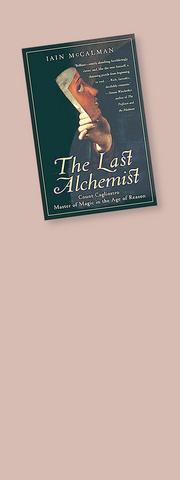
Count Alessandro de Cagliostro is one of those extraordinary figures who channel a particular historical moment while tapping into deeply eternal human drives.
Iain McCalman, the director of the Humanities Research Center at the Australian National University, has written a biography of this rogue. Such a notorious figure has many chroniclers, but if McCalman hasn't dug up new evidence, he has assembled a readable and compact life that gracefully weaves in the politics and passions of the age.
As McCalman relates, this remarkable man had unremarkable beginnings. Born Giuseppe Balsamo in 1743, he lived in one of the most poverty-stricken sections of Palermo, running a predatory street gang at one point, grifting suckers at another.
Yet Balsamo stood out from the run-of-the-mill thugs. A keen
intelligence, magnetic eyes and a golden tongue contributed to his powerful charisma. "He is the most extraordinary person I have ever met," wrote Elisa von der Recke, one of the numerous nobles who fell under his sway. And when Cagliostro's spiritual powers failed to woo, his lovely wife, Seraphina, offered more fleshy enticements to potential benefactors.
But Cagliostro needed the right vehicle for his attributes to catch hold. That came in 1776, during an unhappy sojourn in London, when he joined a Masonic lodge. "Entry into the secret world of Strict Observance Freemasonry at last gave Giuseppe a framework for his remarkable intelligence and ambition," McCalman writes. "Masonry became the crucible of his genius."
It provided a network of contacts and sympathizers throughout Europe and an aura of ancient mystery and magic that Cagliostro (a surname borrowed from an uncle) was able to exploit. He traveled from Warsaw to Paris, from London to St. Petersburg, holding seances, conjuring alchemical transmutations and healing slum dwellers and nobles alike.
The immense popularity of Cagliostro highlights the limits of such tidy nomenclature as "the Age of Reason." Periods of social upheaval -- whether in late 18th-century revolutionary France, late 19th-century industrializing America or post-Soviet Russia in the 1990s -- are often accompanied by popular fascination with the occult.
Remember that at this time, science still had a mystical side. Friedrich Anton Mesmer was using "animal magnetism" to hypnotize patients in Paris and Vienna, while the scientist Emanuel Swedenborg claimed to be in touch with spirits and angels.
When Cagliostro arrived in Paris in 1785, "a cult of Cagliostro" was already sweeping the city, McCalman writes. It was here that Cagliostro got entangled in the notorious "diamond necklace affair," in which Cardinal de Rohan was duped into buying an expensive diamond necklace that he believed to be for an infatuated Marie Antoinette but that was actually acquired by a scheming swindler, who sold the dazzling gems in London.
Cagliostro was imprisoned for his role in the affair, though he was eventually acquitted of all charges. But enemies of King Louis XVI seized on the lurid scandal to undermine the monarchy. Although Cagliostro was often a shrewd manipulator of people, he was obtuse when it came to politics. The radical lawyers who offered to defend him were using his case for their "political campaign to hobble the powers of the king and reform the parliament," McCalman writes.
He continues, "Without realizing it, Cagliostro had permitted himself to become a creature of politics, and there was a price to pay. From now on he would always be viewed through a lens of revolution or reaction."
He escaped temporarily to England. But what finally did him in was his seemingly devoted wife and collaborator of 21 years, Seraphina. Whether tired of their rootless life, nostalgic for the Catholicism of her youth or resentful of their shrinking purse, she sought escape. Unfortunately -- for her -- a plan to smear the steps of their home with soap failed to cause Cagliostro to slip and break his neck, so she decided on another scheme: to denounce him to the Roman Inquisition, so she could get an annulment and marry again.
The first part of her plot succeeded, and Cagliostro was arrested and convicted of heresy. While he spent his final days in solitary confinement in an Italian prison, Seraphina's tale of her own sexual collaboration was far too incendiary for the church to allow her to go free. She was confined to a convent, where she eventually went mad.

Last week Joseph Nye, the well-known China scholar, wrote on the Australian Strategic Policy Institute’s website about how war over Taiwan might be averted. He noted that years ago he was on a team that met with then-president Chen Shui-bian (陳水扁), “whose previous ‘unofficial’ visit to the US had caused a crisis in which China fired missiles into the sea and the US deployed carriers off the coast of Taiwan.” Yes, that’s right, mighty Chen caused that crisis all by himself. Neither the US nor the People’s Republic of China (PRC) exercised any agency. Nye then nostalgically invoked the comical specter
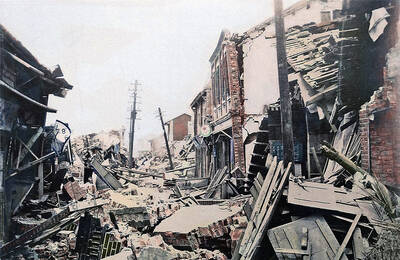
April 15 to April 21 Yang Kui (楊逵) was horrified as he drove past trucks, oxcarts and trolleys loaded with coffins on his way to Tuntzechiao (屯子腳), which he heard had been completely destroyed. The friend he came to check on was safe, but most residents were suffering in the town hit the hardest by the 7.1-magnitude Hsinchu-Taichung Earthquake on April 21, 1935. It remains the deadliest in Taiwan’s recorded history, claiming around 3,300 lives and injuring nearly 12,000. The disaster completely flattened roughly 18,000 houses and damaged countless more. The social activist and

Over the course of former President Ma Ying-jeou’s (馬英九) 11-day trip to China that included a meeting with Chinese Communist Party (CCP) leader Xi Jinping (習近平) a surprising number of people commented that the former president was now “irrelevant.” Upon reflection, it became apparent that these comments were coming from pro-Taiwan, pan-green supporters and they were expressing what they hoped was the case, rather than the reality. Ma’s ideology is so pro-China (read: deep blue) and controversial that many in his own Chinese Nationalist Party (KMT) hope he retires quickly, or at least refrains from speaking on some subjects. Regardless

Approaching her mid-30s, Xiong Yidan reckons that most of her friends are on to their second or even third babies. But Xiong has more than a dozen. There is Lucky, the street dog from Bangkok who jumped into a taxi with her and never left. There is Sophie and Ben, sibling geese, who honk from morning to night. Boop and Pan, both goats, are romantically involved. Dumpling the hedgehog enjoys a belly rub from time to time. The list goes on. Xiong nurtures her brood from her 8,000 square meter farm in Chiang Dao, a mountainous district in northern Thailand’s


 RSS
RSS