


Subtitled Female Same -- Sex Desire in Modern China, The Emerging Lesbian holds Taiwan in reserve until its final chapters. But when it eventually turns to the island, it comes out with all guns blazing. Taiwan, Sang Tze-lin (
American-style its arguments may be, but in a pan-Chinese context they are crucially important. The future, she argues, may show that Taiwan sowed the seeds of a modern Chinese lesbian identity which the mainland's same-sex-oriented women eventually followed.
The book, which started life as a Ph.D. thesis at Berkeley, California, is an academic work that looks at the evolution of lesbian politics in China, Hong Kong and Taiwan. It doesn't, despite its title and subtitle, find evidence of very much of an unbridled nature being done or publicly said in China. The absence of the free interchange of ideas there means that such groups as exist have had to express themselves in guarded, and especially non-political, language.

In Taiwan, however, things could hardly be more different. Taiwan's fiction about lesbian and gay sexuality in the 1990s became "voluminous" the author claims. She points to the "uncountable" number of MOTSS ("Members of the Same Sex") domains set up by students on the Internet BBS (Bulletin Board System) here. She points to Web sites such as that of Hong peiji ("G-zine"), described as an electronic journal featuring incisive feminist and lesbian commentary with intentionally "offensive" graphics, the work of a group at Taiwan's National Tsing Hua University. Another Taiwanese lesbian Web site she points to is that of the TO-GET-HER Lez Cyberpub. Furthermore, quoting a 1996 American source that focused on Taiwanese female same-sex culture, she states that there were, even seven years ago, over 30 lesbian bars ("T-bars" [T for tomboy]) in Taipei, Taichung and Kaohsiung where the clientele was "very young," generally between the ages of 14 and 23.
"The growth of these organizations throughout the 1990s in Taiwan is emblematic of the vitality and strength of the lesbian and feminist movements on the island," she writes. "The Taiwanese militant lesbian feminist persona is not just a new lesbian identity. It is an unprecedented public female identity, at least as far as the Chinese-speaking world is concerned."
It's important to underline just what the writer is saying here: Taiwan's lesbian presence represents, irrespective of sexual preferences, women standing up as a group in public in a way that has no parallel in any other part of the Chinese world. "We are left, then, with an intriguing question indeed," she goes on, "Whether the pointed critiques of the structuring of gender norms, differences, and hierarchies that Taiwanese lesbian feminists have advanced on the island for over a decade can catalyze similar developments on the mainland in the near future."
In discussing the remarkable upsurge of gay and lesbian writing here in the 1990s, Sang Tze-lan gives a lot of space to Qiu Miaojin (邱妙津), the author of The Crocodile's Journal (鱷魚手記), who took her own life in Paris in June 1995, aged 26. She considers the book "honest" and "questioning" and contrasts it favorably with "more ideologically-driven novels and short stories that certain queer theorists-cum-writers produced in 1990s Taiwan." Of course it's not all a bed of roses here for lesbians and gays.
Sang points an accusing finger at Taiwan's sensationalist and "schizophrenic" Chinese-language print and TV media, on the one hand ever eager to give publicity to gay and lesbian issues, yet on the other hand unable to resist falling back on satiric stereotypes.
Qiu Miaojin's book, too, gave a lot of space to (in Sang's words) satirizing the Taiwan media's "invention of homosexuals as a mystical, biologically distinct species." Nor is Sang uncritical of the flourishing study of gender and sexuality in Taiwan's universities.
Local academics who comment on the new fictional material so profusely, she says, have become TV and media personalities in their own right, despite their tendency to tirelessly cite Western queer theory. NTU and the National Central University are given as the powerhouses of this analytical and promotional discourse. Sang points out that in China, by contrast, not only was homosexuality unmentionable in public prior to the 1980s, but also that, even now, no major female writer there has yet publicly claimed a lesbian identity.
After considering the situation in imperial China, the book looks at Republican China (1911 to 1949) and sees at least a debate on the viability of female same-sex love there. It then moves on to analyze the work of some prominent feminist authors in the contemporary PRC. The two most important of these are Lin Bai (
Nevertheless, when Sang visited Beijing again, in 1998, she met a group of self-identified lesbians. When she asked if they planned to start a campaign, one of them significantly remarked, "We want life, not politics." In an obscure footnote, the author refers to Taiwan as "my native place" and China as "my ancestral land."
It's strange, therefore, that the book lacks interview material with Taiwanese writers. Nevertheless, the research into published material on Taiwan appears extremely thorough. What this book shows is what many people have long known, that Taiwan is the most progressive place for a gay and lesbian identity in all East Asia, with the possible exception of Japan.

In late October of 1873 the government of Japan decided against sending a military expedition to Korea to force that nation to open trade relations. Across the government supporters of the expedition resigned immediately. The spectacle of revolt by disaffected samurai began to loom over Japanese politics. In January of 1874 disaffected samurai attacked a senior minister in Tokyo. A month later, a group of pro-Korea expedition and anti-foreign elements from Saga prefecture in Kyushu revolted, driven in part by high food prices stemming from poor harvests. Their leader, according to Edward Drea’s classic Japan’s Imperial Army, was a samurai

Approaching her mid-30s, Xiong Yidan reckons that most of her friends are on to their second or even third babies. But Xiong has more than a dozen. There is Lucky, the street dog from Bangkok who jumped into a taxi with her and never left. There is Sophie and Ben, sibling geese, who honk from morning to night. Boop and Pan, both goats, are romantically involved. Dumpling the hedgehog enjoys a belly rub from time to time. The list goes on. Xiong nurtures her brood from her 8,000 square meter farm in Chiang Dao, a mountainous district in northern Thailand’s
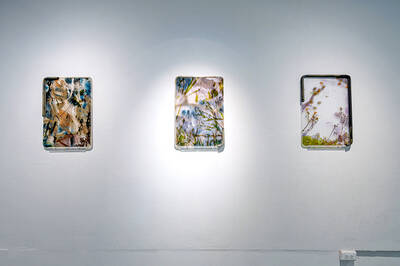
Located down a sideroad in old Wanhua District (萬華區), Waley Art (水谷藝術) has an established reputation for curating some of the more provocative indie art exhibitions in Taipei. And this month is no exception. Beyond the innocuous facade of a shophouse, the full three stories of the gallery space (including the basement) have been taken over by photographs, installation videos and abstract images courtesy of two creatives who hail from the opposite ends of the earth, Taiwan’s Hsu Yi-ting (許懿婷) and Germany’s Benjamin Janzen. “In 2019, I had an art residency in Europe,” Hsu says. “I met Benjamin in the lobby
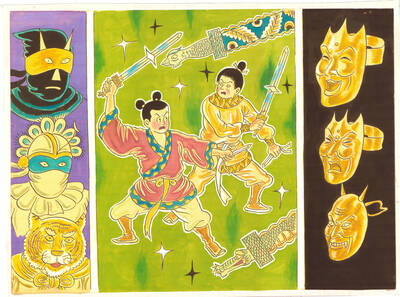
April 22 to April 28 The true identity of the mastermind behind the Demon Gang (魔鬼黨) was undoubtedly on the minds of countless schoolchildren in late 1958. In the days leading up to the big reveal, more than 10,000 guesses were sent to Ta Hwa Publishing Co (大華文化社) for a chance to win prizes. The smash success of the comic series Great Battle Against the Demon Gang (大戰魔鬼黨) came as a surprise to author Yeh Hung-chia (葉宏甲), who had long given up on his dream after being jailed for 10 months in 1947 over political cartoons. Protagonist


 RSS
RSS