


If you have never heard of Yu-Gi-Oh, and haven't realized that it is taking over the world, you are not alone.
Practically unnoticed by adults, this Japanese-devised trading card game has been spreading round the world, sucking pocket money out of boys' pockets faster than the monster characters in the Yu-Gi-Oh storyline can strike a blow.
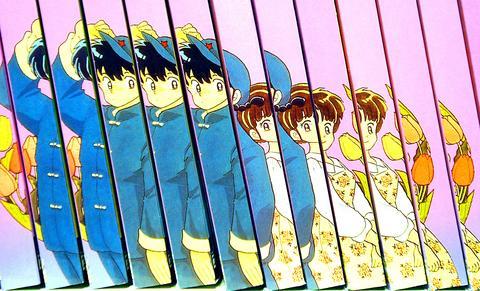
PHOTO: DPA
In German schoolyards in recent weeks, Yu-Gi-Oh trading cards have been an instant key to popularity. A boy fanning out his collection in a park can count on a dozen other kids showing up to rubber-neck at what he has got within a matter of seconds.
The cards show cartoon-style monsters and the game plan is based on the story of Yugi, a young boy who possesses a "Millennium Puzzle" that allows him to transform into a "Game King" when challenged. Players have to memorize game lore and complex points tables.
The German-language version of the cards went on sale in April, and leisure industry sources say the local licensee, Amigo, sold out the first two print runs despite startlingly high prices for the cards and is well into the third.
Children pay 7 euros (US$8) or more for an envelope containing nine of the trading cards, more than two weeks of the average boy's pocket money according to a recent survey of 6-to-14-year-olds by the TV channel Fox Kids.
The 3.43 euros a week registered by Fox rises to 10 euros a week for 13-to-17-year-olds, according to a separate survey by Cologne economic research institute IW in January, so the cards are more affordable for teens, who also know how to buy them second-hand on Internet auction sites like eBay.
Trade sources say retailers can choose whatever markup they like for the cards, and that Amigo wholesales them at the same price as its other big seller, Pokemon cards, which arrived in Germany in 1999.
Children interviewed in Hamburg say Pokemon cards currently retail at about half the price of a Yu-Gi-Oh pack. The industry has no compunction about squeezing the maximum price out of children: you can't learn soon enough that it's a cold, hard world out there.
Last week the European Commission opened distortion-of-competition proceedings against Topps, the company next up the rights chain, accusing it of ensuring Finnish children paid two and a half times as much for Pokemon cards in 2000 as Portuguese children did.
Competition Commissioner Mario Monti said Topps had enforced "a complete ban on exports" from low to high-price countries. Topps has assured the EU it now complies with competition rules.
The European market for stickers, cards and other collectible products bought by children was worth more than 600 million euros in the EU and Switzerland in 2000, according to EU estimates. With the profits so high, parallel imports of Yu-Gi-Oh cards into Germany are in full swing. Many children trade English-language versions of the cards, which are on sale in shops for slightly less. The game went on sale in Britain last year.
Huge numbers of forged cards are also in circulation.
Konami, the Japanese company behind the cards, has devised security features for Yu-Gi-Oh that come close to those used on banknotes:
holograms, fine print, difficult-to-copy colors.
It is not clear where the forgeries are coming from, but they are easily spotted by the practised eye: the hologram is often just a speck of blank aluminum foil, the cardboard is too thick or too thin, and the colors on the standard reverse of the card look wrong.
Ten-year-old boys generally don't notice till it is too late. Attempts to unwind fraudulent deals often lead to playground blows.
There is no indication that the police or the distributors are mounting any major effort to stop the counterfeits.
Instead, children are being encouraged to boycott any "unofficial" cards while playing.
In English-speaking countries, the fight against "illegitimate" cards is more complex, with the British distributors trying to keep out US Yu-Gi-Oh cards, the Americans trying to keep out "Asian English" cards, and so on.
The Yu-Gi-Oh storyline was devised by Japanese cartoonist Kazuki Takahashi, 41, originally appearing as a manga or comic 1996.
Yu-Gi-Oh! (the exclamation mark is part of the official logo) spawned a cartoon TV show, or anime, that began screening on Germany's RTL II television channel in March in a launch carefully coordinated with the collectibles and toy industries.
Unlike the Pokemon TV series, which contained simple stories of monster battles, the Yu-Gi-Oh anime revolves around the card game, which requires a deck of at least 40 cards, teaching viewers the rules and points system.
Games specialists say this has leveraged Yu-Gi-Oh into something bigger than Pokemon: 90 per cent of children simply collected and swapped the Pokemon cards, never catching on to the abstruse play rules.
Konami also aims to earn big from six video-games available for the GameBoy, PlayStation and other platforms. It says it has sold over 4 million units in North America since the series' debut there in March last year.
The big push of the Yu-Gi-Oh product has been under way in Europe since the Nuremberg Toy Fair in January, where Otto Umbach, the head of a German toyshop cooperative, noted that Yu-Gi-Oh licence earnings in Japan so far had totalled US$2 billion.
In Japan, more than 3.5 billion of the trading cards have been sold so far, Umbach said.
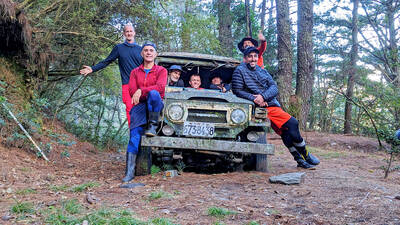
The year was 1991. A Toyota Land Cruiser set out on a 67km journey up the Junda Forest Road (郡大林道) toward an old loggers’ camp, at which point the hikers inside would get out and begin their ascent of Jade Mountain (玉山). Little did they know, they would be the last group of hikers to ever enjoy this shortcut into the mountains. An approaching typhoon soon wiped out the road behind them, trapping the vehicle on the mountain and forever changing the approach to Jade Mountain. THE CONTEMPORARY ROUTE Nowadays, the approach to Jade Mountain from the north side takes an

Last week Joseph Nye, the well-known China scholar, wrote on the Australian Strategic Policy Institute’s website about how war over Taiwan might be averted. He noted that years ago he was on a team that met with then-president Chen Shui-bian (陳水扁), “whose previous ‘unofficial’ visit to the US had caused a crisis in which China fired missiles into the sea and the US deployed carriers off the coast of Taiwan.” Yes, that’s right, mighty Chen caused that crisis all by himself. Neither the US nor the People’s Republic of China (PRC) exercised any agency. Nye then nostalgically invoked the comical specter

Relations between Taiwan and the Czech Republic have flourished in recent years. However, not everyone is pleased about the growing friendship between the two countries. Last month, an incident involving a Chinese diplomat tailing the car of vice president-elect Hsiao Bi-khim (蕭美琴) in Prague, drew public attention to the People’s Republic of China’s (PRC) operations to undermine Taiwan overseas. The trip was not Hsiao’s first visit to the Central European country. It was meant to be low-key, a chance to meet with local academics and politicians, until her police escort noticed a car was tailing her through the Czech capital. The
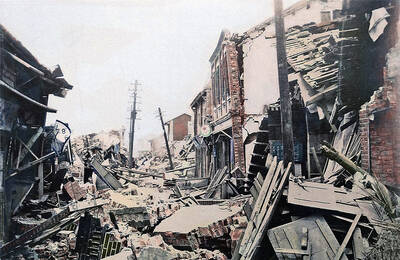
April 15 to April 21 Yang Kui (楊逵) was horrified as he drove past trucks, oxcarts and trolleys loaded with coffins on his way to Tuntzechiao (屯子腳), which he heard had been completely destroyed. The friend he came to check on was safe, but most residents were suffering in the town hit the hardest by the 7.1-magnitude Hsinchu-Taichung Earthquake on April 21, 1935. It remains the deadliest in Taiwan’s recorded history, claiming around 3,300 lives and injuring nearly 12,000. The disaster completely flattened roughly 18,000 houses and damaged countless more. The social activist and


 RSS
RSS