


For centuries, the mighty Incan empire has confounded researchers.
The Incas controlled territory up and down the spine of South America, with a sophisticated system of tributes and distribution that kept millions fed through the seasons. They built irrigation systems and stone temples in the clouds.
And yet they had no writing. For scholars, this has been like trying to imagine how the Romans could have administered their vast empire without written Latin.
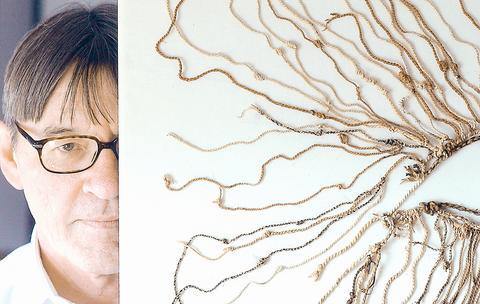
PHOTO: NY TIMES
Now, after more than a decade of fieldwork and research, a professor at Harvard University believes he has uncovered a language of binary code recorded in knotted strings -- a writing system unlike virtually any other.
The strings are found on "khipus," ancient Incan objects that look something like mops. About 600 khipus (also spelled "quipu") survive in museums and private collections, and archeologists have long known that the elaborately knotted strings of some khipus recorded numbers like an abacus. Harvard's Gary Urton said the khipus contain a wealth of overlooked information hidden in their construction details, like the way the knots are tied -- and that these could be the building blocks of a lost writing system which records the history, myths, and poetry of the Incas.
The theory has Incan scholars abuzz. The discovery of true Incan writing would revolutionize their field the same way that deciphering the Egyptian hieroglyphics or Mayan glyphs lifted a veil from those civilizations. But it also has broader interest because the khipus could constitute what is, to Western eyes, a very unorthodox writing system, using knots and strings in three dimensions instead of markings on a flat expanse of paper, clay, or stone.
"What makes this work so interesting is that what is being expressed is being conceptualized in such a different way than we conceptualize," said Sabine MacCormack, a historian of the Romans and the Incas who is a professor at the University of Notre Dame. "This is about an expression of the human mind, the likes of which we don't have elsewhere."
The only way to prove Urton's theory correct would be to translate the khipus, which no one has yet done. In his new book, he proposes a new method for transcribing the knotted strings which he believes could lead to breakthroughs. And his work, funded in part by a genius grant from the MacArthur Foundation, has helped fuel a resurgence of scholarly interest in khipus. Later this month, the Chilean Museum of Pre-Columbian Art in Santiago is opening the world's first exhibit dedicated to the khipu.
"We are on the cusp of a very hot period," said Frank Salomon, a professor of anthropology at the University of Wisconsin who has studied khipus extensively.
The khipu mystery dates to the early 16th century, when the Incas were conquered by Francisco Pizarro and the Spanish set about destroying their culture. The missionaries sent to South America tried to eliminate all touches of the old gods, including the strange stringed textiles that the Incas said held their histories.
The Spanish chroniclers often exaggerated, but they did record histories of tributes and other stories they said were "read" to them by khipukamayuq -- or knot keepers -- from strings of knots.
In 1923, researcher L. Leland Locke was able to show that many khipus recorded numbers like an abacus, with knots in positions representing the hundred's, ten's, or one's place. He concluded that khipus were an accounting tool and scholars largely lost interest.
Locke, however, missed many subtleties in the khipus, which could make them a richer tool for communication, said Urton, whose research was described in a recent issue of the journal Science, and whose new book is called Signs of the Inka Khipu.
The attention to khipus has its roots in insights from Marcia and Robert Ascher, a husband-and-wife team who began an extensive survey and analysis of khipus in 1968, and on the observations of Bill Conklin, a textile specialist at the Textile Museum in Washington, DC, who noticed that khipus were spun and tied in surprisingly complex and varied ways.
Urton is proposing a system for tackling the meaning of the knots. Each knot, Urton suggests, can be thought of as a series of decisions, such as whether to make it of cotton or wool, to tie the knot with a crossing string that begins in the upper left or the upper right, and to use string that is spun clockwise or counterclockwise.
Not all scholars are persuaded by Urton's ideas.
"I don't see that this proposal arises from the actuality of the khipus," said Marcia Ascher, an emerita professor of mathematics at Ithaca College. "I don't see it being shown to fit or explain any of them."
Using money from the National Science Foundation, Urton has undertaken a comprehensive project to record as many khipus as possible in great detail, including the binary information he says could be so important. He hopes to place it all in a single computer database and give access to other scholars and the public in the hopes that somebody will see ways to crack the code. He is being helped by Carrie Brezine, a weaver and database specialist who did her undergraduate thesis in mathematics.
Last week, Brezine brought in a printout of transcriptions taken from khipus found recently in a cave overlooking the Lake of the Condors in northern Peru. As he sat in his office, surrounded by Andean textiles, he noticed long strings of numbers that were virtually identical on three of the khipus -- an indication that information was being copied from one to another, the way medieval scribes copied books by hand.
"It was one of those eureka moments," he said with a boyish grin. "This is really cool."

In late October of 1873 the government of Japan decided against sending a military expedition to Korea to force that nation to open trade relations. Across the government supporters of the expedition resigned immediately. The spectacle of revolt by disaffected samurai began to loom over Japanese politics. In January of 1874 disaffected samurai attacked a senior minister in Tokyo. A month later, a group of pro-Korea expedition and anti-foreign elements from Saga prefecture in Kyushu revolted, driven in part by high food prices stemming from poor harvests. Their leader, according to Edward Drea’s classic Japan’s Imperial Army, was a samurai
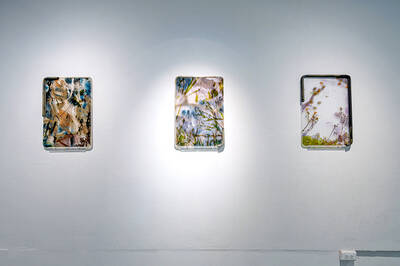
Located down a sideroad in old Wanhua District (萬華區), Waley Art (水谷藝術) has an established reputation for curating some of the more provocative indie art exhibitions in Taipei. And this month is no exception. Beyond the innocuous facade of a shophouse, the full three stories of the gallery space (including the basement) have been taken over by photographs, installation videos and abstract images courtesy of two creatives who hail from the opposite ends of the earth, Taiwan’s Hsu Yi-ting (許懿婷) and Germany’s Benjamin Janzen. “In 2019, I had an art residency in Europe,” Hsu says. “I met Benjamin in the lobby
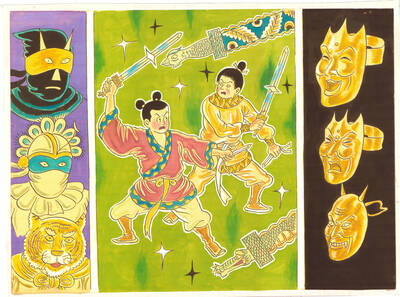
April 22 to April 28 The true identity of the mastermind behind the Demon Gang (魔鬼黨) was undoubtedly on the minds of countless schoolchildren in late 1958. In the days leading up to the big reveal, more than 10,000 guesses were sent to Ta Hwa Publishing Co (大華文化社) for a chance to win prizes. The smash success of the comic series Great Battle Against the Demon Gang (大戰魔鬼黨) came as a surprise to author Yeh Hung-chia (葉宏甲), who had long given up on his dream after being jailed for 10 months in 1947 over political cartoons. Protagonist

Peter Brighton was amazed when he found the giant jackfruit. He had been watching it grow on his farm in far north Queensland, and when it came time to pick it from the tree, it was so heavy it needed two people to do the job. “I was surprised when we cut it off and felt how heavy it was,” he says. “I grabbed it and my wife cut it — couldn’t do it by myself, it took two of us.” Weighing in at 45 kilograms, it is the heaviest jackfruit that Brighton has ever grown on his tropical fruit farm, located


 RSS
RSS