


"Treasure-hunting" in second-hand book stores was once a popular pastime. Up until the 1980s, there were over 100 shops selling second-hand, out-of-print and antique books on Taipei's Kuling Street (牯嶺街) alone. Many of these volumes had been brought over in the 1940s by immigrants from China.
Greater affluence means that most people are less inclined to invest time in searching through the often disorganized shelves of second-hand book stores to save a few dollars. For those involved in collecting, China itself has become a major supplier of antique books. For these reasons, the number of used book stores today has shrunk to around 40 in the greater Taipei and Keelung area and just over 100 around Taiwan, according to the Yuan-Liou (遠流) Publishing Web Site.
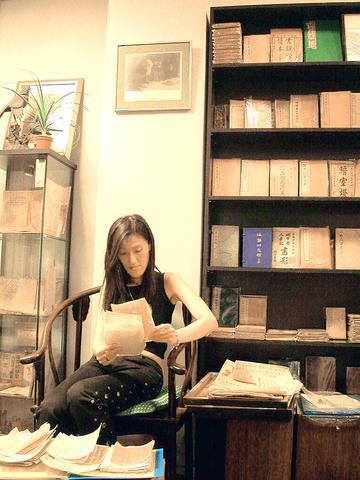
PHOTO: VICO LEE, TAIPEI TIMES
Some of these shops are small mom-and-pop operations with stacks of dust covered books stored in dimly-lit rooms, while others have become more organized outfits targeting budget-conscious readers. A few have decided to specialize in serving a new generation of well-educated and well-heeled collectors. This is the path taken by long time book aficionado Wu Ya-huei (吳雅慧), who runs Chiou Hsiang Chu (舊香居), which opened earlier this month near National Normal University.
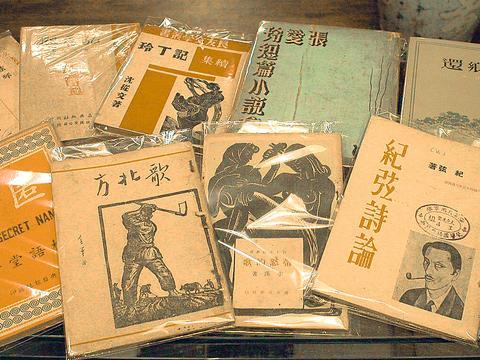
PHOTO: VICO LEE, TAIPEI TIMES
Wu, the 32-year-old proprietor, set up the store with two warehouses of Taiwanese, Chinese and other foreign-language collectible books. This collection was accrued since 1978, when Wu's father first set up an antique and used book store.
Having spent her most of her life among used and old books, Wu acquired a precocious knowledge of old books. This is combined with a understanding of the modern book market, which has contributed to the new operations success.
"Book collectors are not much different from collectors of other things, be they teddy bears, designer brands or celebrity memorabilia. They are usually ardent. Some are fervent, and some are even a little crazy," Wu said. "There are people who will pay any price for an autographed first-edition of a celebrated book by a favorite author. Just like fans collect autographed records by their favorite singer."
Nevertheless, Wu believes there's is something unique about books and book-collecting. "Of all things from the past, books best document the spirit of past ages. Just as archeologists study unearthed remains from ancient times, book lovers read old books to understand the past, " Wu said.
One section in Wu's shop displays hand-bound books from the Ming and Ching dynasties, brought by early immigrants from southern China. Two cabinets next to them display early Taiwanese publications. These were mostly collected by Wu's father decades ago. When they want to acquire more of these antiques, the Wus visit auction houses in Japan and Europe.
Many of Wu's customers are Westerners. "People worry that we might lose these cultural treasures forever if we sell them abroad. But books are meant to be circulated. When we find a valuable Chinese antique book on auction abroad, we can always go there and `bring them back home.'"
A first-edition of a novel by Lu Xun (魯迅), famous as the father of modern Chinese literature, costs over NT$2,000. Books of Eileen Chang (張愛玲), one of the most celebrated novelists active in the 1940s, are similarly priced. The most expensive are Ming dynasty book sets, which can cost tens of thousands of NT dollars. Placing prices on antique or rare books, according to Wu, is extremely difficult. Some books can be priceless.
"Antique books are valuable because people devoted themselves to the art of writing. Fifty years ago, a writer might spend 20 years working on a single book. Nowadays, no one does that. If a writer publishes a successful book, then he or she writes a slew of follow-ups in a couple of years. This way, content easily gets neglected. Today's authors may write good books, but in the end, good is not the same as classic.
"The deluge of information and acceleration of technology means that people have no patience with the slow accumulation of good content or with crafting and perfecting their books to create a masterpiece. That's why people revisit the classics again and again. Tsao Hsuei-chin's (曹雪芹) Dream of the Red Chamber (紅樓夢), like Shakespeare's plays, have been researched and interpreted by countless peopled through the ages. Despite all the new book titles in book stores today, people will still want to read Dream and collect antique copies of the book."
Wu observed that local collectors particularly sought after Chinese literature of the 1920s and 1930s, followed by Taiwanese literature from the 1940s and 1950s. Works such as Wu Cho-liu's (吳濁流) The Orphan of Asia (亞細亞的孤兒) and Kenneth Pai's (白先勇) Taipei People (臺北人) are much sought after, as are works of poetry, which though a marginal genre today, was very popular in the 1950s and 1960s.
Wu has on display a shelf of not-for-sale books that is part of the family's collection. One of them is An Infamous Riot (臺灣事變真相), an official account of the 228 Incident published for non-Taiwanese. Another is Notes on Visiting Taiwan (旅臺須知), a Taiwan provincial government publication, that is a handbook for Chinese visiting Taiwan. Published in May 1949, months before the KMT government's retreat to the island, it is an interesting sidelight to the history of that period.
"Books are never free of the influence of politics. These publications show that," Wu said.
While historical and literary scholars collect antique books for what is written in them, paper manufacturers buy them to study old techniques of printing, graphic-design, print-making and paper-making.
Just as collectors of antique furniture often lament the downfall of carpentry, Wu is generally pessimistic about new publications and doubts their collectibility 50 years from now. Only a limited amount, Wu predicts, will survive.
"Books on politics usually last, no matter in which era they are written. In the field of literature, gay literature stands a better chance of becoming collectible 50 years on, regardless of literary value, as it is a particular trend of this period of Taiwanese literature," Wu said.
Wu said that quality of the content decides books' collectibility. Another important factor is the political affiliations of the collectors.
"People have been collecting early Taiwanese literature for a long time. However, there has been a surge in its popularity in recent years, influenced by the political trend toward Taiwanese cultural identification."
As for the Internet, Wu said it would make little impact on her business. "Ancient books must be seen and felt. Besides, many collectors spend afternoons here not to buy books but to talk with us. Some want learn from us and other want to brag a little about their knowledge of books. Book collectors are like that."

In late October of 1873 the government of Japan decided against sending a military expedition to Korea to force that nation to open trade relations. Across the government supporters of the expedition resigned immediately. The spectacle of revolt by disaffected samurai began to loom over Japanese politics. In January of 1874 disaffected samurai attacked a senior minister in Tokyo. A month later, a group of pro-Korea expedition and anti-foreign elements from Saga prefecture in Kyushu revolted, driven in part by high food prices stemming from poor harvests. Their leader, according to Edward Drea’s classic Japan’s Imperial Army, was a samurai
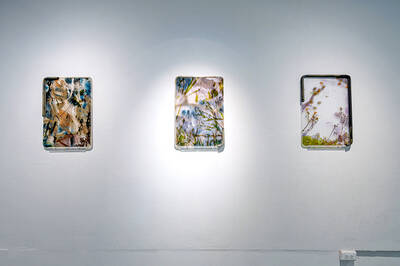
Located down a sideroad in old Wanhua District (萬華區), Waley Art (水谷藝術) has an established reputation for curating some of the more provocative indie art exhibitions in Taipei. And this month is no exception. Beyond the innocuous facade of a shophouse, the full three stories of the gallery space (including the basement) have been taken over by photographs, installation videos and abstract images courtesy of two creatives who hail from the opposite ends of the earth, Taiwan’s Hsu Yi-ting (許懿婷) and Germany’s Benjamin Janzen. “In 2019, I had an art residency in Europe,” Hsu says. “I met Benjamin in the lobby
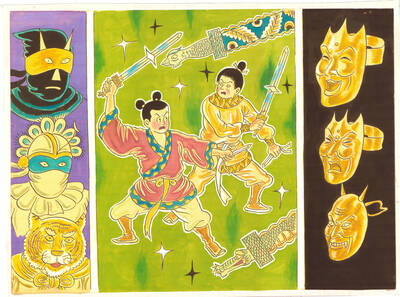
April 22 to April 28 The true identity of the mastermind behind the Demon Gang (魔鬼黨) was undoubtedly on the minds of countless schoolchildren in late 1958. In the days leading up to the big reveal, more than 10,000 guesses were sent to Ta Hwa Publishing Co (大華文化社) for a chance to win prizes. The smash success of the comic series Great Battle Against the Demon Gang (大戰魔鬼黨) came as a surprise to author Yeh Hung-chia (葉宏甲), who had long given up on his dream after being jailed for 10 months in 1947 over political cartoons. Protagonist

A fossil jawbone found by a British girl and her father on a beach in Somerset, England belongs to a gigantic marine reptile dating to 202 million years ago that appears to have been among the largest animals ever on Earth. Researchers said on Wednesday the bone, called a surangular, was from a type of ocean-going reptile called an ichthyosaur. Based on its dimensions compared to the same bone in closely related ichthyosaurs, the researchers estimated that the Triassic Period creature, which they named Ichthyotitan severnensis, was between 22-26 meters long. That would make it perhaps the largest-known marine reptile and would


 RSS
RSS