


Berliners young and old will gather on Thursday to hear the voice of John F. Kennedy delivering his famous, "Ich bin ein Berliner" speech which electrified listeners at the height of the Cold War four decades ago.
Relations between Germany and the US may have soured in recent years, but Berliners have never forgotten Kennedy's rallying call from the steps of Schoeneberger Town Hall in West Berlin to a crowd of 400,000 cheering residents and to a world worried about the prospect of nuclear war.
So, on Thursday afternoon, the 40th anniversary of the speech, crowds will gather again in front of Shoeneberger Town Hall in re-unified Berlin. Local dignitaries will join pupils from John F. Kennedy School and eyewitnesses to the June 26, 1963, speech in commemorating the anniversary.
And at precisely 6:44pm on Thursday -- with Prussian precision, Berliners remember the exact time -- loudspeakers will reverberate with a recording of Kennedy's historic words, delivered in English except for that one or two stirring sentences in badly accented German which sent West Berliners into a frenzy of cheering.
Standing on that portico, the slanting rays of sunlight on a balmy mid-summer's evening dramatically lighting his facial features, the young president's Boston Irish voice rang out over the crowd and across the rooftops as if he were trying to breach the Berlin Wall itself, only a short distance to the east.
"I am proud to come to this city as the guest of your distinguished mayor, who has symbolized throughout the world the fighting spirit of West Berlin," Kennedy said with a nod to Willy Brandt, who would use his popularity as West Berlin mayor as a springboard to the chancellorship and to a Nobel Peace Prize.
"And I am proud to visit the Federal Republic with your distinguished chancellor who for so many years has committed Germany to democracy and freedom and progress," Kennedy said with a nod in the other direction to craggy-faced Konrad Adenauer, the aging West German leader who, ironically, would out-live the young American and walk up Pennsylvania Avenue only a few months later in his funeral procession.
The formalities out of the way, Kennedy got down to the meat of the speech. "There are many people in the world who really don't understand, or say they don't, what is the great issue between the free world and the Communist world," he said. Then he paused.
"Let them come to Berlin," Kennedy bellowed. The crowd went wild.
"There are some who say that communism is the wave of the future." Another pause. "Let them come to Berlin."
He went on, "And there are some who say in Europe and elsewhere we can work with the Communists. Let them come to Berlin."
Addressing voices of opportunism he added, "And there are even a few who say that it is true that communism is an evil system, but it permits us to make economic progress."
Another pause before adding in German, "Lass' sie nach Berlin kommen. Let them come to Berlin."
With the crowd suitably energized, Kennedy settled into the stirring "freedom is indivisible" section of his speech, spelling out in terms anyone could understand how ludicrous, how inhumane, how intolerable the division of Berlin and of Germany truly was.
"When one man is enslaved, all are not free," he affirmed. "When all are free, then we can look forward to that day when this city will be joined as one and this country and this great continent of Europe in a peaceful and hopeful globe."
He had expressed the hopes of everyone in the crowd, living in an outpost of capitalism, a veritable island in a sea of communism. It was lonely to be a Berliner in those days and Kennedy addressed that sense of alone-ness by making Berlin universal.
"All free men, wherever they may live, are citizens of Berlin, and, therefore, as a free man, I take pride in the words `Ich bin ein Berliner.'"
There was no containing the crowd now. They cheered and they wept. And the cheering and weeping went on and on. The police were useless because they were cheering and the tears were streaming down their faces as well.
It did not matter that Kennedy's German was mangled, that an interpreter had pencilled the phonetic transliteration "Ish bin ine bear-LEAN-ar" on the margin of the text of his speech.
He had touched something deep inside his listeners and the response took him and everyone else on the podium aback. Not since Adolf Hitler had a Berlin crowd been so ecstatic. That was a sobering thought.
"Mr. President, I think you went too far," Kennedy's aide McGeorge Bundy said as they were whisked across town to Kennedy's next speaking appearance at Berlin's Free University. Chastened, Kennedy toned down the text for that venue.
That evening he flew to Ireland, never to return. Less than five months later he would be felled by an assassin's bullet and Berliners -- on both sides of the Wall -- would place candles in their windows.
And they would never forget his words to them and his confidence that Berlin would one day be re-united.
"When that day finally comes, as it will," he had told them that mid-summer's evening, "the people of West Berlin can take sober satisfaction in the fact that they were in the front lines."
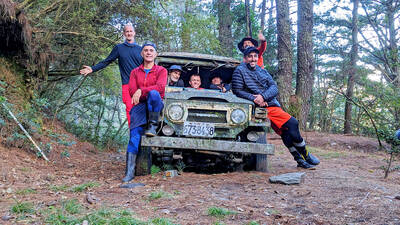
The year was 1991. A Toyota Land Cruiser set out on a 67km journey up the Junda Forest Road (郡大林道) toward an old loggers’ camp, at which point the hikers inside would get out and begin their ascent of Jade Mountain (玉山). Little did they know, they would be the last group of hikers to ever enjoy this shortcut into the mountains. An approaching typhoon soon wiped out the road behind them, trapping the vehicle on the mountain and forever changing the approach to Jade Mountain. THE CONTEMPORARY ROUTE Nowadays, the approach to Jade Mountain from the north side takes an

Last week Joseph Nye, the well-known China scholar, wrote on the Australian Strategic Policy Institute’s website about how war over Taiwan might be averted. He noted that years ago he was on a team that met with then-president Chen Shui-bian (陳水扁), “whose previous ‘unofficial’ visit to the US had caused a crisis in which China fired missiles into the sea and the US deployed carriers off the coast of Taiwan.” Yes, that’s right, mighty Chen caused that crisis all by himself. Neither the US nor the People’s Republic of China (PRC) exercised any agency. Nye then nostalgically invoked the comical specter
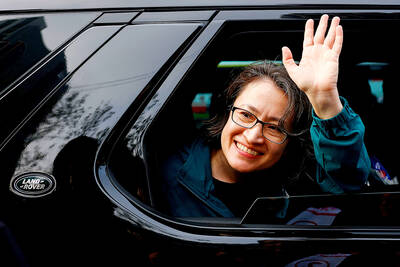
Relations between Taiwan and the Czech Republic have flourished in recent years. However, not everyone is pleased about the growing friendship between the two countries. Last month, an incident involving a Chinese diplomat tailing the car of vice president-elect Hsiao Bi-khim (蕭美琴) in Prague, drew public attention to the People’s Republic of China’s (PRC) operations to undermine Taiwan overseas. The trip was not Hsiao’s first visit to the Central European country. It was meant to be low-key, a chance to meet with local academics and politicians, until her police escort noticed a car was tailing her through the Czech capital. The
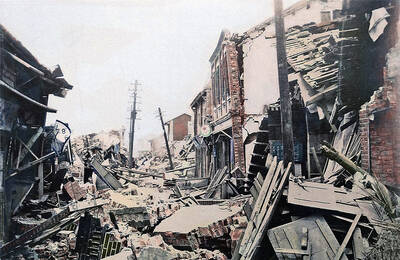
April 15 to April 21 Yang Kui (楊逵) was horrified as he drove past trucks, oxcarts and trolleys loaded with coffins on his way to Tuntzechiao (屯子腳), which he heard had been completely destroyed. The friend he came to check on was safe, but most residents were suffering in the town hit the hardest by the 7.1-magnitude Hsinchu-Taichung Earthquake on April 21, 1935. It remains the deadliest in Taiwan’s recorded history, claiming around 3,300 lives and injuring nearly 12,000. The disaster completely flattened roughly 18,000 houses and damaged countless more. The social activist and


 RSS
RSS