


To Karen Melnick, the Gulfstream Trailer Park here is a tidy community of narrow streets and close ties, where she pays less than US$500 a month rent and neighbors gather at a tiki hut to watch the sun set over the bay.
To developers in this Florida Keys city, where land is scarce, the park is a potential platform for 83 luxury apartments worth US$300,000 to US$1 million each.
So begins the battle for Gulfstream Trailer Park, as do fights for many older mobile home parks on prime real estate throughout the state.

PHOTO: NY TIMES
There are 849,000 mobile homes in Florida, the 2000 census reported, or 12 percent of the state's housing units. As the price of real estate has shot up, and suburban sprawl has reached its limits in some areas, many developers are looking at the ground beneath trailer parks as an underused resource.
That trend has Melnick and her neighbors fighting for their homes.
In February, she said, the park's owners announced that they had accepted an offer to sell the property. "They're telling us, when the developers take over, you have to go away," said Melnick, 53, who sells advertising space for three local radio stations. "This is where I thought I'd live the rest of my life. Where can you go for US$425 plus utilities? We've got nowhere to go."
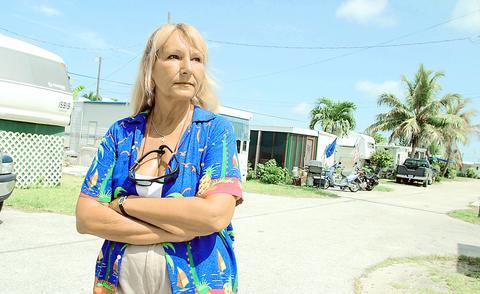
PHOTO: NY TIMES
Trailer parks containing a total of 3,000 homes closed in the last three years, said Don Hazelton, president of the Federation of Manufactured Home Owners of Florida, a tenants' group that has 56,000 members. In Hazelton's own hometown, Largo, the residents of 12 parks are facing eviction, he said.
To live in a trailer park like Gulfstream, one of more than 2,600 in Florida, is to occupy a precarious niche in the housing system. Residents at Gulfstream own their homes, which cost US$10,000 to US$40,000, but rent the land. Most homes are mobile in name only, too old or anchored to survive a move. As the value of real estate skyrocketed through the 1990s, park owners found they could make more redeveloping the land for houses or condominiums or selling to redevelopers.
"I can sympathize with the park owners," said Robert Cintron, a lawyer representing the tenants of Gulfstream. "They're getting below-market rent."
At the same time, said Joshua Mothner, a commercial loan officer in Marathon, without trailer parks the Keys' essential work force -- the teachers and police officers, hotel workers and bank tellers -- could not afford to live there. The price of houses in the area begins at around US$300,000, apartment rentals at about US$1,000 a month.
"I grew up on Shelter Island and saw this happen in the Hamptons," Mothner said, referring to the Long Island communities. "You lose whole strata of the population." Some workers already have two-hour bus rides to the area, often to jobs paying US$7 an hour, said Jeff Pinkus, a Marathon councilman.
Recently, Cintron stood on an empty lot on Route 1, the highway running the length of the Keys. Until last summer, the lot had been a 45-unit mobile home park called Coral Isle. Now an attractive sign at one end advertises "Key West's Newest Gated Community," with two- and three-bedroom apartments selling for just over US$300,000 to US$450,000. When the park owners sold the property to a redeveloper, only two of the homes could be moved; the others were left like litter.
"We all scattered," said David Ray, 48, a carpenter who left his 4m by 18m mobile home behind, and is now renting a trailer nearby. Moving his home would have cost US$18,000 to US$20,000, he said.
When owners decide to sell or redevelop a mobile home park, tenants have few legal protections. If they have formed a homeowners' association and registered with the state, they have the right to match the highest offer from a prospective buyer. Owners often prefer to sell to a well-financed developer. If tenants cannot buy the property, they may be eligible for a relocation payment of up to US$6,000, depending on the size of their trailers and whether they can be moved. After an eviction notice, residents have six months to move.
At Gulfstream, Cintron said, the owners, Frank and Roseanne Mauro, announced that they had sold the park, not giving residents a chance to match the offer. On behalf of the tenants, Cintron sued to block the sale before it could be finalized, citing the rights of a homeowners' association. Tenants say they believe the sale price was US$4 million to US$4.6 million.
Frank Mauro refused to be interviewed for this article. His lawyer, William N. DeVane, did not respond to phone calls. The buyers, Southstar of Tampa, said through their lawyer, Douglas M. Halsey, that they would not comment.
At Gulfstream, residents leave their doors unlocked and spend hot afternoons in a community pool. Recently, Dee Villa-Louis, 47, showed off her air-conditioned home, a single-wide with a sunroom added on, and one of the park's popular curiosities, her hot tub. Villa-Louis and her husband, Patrick Louis, who are retired, moved to the park from Colorado last year and settled quickly into the swing of Keys life.
When she bought her home and another nearby for her parents, she said, she had no warning that the land might be sold. Neither of her trailers can be moved. If the sale goes through, she said, her $30,000 investment will be worthless.
"We'll be OK," she said, "but what's going to happen to our neighbors? A lot of the older people here are on fixed incomes. They don't want to change."
A neighbor, Donna King, said her fortunes had already been affected by the prospect of redevelopment. King, 48, is a flight attendant for US Airways who has lived at Gulfstream for seven years, she said. When US Airways declared bankruptcy last year, King made plans to move to Charlotte, North Carolina.
King paid US$8,000 for her one-bedroom mobile home here and estimates that she put another US$4,000 into fixing it up. In a competitive market, she said, she could easily sell it for US$15,000. But since word circulated that Gulfstream might be destined for the bulldozer, no one is interested in buying there.
"I don't see how you can tell someone your house is now worthless," King said.
Under present law, homeowners and buyers often have no way of knowing whether a park might come up for sale or redevelopment, said Frank Williams, executive director of the Florida Manufactured Housing Association, a trade group that represents park owners, manufacturers and dealers. "How a consumer can deduce these things, I don't know," Williams said.
Most of the parks being redeveloped, he said, were built more than 30 years ago. "The economics no longer work" for park owners, he said. If buyers see an old community suddenly being surrounded by supermarkets and upscale developments, Williams said, "a light bulb should go off," adding, "But if they're moving into a modern retirement community, the chances of change are almost nil."
There are no official statistics on park age. Al Hesselbart, a historian of manufactured housing and recreational vehicles, estimates that about half of Florida's mobile home parks are more than 30 years old. He added that many of them would not be candidates for redevelopment.
Larry Shaffer, 52, a retired Navy chief warrant officer, moved to Gulfstream in 1997, when his previous trailer park, near Tampa, was closed to make room for a Home Depot.
When the Mauros announced in February that they were selling the park, Shaffer and others began meeting in the home of Emil Kuhn, a retired veterinarian who has spent winters in the park since 1986. Though they did not have an active homeowners association, they found documents they say show that a homeowners organization had incorporated in 1982 and never disbanded.
Shaffer said the residents would have no trouble raising the money to buy the park -- roughly US$50,000 per homeowner -- and that mortgage and maintenance payments would not be much more than their current rents. The residents of a nearby trailer park, Lion's Lair, recently brought a successful suit to buy their property.
Even if the Gulfstream tenants' suit is successful, it will do little to ease the crunch for affordable housing in the Keys, said Debbie Love, president of the Middle Keys Community Land Trust, a nonprofit group formed to create and preserve affordable housing. Changes in state regulations have made it easier and cheaper for owners to evict tenants and redevelop trailer parks.
But she said public sentiment was starting to shift. Shaffer, motivated by his experience at Gulfstream, said he was resigning from the homeowners' board to run for city council, saying he wants to protect other parks. "I've been alone in the woods crying about this for years," Love said. "All of the sudden, a light has switched on."

In late October of 1873 the government of Japan decided against sending a military expedition to Korea to force that nation to open trade relations. Across the government supporters of the expedition resigned immediately. The spectacle of revolt by disaffected samurai began to loom over Japanese politics. In January of 1874 disaffected samurai attacked a senior minister in Tokyo. A month later, a group of pro-Korea expedition and anti-foreign elements from Saga prefecture in Kyushu revolted, driven in part by high food prices stemming from poor harvests. Their leader, according to Edward Drea’s classic Japan’s Imperial Army, was a samurai

Located down a sideroad in old Wanhua District (萬華區), Waley Art (水谷藝術) has an established reputation for curating some of the more provocative indie art exhibitions in Taipei. And this month is no exception. Beyond the innocuous facade of a shophouse, the full three stories of the gallery space (including the basement) have been taken over by photographs, installation videos and abstract images courtesy of two creatives who hail from the opposite ends of the earth, Taiwan’s Hsu Yi-ting (許懿婷) and Germany’s Benjamin Janzen. “In 2019, I had an art residency in Europe,” Hsu says. “I met Benjamin in the lobby

April 22 to April 28 The true identity of the mastermind behind the Demon Gang (魔鬼黨) was undoubtedly on the minds of countless schoolchildren in late 1958. In the days leading up to the big reveal, more than 10,000 guesses were sent to Ta Hwa Publishing Co (大華文化社) for a chance to win prizes. The smash success of the comic series Great Battle Against the Demon Gang (大戰魔鬼黨) came as a surprise to author Yeh Hung-chia (葉宏甲), who had long given up on his dream after being jailed for 10 months in 1947 over political cartoons. Protagonist

Peter Brighton was amazed when he found the giant jackfruit. He had been watching it grow on his farm in far north Queensland, and when it came time to pick it from the tree, it was so heavy it needed two people to do the job. “I was surprised when we cut it off and felt how heavy it was,” he says. “I grabbed it and my wife cut it — couldn’t do it by myself, it took two of us.” Weighing in at 45 kilograms, it is the heaviest jackfruit that Brighton has ever grown on his tropical fruit farm, located


 RSS
RSS