


In visiting Poland last month, President Bush took the time to go to Auschwitz and tour one of the most ghastly assaults to humanity in the history of mankind. After finishing his tour, he remarked, "And this site is also a strong reminder that the civilized world must never forget what took place on this site. May God bless the victims and the families of the victims, and may we always remember."
The next day, Bush was in St. Petersburg, Russia. While there, he did not make it up to the Solovetsky Islands, the site of the first camp of the gulag. Nor did he call upon the world to "always remember" the millions of people who perished in the Soviet concentration camps well before Auschwitz was constructed and well after Auschwitz was dismantled. The families of the victims of Soviet Communism -- much more numerous than the families who lost loved ones in Hitler's camps -- received no special blessing from the leader of the free world.
Bush should not be singled out for failing to remember the innocents killed in the gulag. Rarely do visiting dignitaries take time to remember the tragedies of Soviet Communism. The Russian state has done little to commemorate the millions who died or lived miserable lives inside the hundreds of camps scattered throughout the former Soviet Union. Tour buses do not haul visitors to Auschwitz-like memorials, because they do not exist. While private, informal memorials have sprouted, the Russian state and most of Russian society seem determined to avoid coming to grips with their Soviet past.

Strangely, the coming parliamentary elections in Russia will be dominated by two parties with historical links to the gulag. The forefathers of the Communist Party of the Russian Federation (not a Socialist or Social Democratic party) created the gulag. The informal head of Russia's other major political party, United Russia, is President Vladimir Putin, an alumnus of the KGB, the last incarnation of the Soviet secret police, which ran the gulag. Putin and the Communist Party leadership practice very different politics than their predecessors, but they have also spent very little energy recognizing the atrocities of their organizations' pasts.
Anne Applebaum, a columnist for The Washington Post, however, has not forgotten. In her new book, Gulag: A History, she is determined to make sure the victims of the Soviet concentration camps are remembered and their oppressors exposed. Her book is tragic testimony to how evil ideologically inspired dictatorships can be.
In the Soviet camps, as Applebaum documents in a straightforward, just-the-facts way, people were tortured and died in the most inhumane of ways -- packed in boxcars, lying in excrement, raped, starved, frostbitten or standing naked, hands and feet tied, exposed to swarms of mosquitoes. These are horrors of a scale and scope that few in Russia or the West can imagine.
Many of my students at Stanford have never even heard of the gulag. (Aleksandr Solzhenitsyn's account was published long ago.) However heavy and difficult the reading can be, this book should be a required text for every student of 20th-century history in Moscow, Russia, and Moscow, Idaho.
For scholars of the Soviet era, this book does not uncover shocking new material. It should now be known to all serious scholars that the camps began under Lenin and not Stalin. It should be recognized by all that people were sent to the camps not because of what they did, but because of who they were. Some may be surprised to learn about the economic function that the camps were designed to perform. Under Stalin, the camps were simply a crueler but equally inefficient way to exploit labor in the cause of building socialism than the one practiced outside the camps in the Soviet Union. Yet, even this economic role of the camps has been exposed before.
What is remarkable is that the facts about this monstrous system so well documented in Applebaum's book are still so poorly known and even, by some, contested. For decades, academic historians have gravitated away from event-focused history and toward social history. Yet, the social history of the gulag somehow has escaped notice. Compared with the volumes and volumes written about the Holocaust, the literature on the gulag is thin.
In one meticulously researched and well-written account, Applebaum's book makes an enormous contribution to filling the void. But rather than the last word, Gulag should serve as a foundation for a new literature. The book begins to answer many important questions, but more must be said.
Did Stalin really believe that the camps might re-educate enemies of the state into productive socialist citizens? Why were Stalin and his henchmen so obsessed with obtaining confessions? Why did they take so seriously judicial procedures? And all the classic debates about the Holocaust need to be asked systematically again with this case (and hopefully by others about camps in China, Cambodia and contemporary North Korea). How could the guards have been so cruel? What did these conspirators in genocide actually believe they were doing? Why did those interned in the camps not revolt? And in contrast to Hitler's death camps, why were so many gulag inmates released?
Applebaum advances our understanding of all these questions but also sets the stage for future scholars to take the analysis one step further. In academic circles, there can be no more excuses for neglect.
Nor in political circles. Bush should take Applebaum's book with him to his ranch this August. After reading it, he could never travel to Russia again without remembering the victims of Soviet concentration camps. If Solovetsky is too hard to get to, he might at least make the 10-minute drive from the Kremlin to the offices of Memorial, the Russian group dedicated to preserving the memory of Stalin's victims. From their modest offices, he might call upon the civilized world to "never forget."

In late October of 1873 the government of Japan decided against sending a military expedition to Korea to force that nation to open trade relations. Across the government supporters of the expedition resigned immediately. The spectacle of revolt by disaffected samurai began to loom over Japanese politics. In January of 1874 disaffected samurai attacked a senior minister in Tokyo. A month later, a group of pro-Korea expedition and anti-foreign elements from Saga prefecture in Kyushu revolted, driven in part by high food prices stemming from poor harvests. Their leader, according to Edward Drea’s classic Japan’s Imperial Army, was a samurai

Located down a sideroad in old Wanhua District (萬華區), Waley Art (水谷藝術) has an established reputation for curating some of the more provocative indie art exhibitions in Taipei. And this month is no exception. Beyond the innocuous facade of a shophouse, the full three stories of the gallery space (including the basement) have been taken over by photographs, installation videos and abstract images courtesy of two creatives who hail from the opposite ends of the earth, Taiwan’s Hsu Yi-ting (許懿婷) and Germany’s Benjamin Janzen. “In 2019, I had an art residency in Europe,” Hsu says. “I met Benjamin in the lobby
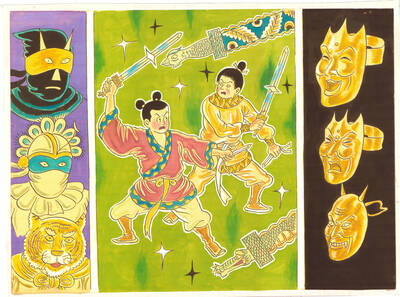
April 22 to April 28 The true identity of the mastermind behind the Demon Gang (魔鬼黨) was undoubtedly on the minds of countless schoolchildren in late 1958. In the days leading up to the big reveal, more than 10,000 guesses were sent to Ta Hwa Publishing Co (大華文化社) for a chance to win prizes. The smash success of the comic series Great Battle Against the Demon Gang (大戰魔鬼黨) came as a surprise to author Yeh Hung-chia (葉宏甲), who had long given up on his dream after being jailed for 10 months in 1947 over political cartoons. Protagonist

Peter Brighton was amazed when he found the giant jackfruit. He had been watching it grow on his farm in far north Queensland, and when it came time to pick it from the tree, it was so heavy it needed two people to do the job. “I was surprised when we cut it off and felt how heavy it was,” he says. “I grabbed it and my wife cut it — couldn’t do it by myself, it took two of us.” Weighing in at 45 kilograms, it is the heaviest jackfruit that Brighton has ever grown on his tropical fruit farm, located


 RSS
RSS