


There's a common misconception that escaping the smog of Taipei is a prolonged hassle if you rely on trains and buses -- but a day trip to Neiwan in Hsinchu County can easily soften even the most persistent public transportation pessimist.
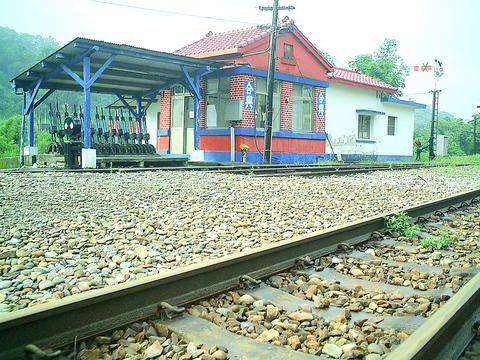
The Neiwan Line is one of three Taiwan Rail Administration lines that reach into the island's interior. Originally serving the mining and timber industries, these "small lines" as they're called now happily shuttle tourists to some of the nation's more quaint locations.
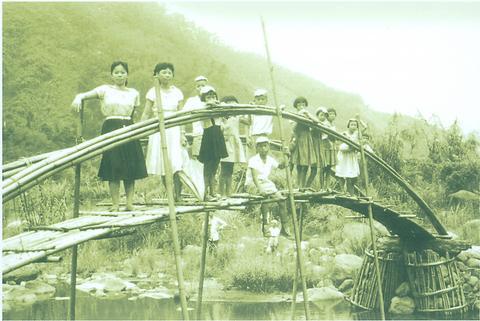
PHOTO COURTESY OF HENGSHAN COUNTY TOURISM BUREAU
And of these tourist-trod townships, perhaps none are worth a visit more than Neiwan.

While other townships in Taiwan hold festivals centered around kites, rocks and even windsocks to draw tourists, Neiwan's quiet charm suffices. It is this charm that has most famously drawn filmmakers to the township. Neiwan has provided the backdrop for several films, including Black Skin and White Teeth (
It's no surprise then that Wu chose to shoot his film in Neiwan, as the town itself retains a strong Japanese feel. During the Japanese occupation when the mountainsides surrounding the township were being pillaged of hardwoods, occupying soldiers found the local climate to be similar to Japan's Kyushu and therefore conducive to growing cherry trees. Not long afterward, enough of the trees were planted to earn Neiwan the moniker "city of cherry blossoms" (櫻花之都), and blanket the township in vivid pink blossoms at the end of winter.

Another floral attraction is found in mid-winter, when you'd least expect to see blossoms. Whole fields turn from green to bright yellow with the blooming of rapeseed flowers planted by farmers to fertilize their fields for spring.
This time of year, however, the main visual attraction is lightning bugs. In the 1970s, when the area became famous for them, huge clouds of the luminescent bugs would light up the forest and river valley at mid-evening. But even as scientists went to work classifying the various types (the area is home to at least six kinds of lightning bug), advances in pesticides and the aforementioned deforestation began decimating their numbers.
Nowadays, while there aren't enough to make the night bright, there are enough to brighten the spirits of young couples, who are happy to stroll hand-in-hand into the evening countryside in search of them.
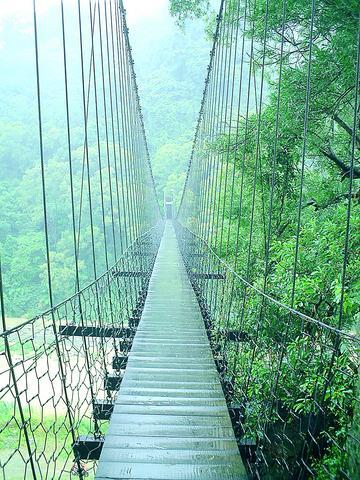
It's Neiwan's natural beauty that is its biggest draw and this asset has been accentuated by several trails that have been raked across the mountainsides. The Taisan Trail (
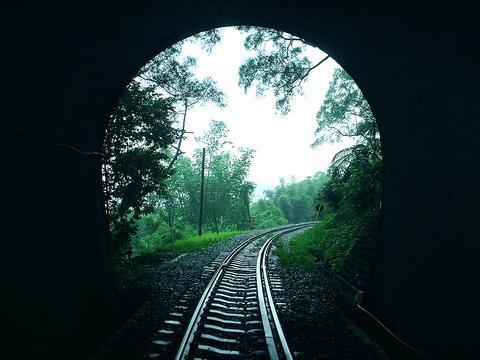
PHOTO: DAVID MOMPHARD, TAIPEI TIMES
Other popular -- and well paved -- trails are the Dachidong trail (大旗崠步道), the Chiling trail (騎步道) and the Teahouse trail (茶亭古道), all of which are less than 2km in length and can be walked leisurely within a couple hours. Besides the panoramic vistas, the highlights along each of these trails are waterfalls, bamboo forests and ancient stone structures, including the teahouse, sticky rice bridges (糯米 橋) and Yang family stone house.
Smaller trails will take you along the paths used by the old pulled wooden horse ( 拉木馬), which helped denude the forest. It consisted of a line of greased cedar logs and a wooden sled used to pull loads of cut timber. The hardwood remnants of it can still be seen in several locations in the hills above the town and along sections of the Neiwan Line and are worth searching for -- if not for the wooden trail itself, then for the several centuries-old hardwood trees that were left in place.

Legend has it that after cutting one of the oldest and biggest hardwood trees, several lumberjacks became ill. The timber crews then came to believe that the older trees had a spirit and refused to fell them. These ancient giants are easily spotted given the contrast in size between them and the new trees that have grown since deforestation stopped. One of the biggest of these trees can be seen in the town itself, adjacent the elementary school where a 200-year-old camphor tree rises out of the playground.

PHOTO: DAVID MOMPHARD, TAIPEI TIMES
Another site of interest in Neiwan village is the town theater built by the Japanese to entertain lumber and mining crews. The inside has been turned into a restaurant and crafts store, with displays of alcohol and cigarettes manufactured by the Taiwan Tobacco and Wine Monopoly over the decades.
The Hakka Culture Hall is located near the side of the river at the entrance to the Neiwan village and provides insight into the culture and customs of the area's Hakka population.
Most every street in the village contains something of interest and most are identified by life-sized cartoon characters, the creations of the county's most prominent citizen, cartoonist Liu Hsing-ching (
If fact, if your idea of a relaxing getaway is a location with plenty of quaint cafes and arts and crafts stores, Neiwan should rank high on your list of destinations. Tourism is now the town's mainstay industry and a stroll along Neiwan's streets makes that very apparent. But do yourself a favor and take a walk out of town before loading yourself down with souvenirs. You'll be glad you did.
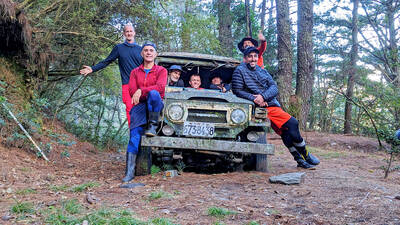
The year was 1991. A Toyota Land Cruiser set out on a 67km journey up the Junda Forest Road (郡大林道) toward an old loggers’ camp, at which point the hikers inside would get out and begin their ascent of Jade Mountain (玉山). Little did they know, they would be the last group of hikers to ever enjoy this shortcut into the mountains. An approaching typhoon soon wiped out the road behind them, trapping the vehicle on the mountain and forever changing the approach to Jade Mountain. THE CONTEMPORARY ROUTE Nowadays, the approach to Jade Mountain from the north side takes an

Last week Joseph Nye, the well-known China scholar, wrote on the Australian Strategic Policy Institute’s website about how war over Taiwan might be averted. He noted that years ago he was on a team that met with then-president Chen Shui-bian (陳水扁), “whose previous ‘unofficial’ visit to the US had caused a crisis in which China fired missiles into the sea and the US deployed carriers off the coast of Taiwan.” Yes, that’s right, mighty Chen caused that crisis all by himself. Neither the US nor the People’s Republic of China (PRC) exercised any agency. Nye then nostalgically invoked the comical specter

Relations between Taiwan and the Czech Republic have flourished in recent years. However, not everyone is pleased about the growing friendship between the two countries. Last month, an incident involving a Chinese diplomat tailing the car of vice president-elect Hsiao Bi-khim (蕭美琴) in Prague, drew public attention to the People’s Republic of China’s (PRC) operations to undermine Taiwan overseas. The trip was not Hsiao’s first visit to the Central European country. It was meant to be low-key, a chance to meet with local academics and politicians, until her police escort noticed a car was tailing her through the Czech capital. The
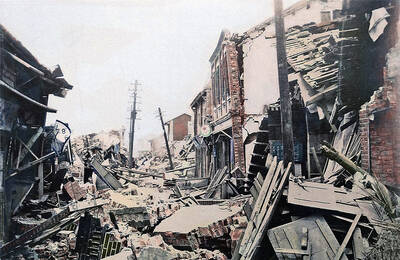
April 15 to April 21 Yang Kui (楊逵) was horrified as he drove past trucks, oxcarts and trolleys loaded with coffins on his way to Tuntzechiao (屯子腳), which he heard had been completely destroyed. The friend he came to check on was safe, but most residents were suffering in the town hit the hardest by the 7.1-magnitude Hsinchu-Taichung Earthquake on April 21, 1935. It remains the deadliest in Taiwan’s recorded history, claiming around 3,300 lives and injuring nearly 12,000. The disaster completely flattened roughly 18,000 houses and damaged countless more. The social activist and


 RSS
RSS