


By the time you read this, the waters of the Yangtze River (長江) have risen up to 135m above sea-level because of China's new Three Gorges Dam (三峽大壩), marking the beginning of the final stage of construction of the world's biggest hydro-electric project.
When completed in 2009, it will have cost over US$25 billion. The 26 generators at the Three Gorges Hydropower Plant will have a capacity of 18,200 megawatts, 40 percent more than that of the Paraguayan-Brazilian Itaipu, the biggest hydropower plant at present.
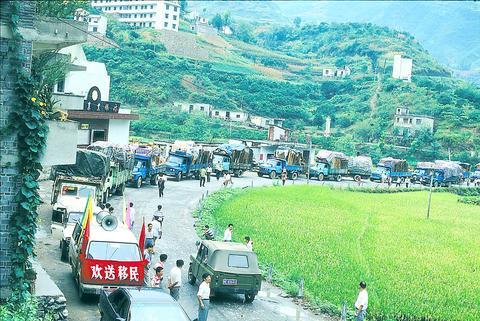
PHOTO COURTESY OF RHYTHMS MONTHLY
To make way for the 39.3 billion square meters, 1.13 million residents from 13 cities, 140 towns and 1,300 villages in Hubei and Sichuan provinces were forced to relocate before the their hometowns were submerged in water.
The Three Gorges scenery, which has inspired numerous poets throughout history, has been changed forever by the "Great Wall on the Yangtze River."
Since construction started on the dam in 1993, media from China, Hong Kong and Taiwan, have documented the historical project. There have been TV documentaries on the waves of relocation and the dam's spectacular construction, and written accounts of the project have multiplied.
In San Xia Ji (三峽記), a new book by dozens of photographers and writers across the Taiwan Strait, the dam is seen in an archeological, geographical and technological light, in relation to Chinese literature and the history of national heroes.
To accompany the book's launch last Tuesday, a photo exhibition showed various aspects of the landmark. The 80 medium-scale photos were taken mostly by photographers working on the Three Gorges Dam for a long time, including Zheng Yufeng (鄭雲峰), a freelance Chinese photographer who has been working on the project for seven years, and is still shooting there now.
A self-appointed witness to the dam project, Zheng has produced, from his rented fishing boat, memorable images of both journalistic significance and high aesthetic standards. His ingeniously composed pictures of the Yangtze River serve as a solemn commemoration of the breathtaking landscape that will never be the same.
Zhou Hao (周浩), another Chinese photographer who is exhibiting, documented the last festival at Zhang Fei (張飛) Temple in Sichuan's Yunyang (雲陽), before the reservoir started operating on June 1. The picture of crowded worshippers' faces reflecting the surrounding red candlelight captures the subtle emotions of the Yunyang residents in their last ever community event.
Captions for the images of relocating residents are mostly sorrowful, even indulgent and sentimental, which is a pity for an exhibition aiming to bear objective witness to a historic project.
Among the selection of photographs are well known Chinese documentary photographer Yang Yankang's (
San Xia Ji photo exhibition will run until July 25 at Tzuchi (慈濟) Foundation Songshan Branch, 16F, No. 188, Nanjing E Rd, Sec 5, Taipei. (台北市105松山區南京東路5段188號16樓).

Last week Joseph Nye, the well-known China scholar, wrote on the Australian Strategic Policy Institute’s website about how war over Taiwan might be averted. He noted that years ago he was on a team that met with then-president Chen Shui-bian (陳水扁), “whose previous ‘unofficial’ visit to the US had caused a crisis in which China fired missiles into the sea and the US deployed carriers off the coast of Taiwan.” Yes, that’s right, mighty Chen caused that crisis all by himself. Neither the US nor the People’s Republic of China (PRC) exercised any agency. Nye then nostalgically invoked the comical specter

Relations between Taiwan and the Czech Republic have flourished in recent years. However, not everyone is pleased about the growing friendship between the two countries. Last month, an incident involving a Chinese diplomat tailing the car of vice president-elect Hsiao Bi-khim (蕭美琴) in Prague, drew public attention to the People’s Republic of China’s (PRC) operations to undermine Taiwan overseas. The trip was not Hsiao’s first visit to the Central European country. It was meant to be low-key, a chance to meet with local academics and politicians, until her police escort noticed a car was tailing her through the Czech capital. The
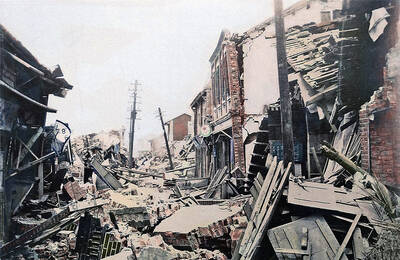
April 15 to April 21 Yang Kui (楊逵) was horrified as he drove past trucks, oxcarts and trolleys loaded with coffins on his way to Tuntzechiao (屯子腳), which he heard had been completely destroyed. The friend he came to check on was safe, but most residents were suffering in the town hit the hardest by the 7.1-magnitude Hsinchu-Taichung Earthquake on April 21, 1935. It remains the deadliest in Taiwan’s recorded history, claiming around 3,300 lives and injuring nearly 12,000. The disaster completely flattened roughly 18,000 houses and damaged countless more. The social activist and

Over the course of former President Ma Ying-jeou’s (馬英九) 11-day trip to China that included a meeting with Chinese Communist Party (CCP) leader Xi Jinping (習近平) a surprising number of people commented that the former president was now “irrelevant.” Upon reflection, it became apparent that these comments were coming from pro-Taiwan, pan-green supporters and they were expressing what they hoped was the case, rather than the reality. Ma’s ideology is so pro-China (read: deep blue) and controversial that many in his own Chinese Nationalist Party (KMT) hope he retires quickly, or at least refrains from speaking on some subjects. Regardless


 RSS
RSS