


It is very hard to write an even-handed review in Taiwan of any book by John Pilger. Taiwan arguably relies heavily on the US for its continued existence, yet Pilger's controlling belief is that the US is the center of all evil, and (apart from its wicked ally the UK) the only real rogue state. In The New Rulers of the World, Pilger focuses mainly on three countries -- Indonesia, Iraq and his native Australia. But he does also offer an overview of global power politics from his own radical perspective in one chapter, "The Great Game."
He opens by comparing the modern state of world affairs with George Orwell's 1984. We are entering a state of permanent war, he claims, justified by the creation of a total enemy, and almost all the information we receive is government disinformation to back up that state of affairs. The reality, Pilger would say, is that the US is gearing up to rule the world, crush all freedom movements, and view all political situations from a single perspective -- whether or not they benefit US commercial interests. Britain is tagging along in the hope of a few crumbs from the rich man's table. The rest is icing on a cake that will break your jaw if you even try to bite it.

Pilger's background is in Australian labor activism, and he has, he claims, spent half a lifetime championing Aboriginal rights in his native country. A searing chapter in this book catalogues the abuses these people have suffered. What arguments might be deployed, then, to counter or qualify Pilger's claims?
First, that though it is true that all very powerful states tend to create empires, both to supply themselves with reliable sources of cheap materials and as compliant markets for their manufactured goods, this is not invariably to the client states' disadvantage. The modern British are undeniably proud to have once been part of the Roman Empire, for example. Furthermore, the benefits an advanced culture can bestow on a less developed one can be considerable. Rome ruled for its own gain, but it brought peace, law, education and an international perspective to many of its conquered peoples. Secondly, little notice is taken in this book of the evils attendant on the rule of powerful governments other than the US and the UK. The casualties of left-leaning administrations such as China, Cuba, North Korea and the former Soviet Union and its satellites don't get much space.
Perhaps Pilger would argue that these have already been over-publicized by the Western, capitalist media. Nonetheless, something in the way of a balance to Pilger's undeniably damning account would appear to be called for.
What appears as an interesting alternative to Pilger's crusading rhetoric, and his attendant black-and-white view of the world, is a realization that almost all power corrupts, and so do a great many schemes for money-making on a corporate scale. Workers are routinely exploited in many parts of the world, and by many different forms of business enterprise.
Furthermore, it's militarism in itself, rather than militarism
originating from one particular place, that's the enemy of us all. A definition of militarism is the control of government policy by the military for its own greater power and influence. This is a universal danger, and something that in the long run threatens everyone. It's not something confined, as Pilger would have it, to one particular power block.
For all his charismatic eloquence -- and he is very persuasive -- Pilger's is a Marxist analysis of the world, presented in a popular and accessible form. It may have its strengths, but it isn't the only way of seeing things.
So -- read this book by all means. Digest the details of the terrible things he lists about the horrors of the anti-Communist murders when Suharto took over Indonesia (including the slaughter of huge numbers of Indonesian Chinese), the long-term involvement of the West with Iraq, or the unending sufferings of the Australian Aborigines. But don't automatically or unthinkingly assume it's the last word on all matters political and economic.
The world is an old place. Empires rise and fall, and they don't do so without bloodshed and exploitation. But power is power. For men to exist without taking the opportunities to exert power when they present themselves would, sadly, be for human beings to be made differently than they are.
Some of John Pilger's fellow journalists have written about the process of "Pilgerization," the processing and simplifying of any given situation until it fits in with his intransigent view of the world.
This is unfair, but it suggests how global politics can be made to fit into Pilger's crusading pattern only after a degree of
simplification.
Taiwan is a good example. Here is an island where the political divide is not, as in most other places, between right and left, rich and poor, but between pro-independence and pan-China camps. Nor is Taiwan the only place that fails to fit into Pilger's shining, ideologically crystal-clear pattern.
Nevertheless, despite his dark material, Pilger ends on a hopeful note. The anti-globalization (read anti-US) movement, he claims, represents youth's growing awareness of the realities of the situation. Protest marches in the US may not be as big as they were in the anti-Vietnam War days, but in Europe they're bigger. The young, he believes, are seeing the truth at last.
Pilger is these days based in London, like so many Australians ambitious to reach wider horizons than their native country affords them. And at least he's allowed to express such inflammatory opinions from there. Things were not always so easy for radical opponents of the state.
When the Roman philosopher Cicero wouldn't stop criticizing the emperor, he was killed on a lonely coast road, and his head delivered to the imperial palace where the empress entertained herself by poking pins through his once-hostile tongue.
It's when John Pilger's body is found one rainy night on a British lay-by, the victim of a hit-and-run driver, that we'll really have cause to worry.
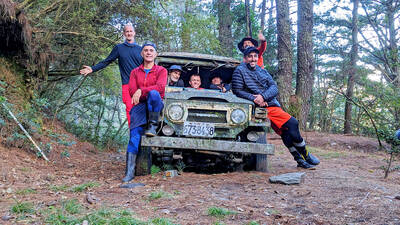
The year was 1991. A Toyota Land Cruiser set out on a 67km journey up the Junda Forest Road (郡大林道) toward an old loggers’ camp, at which point the hikers inside would get out and begin their ascent of Jade Mountain (玉山). Little did they know, they would be the last group of hikers to ever enjoy this shortcut into the mountains. An approaching typhoon soon wiped out the road behind them, trapping the vehicle on the mountain and forever changing the approach to Jade Mountain. THE CONTEMPORARY ROUTE Nowadays, the approach to Jade Mountain from the north side takes an

Last week Joseph Nye, the well-known China scholar, wrote on the Australian Strategic Policy Institute’s website about how war over Taiwan might be averted. He noted that years ago he was on a team that met with then-president Chen Shui-bian (陳水扁), “whose previous ‘unofficial’ visit to the US had caused a crisis in which China fired missiles into the sea and the US deployed carriers off the coast of Taiwan.” Yes, that’s right, mighty Chen caused that crisis all by himself. Neither the US nor the People’s Republic of China (PRC) exercised any agency. Nye then nostalgically invoked the comical specter

Relations between Taiwan and the Czech Republic have flourished in recent years. However, not everyone is pleased about the growing friendship between the two countries. Last month, an incident involving a Chinese diplomat tailing the car of vice president-elect Hsiao Bi-khim (蕭美琴) in Prague, drew public attention to the People’s Republic of China’s (PRC) operations to undermine Taiwan overseas. The trip was not Hsiao’s first visit to the Central European country. It was meant to be low-key, a chance to meet with local academics and politicians, until her police escort noticed a car was tailing her through the Czech capital. The
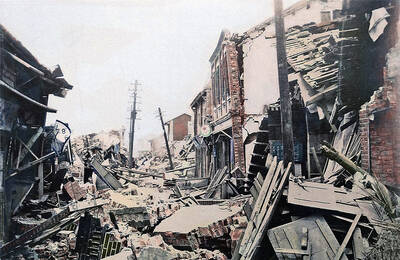
April 15 to April 21 Yang Kui (楊逵) was horrified as he drove past trucks, oxcarts and trolleys loaded with coffins on his way to Tuntzechiao (屯子腳), which he heard had been completely destroyed. The friend he came to check on was safe, but most residents were suffering in the town hit the hardest by the 7.1-magnitude Hsinchu-Taichung Earthquake on April 21, 1935. It remains the deadliest in Taiwan’s recorded history, claiming around 3,300 lives and injuring nearly 12,000. The disaster completely flattened roughly 18,000 houses and damaged countless more. The social activist and


 RSS
RSS