


The Eurovision Song Contest, which has provided nearly half a century of evidence that globalization comes to a screeching halt when it approaches the borders of Euro pop, is over again for a year.
Twenty-six nations, including most of NATO, large swaths of the former Warsaw Pact, as well as Israel, sent their top pop stars to the 48th annual Eurovision contest, to perform previously unpublished songs. The contest was first broadcast in 1956 and is the longest continuously running program in Europe. It is shown in 42 countries worldwide, with an estimated 150 million viewers.
Though America created the vocabulary for pop music, Euro pop has long since pidginized the genre, making it all its own. This year's winner was a prime example.
Every Way That I Can was an exotic belly-dancing tune sung in English by Sertab Erener, an
established Turkish star whose biggest prior boast was having once sung a duet with Ricky Martin.
The band Urban Trad of Belgium placed second with a song whose lyrics were in a made-up, Tolkeinesque language, presumably dodging the wrath of both the Flemish and Walloon communities. Russia placed third with its hottest current commodity, the pouty, pubescent minxes of t.A.T.u., who were up to their old tricks in Riga. During their news conference, the pop duo declared they had no plans to explore Riga's cultural offerings because they would be too busy having sex.
Eurovision, originally conceived as a means of unifying a war-torn Europe, was arguably the most visible symbol of European unity before the EU. In keeping with political trends, the former Eastern bloc countries were invited to join the contest shortly after the breakup of the Soviet Union.
In recent Eurovision contests, some Western European countries have skidded -- this year, Britain placed a jaw-dropping last place, with zero points.
Juries happily gave points to Austria (an apparent cretin with toy animals on stage), Ukraine (featuring a contortionist in a turquoise leotard), and even Poland (a man with bright red hair who looked like a hormonally challenged Lulu). On all these they lavished points, but to the UK, not a bean.
Jemini, the UK hopeful, didn't do themselves any favors. Gemma Abbey sang the first verse of Cry Baby off key, and spent the rest of the performance like a rabbit in headlights. Chris Cromby exhorted the crowd ("C'mon, Latvia!") to little effect. It was a feeble showing from a supposedly great pop nation -- so, Gemma and Chris limped back to Liverpool, forever branded the first UK act to get the Euro-raspberry.
After several years in which Eurovision has become worryingly slick and classy, this year's contest boasted some real, old-fashioned tat. Mandou from Greece looked like an older Christina Aguilera squeezed into a fetish dress. Germany's Lou had been at the henna; she sang "Let's get happy, let's get gay," and it looked as if her backing dancers had taken her advice to heart.
When it came to the voting, most of the national representatives appeared to be standing on traffic islands. The same black halter-neck dress must have been couriered around Europe: they were all wearing it, apart from a woman from Iceland, draped in what looked like luncheon meat. Key style icons, for both singers and juries, were Cher, Britney and Darius.
Meanwhile, former Eastern bloc countries have invested copious funds and unsmirking enthusiasm in the contest. The last three winners -- Estonia, Latvia and now Turkey -- are all vying for membership in the EU. Aware that all eyes were on Latvia, the Latvian government spent the equivalent of US$11 million to put on the show, an enormous sum for a nation of 2.3 million
The Eurovision winner is determined by an hourlong, logistically nightmarish system in which each participating nation conducts its own telephone vote (or in rare cases, a jury vote), with the stipulation that the callers cannot choose their own nation's entry. Typically, anywhere from 100,000 to 800,000 viewers per country phone in. These votes are then distilled into a baroque 1-to-12-point ranking system.
This voting process may explain, in part, why the US has never broadcast or otherwise shown any interest in Eurovision.
"I shudder to think what it would take in the US to have an all-American phone-in vote," said Karlis Streips, a Chicago-born Latvian-American who served as Latvian television's Eurovision commentator.
Americans "can hardly manage a presidential election," he said, adding, "If we had a Eurovision election, there would be chads in the ballots."
But this is not the only reason the contest will probably never include American participation. It has been observed that the more that Euro pop tries to sound American, the more distinctly European it sounds. Take, for example, this year's German entry, Let's Get Happy, sung by an orange-haired Phyllis Diller look-alike named Lou. Lou belted out the first line, "Last night at the discotheque," in a near-flawless R&B down-home American accent, yet "discotheque" is a word no self-respecting American rock star would say.
Latvia won the right to be the host of this year's contest by winning first place last year, and the Latvian president, Vaira Vike-Freiberga, explained the importance of this coup. "We were behind the Iron Curtain for half a century, during which time we didn't exist."
Vike-Freiberga said she saw Eurovision as a sacred haven safe from American cultural imperialism.
"It is the one chance for pop singers, other than those who have been created by the grinder of the American entertainment industry," she said.
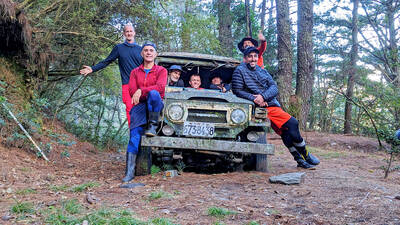
The year was 1991. A Toyota Land Cruiser set out on a 67km journey up the Junda Forest Road (郡大林道) toward an old loggers’ camp, at which point the hikers inside would get out and begin their ascent of Jade Mountain (玉山). Little did they know, they would be the last group of hikers to ever enjoy this shortcut into the mountains. An approaching typhoon soon wiped out the road behind them, trapping the vehicle on the mountain and forever changing the approach to Jade Mountain. THE CONTEMPORARY ROUTE Nowadays, the approach to Jade Mountain from the north side takes an

Last week Joseph Nye, the well-known China scholar, wrote on the Australian Strategic Policy Institute’s website about how war over Taiwan might be averted. He noted that years ago he was on a team that met with then-president Chen Shui-bian (陳水扁), “whose previous ‘unofficial’ visit to the US had caused a crisis in which China fired missiles into the sea and the US deployed carriers off the coast of Taiwan.” Yes, that’s right, mighty Chen caused that crisis all by himself. Neither the US nor the People’s Republic of China (PRC) exercised any agency. Nye then nostalgically invoked the comical specter

Relations between Taiwan and the Czech Republic have flourished in recent years. However, not everyone is pleased about the growing friendship between the two countries. Last month, an incident involving a Chinese diplomat tailing the car of vice president-elect Hsiao Bi-khim (蕭美琴) in Prague, drew public attention to the People’s Republic of China’s (PRC) operations to undermine Taiwan overseas. The trip was not Hsiao’s first visit to the Central European country. It was meant to be low-key, a chance to meet with local academics and politicians, until her police escort noticed a car was tailing her through the Czech capital. The
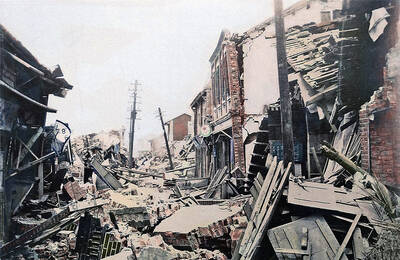
April 15 to April 21 Yang Kui (楊逵) was horrified as he drove past trucks, oxcarts and trolleys loaded with coffins on his way to Tuntzechiao (屯子腳), which he heard had been completely destroyed. The friend he came to check on was safe, but most residents were suffering in the town hit the hardest by the 7.1-magnitude Hsinchu-Taichung Earthquake on April 21, 1935. It remains the deadliest in Taiwan’s recorded history, claiming around 3,300 lives and injuring nearly 12,000. The disaster completely flattened roughly 18,000 houses and damaged countless more. The social activist and


 RSS
RSS