


Opened just two days ago, the Shihsanhang Museum of Archeology (
In this regard he mentioned a scholar named Benedict Anderson and said something about museums and "nation building". It was curious because the last time I'd heard anyone drop the English phrase "nation building" into a Chinese sentence about museums, it was National Palace Museum Director Tu Cheng-sheng (
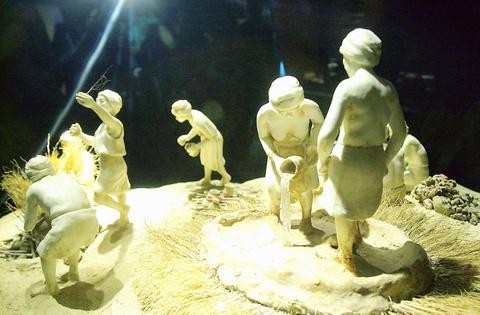
PHOTO: SEAN CHAO, TAIPEI TIMES
The term "nation building" comes from Anderson's book Imagined Communities: Reflections on the Origin and Spread of Nationalism. In it, Anderson proposes that the only thing that holds a nation together is its citizens' shared imagination that they're all somehow linked. And what feeds this collective idea is cultural information museums, the media, textbooks and other productions -- disseminated by some central force or forces, usually the government. It's a deconstruction of the idea of "nation-ness" that breaks the concept down into smaller parts, but on the flip side it also provides a blueprint for building a nation, if that happens to be what you want to do.
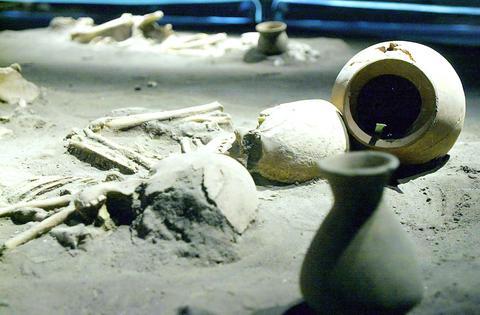
PHOTO: SEAN CHAO, TAIPEI TIMES
My tour guide, a recent college graduate who'd studied journalism, told me the book had been translated into Chinese and was required reading for several departments in universities here.
The strategy, one can suppose -- and the intentions of the Ministry of Education are still in question here -- is to emphasize aspects of Taiwan's history that have nothing to do with China; and this will in turn galvanize Taiwanese notions of a unique, non-Chinese identity. In this way the Shihsanhang Museum fits in with other recent projects focusing on Taiwan's pre-(Chinese)-history, including Taitung's Peinan Culture Park (opened last December), the Prehistory Museum (opened 2001) and the Austronesian Culture Festival (begun 1999).
The museum itself tells the story of the Shihsanhang culture, which existed in and around the site of the museum between 500 and 1,800 years ago. Its people were possibly, but not definitely, related to the Ketagalan, the Aborigines who lived in the Taipei region before the Chinese began driving them out around the 17th century. They lived all along the northern Taiwan coast, though the culture takes its name from the Shihsanhang site to the south of the Tamshui River's mouth in what is now Pali township.
They were fairly advanced as indigenous tribal cultures go. They hunted with spears and arrows and fished from dugout boats; they traded for gold, bronze and glass with the Fukienese and for pottery and jade with tribes from all over Taiwan; they lived in 10m long wooden houses on stilts; and most importantly, they knew how to smelt iron.
The forge discovered at the Shihsanhang dig merits its designation as a "class two historical site." From around 2,000 years ago there is evidence of iron tools all over the island, but only at Shihsanhang had a furnace for producing iron been found.
The site's large amounts of iron slag, a byproduct of smelting, even accounted for its initial discovery. In 1955 an ROC air force pilot was flying over the area when he noticed the compass on his control panel going haywire. He later returned with a geologist who discovered enough remnants of prehistoric smelting to generate a magnetic field.
The full significance of the find wasn't fully revealed until 1989, however, when the local government began constructing a sewage treatment plant on the site. Archeologists caught wind of what was going on and joined forces with Taiwan's budding social movements. They ended up saving about 6,000 square meters, or 10 percent of the archeological site. The museum was put about 1km away in a location that's the quintessence of Taiwanese picturesque: ocean in front, mountain behind, sewage treatment plant to the left and oil derricks to the right.
The museum displays its history through a combination of reconstructions, filmstrips, artifacts in glass cases and -- the most interesting -- a few slices of earth moved intact from the dig site. The reconstructions, like their close cousins, dioramas and wax museums, are interesting mostly as camp, especially the exhibit introduced with "Hi everybody! We're a family who lived near the seashore of Shihsanhang in Pali about 1,000 years ago."
The dig sections are wonderful for their not-so-mediated information. One horizontal patch shows skeletons as they were buried -- in a curled sleeping position that may have religious significance. A vertical cross-section meanwhile shows the layers of history. More than a meter down is a Shihsanhang shell midden, basically an ancient garbage dump of potsherds, shells and animal bones. Directly above it and within 30cm of the surface, one finds its equally fascinating modern counterpart, a layer of plastic bottles, discarded hoses, bricks and asphalt -- our own archeological legacy.
A temporary exhibit on Malaysia's Iban people carries out another part of the nation-building mission, proposing links between Shihsanhang and other Austronesian speaking cultures. Austronesian is a language family that currently includes around 200 million people from Madagascar in the west, to Easter Island in the east, to New Zealand in the south, to Taiwan (here it includes all Aboriginal languages) in the north. It includes all the Polynesian languages, Bahasa Malaysia, Bahasa Indonesia and most of the languages in between.
Taiwan occupies a central spot in the Austronesian picture because the entire language family finds its earliest and most complete traces here. University of Hawaii linguist Robert Blust has found nine of ten Austronesian subgroups among those Taiwan Aboriginal languages that were not lost, which is more subgroups than anywhere else. At the same time, archeological evidence shows how a culture of red pottery-making, tattooing and yam-eating head hunters poured out of Southeast Asia around 4,000 to 5,000 years ago and, over three millennia, populated almost every island in the South Pacific.
Where does the Shihsanhang culture fit into this incredible migration? There is no clear answer to this question. A theory by one of Taiwan's top archeologists, Tsang Cheng-hwa (臧振華), holds that a wave of migration from the Philippines rode the north-flowing Black Current up to Taiwan about 2,000 years ago. But the more internationally accepted theory of Australian archeologist Peter Bellwood sees Taiwan as the origin of the entire dispersal 4,000 years ago, with no subsequent backtracking. So the archeologists at the Shihsanhang site keep digging, in search of a nation perhaps, or maybe even something unknown. Because as Bellwood once said, "As an archeologist, you never know what it is that you haven't found."
The Shihsanhang Museum of Archeology is located in Pali at 200 Museum Ave (台北縣八里鄉博物館路200號). It can be reached from Taipei by taking the MRT to Kuantu Station (關渡站), then transferring to the red number 13 bus. Admission is NT$100 for adults and NT$70 for children and senior citizens. For more information check the web site www.sshm.gov.tw or call (02) 2619-1313.

In late October of 1873 the government of Japan decided against sending a military expedition to Korea to force that nation to open trade relations. Across the government supporters of the expedition resigned immediately. The spectacle of revolt by disaffected samurai began to loom over Japanese politics. In January of 1874 disaffected samurai attacked a senior minister in Tokyo. A month later, a group of pro-Korea expedition and anti-foreign elements from Saga prefecture in Kyushu revolted, driven in part by high food prices stemming from poor harvests. Their leader, according to Edward Drea’s classic Japan’s Imperial Army, was a samurai
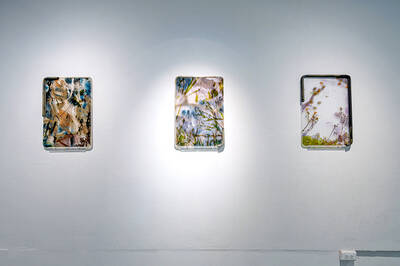
Located down a sideroad in old Wanhua District (萬華區), Waley Art (水谷藝術) has an established reputation for curating some of the more provocative indie art exhibitions in Taipei. And this month is no exception. Beyond the innocuous facade of a shophouse, the full three stories of the gallery space (including the basement) have been taken over by photographs, installation videos and abstract images courtesy of two creatives who hail from the opposite ends of the earth, Taiwan’s Hsu Yi-ting (許懿婷) and Germany’s Benjamin Janzen. “In 2019, I had an art residency in Europe,” Hsu says. “I met Benjamin in the lobby
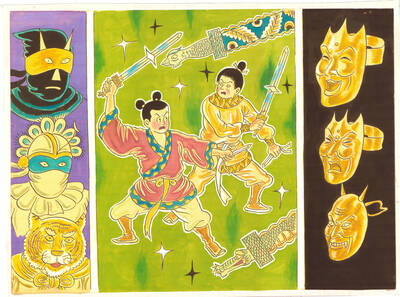
April 22 to April 28 The true identity of the mastermind behind the Demon Gang (魔鬼黨) was undoubtedly on the minds of countless schoolchildren in late 1958. In the days leading up to the big reveal, more than 10,000 guesses were sent to Ta Hwa Publishing Co (大華文化社) for a chance to win prizes. The smash success of the comic series Great Battle Against the Demon Gang (大戰魔鬼黨) came as a surprise to author Yeh Hung-chia (葉宏甲), who had long given up on his dream after being jailed for 10 months in 1947 over political cartoons. Protagonist

A fossil jawbone found by a British girl and her father on a beach in Somerset, England belongs to a gigantic marine reptile dating to 202 million years ago that appears to have been among the largest animals ever on Earth. Researchers said on Wednesday the bone, called a surangular, was from a type of ocean-going reptile called an ichthyosaur. Based on its dimensions compared to the same bone in closely related ichthyosaurs, the researchers estimated that the Triassic Period creature, which they named Ichthyotitan severnensis, was between 22-26 meters long. That would make it perhaps the largest-known marine reptile and would


 RSS
RSS