


People used to call the exotic house on Taipei's Chungshan North Road, just outside the Taipei Fine Arts Museum, the Yuanshan Villa. Now, after extensive renovation, it has been renamed the Taipei Story House, and is scheduled to open on April 19.
The building is joining a number of other heritage sites targeted by the Taipei Cultural Affairs Bureau -- the Chian Mu Residence (
One difference though -- Taipei Story House is the first of these sites in which the initiator of the project has been a private person.
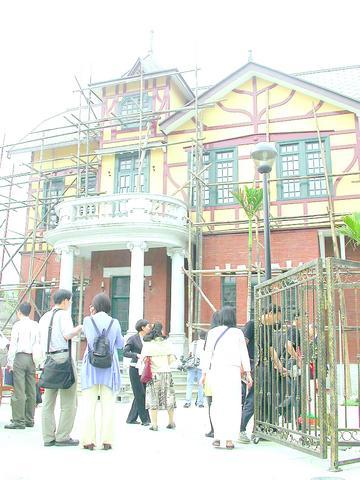
PHOTO:VICO LEE, TAIPEI TIMES
Chen Kuo-tsi (陳國慈), chairwoman of the Female Cancer Foundation and a respected lawyer, won the contract to run the venue last year. Comparing the building to a grandpa with countless stories to tell, Chen named the villa Taipei Story House.
Over its 90-year history, the house has served many functions. According to a study published by the Taipei City Government, what is now called the Taipei Story House was built in 1914 as a private guest house for Chen Chao-chun (
After Chen's business collapsed in 1923, the occupying Japanese military's Execution Team took over the building to incarcerate prisoners.
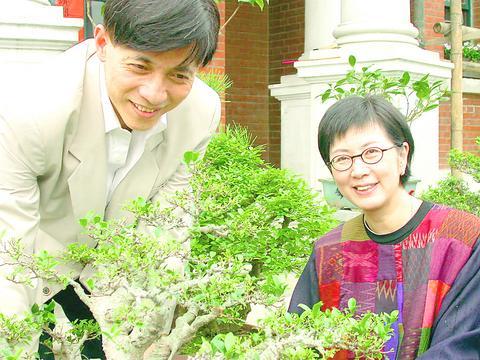
PHOTO:VICO LEE, TAIPEI TIMES
Following Retrocession, it became the residence of legislative speaker, Huang Guo-shu (黃國書).
The Taipei City Government managed the place from 1979, when the Taipei Fine Arts Museum (TFAM) was being built.
Under TFAM's management, it first served as a Center for Artist Exchange (
When the city government classified it as a Class C heritage site in 1998, it was already so dilapidated that the Culture Affairs Bureau decided to give it a thorough face-lift, a process that took five years.
Details on the early history of the building are sketchy. "So few documents about the house have survived to give a precise history, so it remains somewhat mysterious," said Chen.
"The word `story' means `things of the past' in Chinese, so that the Story House is meant to be a place where people can reminisce about the past," Chen said.
Taipei's history will be the theme of seasonal events at this location, which, soon after it opens on April 19, will also play host to a series of seminars on the preservation of cultural heritage and a painting competition themed on historical buildings.
To pay tribute to the house's origin as a tea trader's villa, tea culture will also be a regular theme for seminars and exhibitions.
To help people recall the past, Chen and her team have scheduled screenings of silent movies in the audio-visual room. Some of the films, from France, the US and Taiwan, will be about historical figures. A small gallery of "living art" will provide artists working in pottery, glass, leather or other materials a location to display and sell their work. Visitors will be able to relax in an outdoor garden restaurant, which surrounds the building.
All this, Chen said, will have cost her NT$35 million over the next four years, but Chen considers it worth the money. "Not everyone has the time and the personal resources to do such things. I was lucky to know people who can help me in this. If my move encourages others to adopt historical buildings, then it's worthwhile," Chen said.
Chen was born in Hong Kong and spent her formative years there, but 20 years ago she adopted Taiwan as her home. "I have a strong sense of belonging in Taipei," Chen said.
Hong Kong's colonial atmosphere did not appeal to Chen, who practiced law in New York before migrating to Taiwan in 1986. "Taiwan represents for me the only free land of the Chinese people," she said.
Passing the villa every day, Chen feels a sense of attachment. The building is also special architecturally, for the British inspired building stands out against the more numerous buildings of the Japanese colonial period, such as the Presidential Building and Chungshan Hall.
"When I first saw the building, I felt a kinship, perhaps because I studied in England," Chen said.
Chen's enthusiasm for cultural activities partly stems from her three-year term as the first Chief Executive of the National Culture and Arts Foundation (國家文化藝術基金會), which offers arts awards and provides grants for artists.
"Arts and cultural workers work very hard and in very difficult conditions. I came to sympathize with them and agree with their ideals. Although the foundation gave them subsidies, they helped improve the quality of life for the general public, which is more important," said Chen, who hopes the Story House will help cultural workers in their future endeavors.
After helping the Foundation get on its feet, Chen took the position of chief of legal affairs at Taiwan Semiconductor Manufacturing Company Foundation (
"I was in charge of the distribution of funds for arts and culture. Although some people regard subsidizing cultural activities as charity, I think it's our duty, because the money you give to art groups eventually goes into the improvement of our quality of our life, and therefore we are the real beneficiary."
During her stint at TSMC, Chen contributed to the reopening of Taipei Film House, another recently renovated building in Taipei, a project in to which TSMC contributed NT$60 million.
The private sector and individuals should make more of an effort to make our cultural heritage an active part of people's lives, Chen said. "Waiting passively for the government to liven up heritage buildings is not enough. We can make efforts ourselves so that old houses do not just become homes for mosquitoes," Chen said.

“Taiwan’s Opposition Leader Comes to US With a Message Straight Out of Beijing” read a May 31 headline in the Wall Street Journal. Top US administration officials and members of Congress almost certainly read the WSJ, and if there was a bullet point takeaway that people in Washington should absorb ahead of Chinese Nationalist Party (KMT) Chair Cheng Li-wun’s (鄭麗文) arrival in DC on June 9, that headline is it. The last few columns have discussed this very topic, and the timing is not coincidental. While those top officials likely do not read the Taipei Times, judging by the number
With weighty, anxiety-inducing geopolitical topics dominating the headlines, checking in on the wild and weird state of local politics can take some of the edge off. This November’s elections will determine who will be in charge of fixing potholes in your neighborhood, not the potholes in Taiwan’s complicated geopolitical space. Recently, after an online interview with a Taipei-based journalist, I commented that Taipei journalists never go further than the MRT can take them. He laughed and agreed. Naturally, the Taipei mayoral race is eating up much of the press attention. TAIPEI CITY Democratic Progressive Party (DPP) candidate Puma Shen (沈伯洋) has
Audiences in Leicester, Cardiff, London and Sheffield will this month gather to watch a series of black-and-white Taiwanese-language films made more than 70 years ago. On the surface, these screenings commemorate the seventieth anniversary of taiyupian (台語片) — Taiwanese-language cinema. Yet the significance of these events extends far beyond nostalgia or film history. They represent a remarkable chapter in Taiwan’s ongoing effort to recover, preserve and reinterpret a cultural heritage that was once thought to have largely disappeared. The centerpiece of the program is the Ho Chi-ming (何基明) directed Xue Pinggui and Wang Baochuan (薛平貴與王寶釧), a film produced in 1955 and
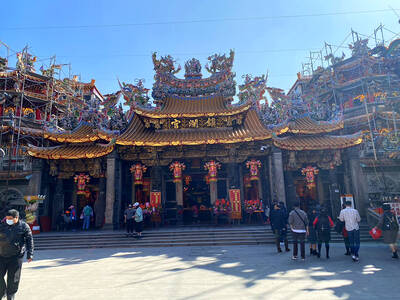
In December of 2008 Lee E-tin (李乙廷), a Miaoli county legislative hopeful, was convicted of vote-buying. Rather than buy votes retail, voter by voter, in the usual manner, Lee had done it wholesale, in a commendably efficient manner: he had visited local temples and made donations to gain their support. Because he did not normally make donations to temples, the court ruled he was attempting to improperly influence voter behavior. The case indicates how important temples are in influencing political life. Both judge and politician appeared to see them in the same way. Beijing sees them that way as well. Democratic Progressive


 RSS
RSS