


A precursor of the Renaissance and the first painter to depart from the formulated Byzantine style, Giotto di Bondone won praise from Dante in the Divine Comedy and Boccaccio's The Decameron. Giotto un Artista Universale, the current exhibition at Sun Yat-sen Memorial Hall aims to introduce the significance of the Italian master of church painting to Taiwan, where he is relatively unknown.
Giotto di Bondone was born around 1266 in Vespignano, a village near Florence, to a farming family. Since childhood, Giotto had helped his family as a shepherd while showing his talent with sketches of nature and animals on rocks.
Cimabue, a famous Florentine painter at the time, encountered the 12-year-old prodigy and recruited him as his pupil.
Having made more contributions to Cimabue's studio than any other apprentice, Giotto soon set up his own studio and more than surpassed his teacher in fame. One of his earliest works is a series of frescoes about the life of St. Francis in the church at Assisi. The emotional and realistic depiction of humans that later came to define Giotto's works was already notable at the time.
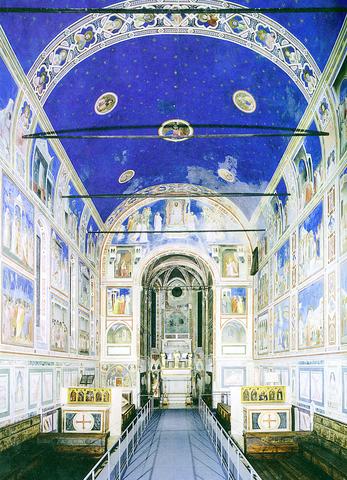
Most of Giotto's works remain today in various churches in Rome, Naples, Assisi and other parts of Italy. The 38 frescoes painted during 1305 and 1306 in the Cappella degli Scrovegni in Padua (Arena Chapel) are deemed his masterpieces. Despite difficulties in determining the author of many ancient murals, it is the work universally attributed to him.
The frescos illustrate scenes of the court of heaven and the last judgement, the lives of Jesus Christ, the Virgin Mary and her parents, St. Anne and St. Joachim. In the lower walls are personifications of virtues and vices. The exhibition features a reconstruction of the chapel building at a quarter of its size where viewers can walk in to simulate the experience of coming face to face with the splendor of the original.
At the time of the chapel's finishing ceremony, the local residents were intrigued by Giotto's bold and unprecedented style. Visiting monks were appalled by Giotto's approach to religious subjects and filed a collective complaint to the archbishop of Padua. What roused their anger was Giotto's idea to bridge the gap between religious paintings and ordinary people. The subjects' facial expressions were more animated, the saints were painted as humans and daily life activities, trendy attire, folk festivals and legends about the Virgin Mary were all included.
One of the frescos tells of the birth of Jesus. In it Mary is reaching out to hold the baby Jesus, in contrast to most other paintings of the same subject where the holy mother is usually shown nonchalantly saluting the baby. Joseph, in another fresco, was sits despondently on the floor while others congratulate Mary on the birth of her son. It's a delicate rendering of what a father would feel when neither his marriage nor his child-raising is within his control. These are human situations formerly ignored in the quest to portray the glory of religious figures.
In addition to these reproductions, the exhibition has on show three pieces of murals by Giotto and eight pieces by his contemporaries who Giotto had greatly influenced.
Perizoma di Cristo crocifisso is an example of how Giotto insisted on faithfully presenting the real appearances of things. Unlike earlier artists, who treated the cloth around the waist of crucified Jesus with ornately graceful outlines, Giotto painted the cloth like as a rough white cotton rag with folds of varying tightness.
Guariento's Battesimo di Cristo, a depiction of Jesus as John the Baptist baptized him, shows how the latecomer, is influenced by Giotto's emphasis on emotional interactions between subjects while giving his figures a less solemn atmosphere than Giotto did.
What: Giotto un Artista Universale
Where: Sun Yat-sen Memorial Hall
When: Through Jan. 26
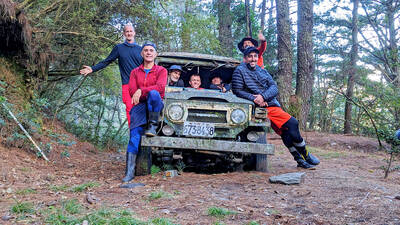
The year was 1991. A Toyota Land Cruiser set out on a 67km journey up the Junda Forest Road (郡大林道) toward an old loggers’ camp, at which point the hikers inside would get out and begin their ascent of Jade Mountain (玉山). Little did they know, they would be the last group of hikers to ever enjoy this shortcut into the mountains. An approaching typhoon soon wiped out the road behind them, trapping the vehicle on the mountain and forever changing the approach to Jade Mountain. THE CONTEMPORARY ROUTE Nowadays, the approach to Jade Mountain from the north side takes an
Last week Joseph Nye, the well-known China scholar, wrote on the Australian Strategic Policy Institute’s website about how war over Taiwan might be averted. He noted that years ago he was on a team that met with then-president Chen Shui-bian (陳水扁), “whose previous ‘unofficial’ visit to the US had caused a crisis in which China fired missiles into the sea and the US deployed carriers off the coast of Taiwan.” Yes, that’s right, mighty Chen caused that crisis all by himself. Neither the US nor the People’s Republic of China (PRC) exercised any agency. Nye then nostalgically invoked the comical specter
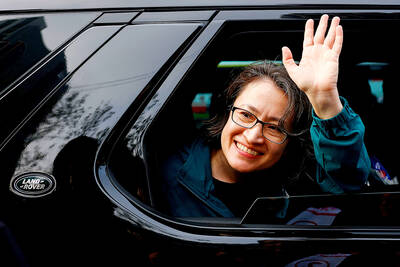
Relations between Taiwan and the Czech Republic have flourished in recent years. However, not everyone is pleased about the growing friendship between the two countries. Last month, an incident involving a Chinese diplomat tailing the car of vice president-elect Hsiao Bi-khim (蕭美琴) in Prague, drew public attention to the People’s Republic of China’s (PRC) operations to undermine Taiwan overseas. The trip was not Hsiao’s first visit to the Central European country. It was meant to be low-key, a chance to meet with local academics and politicians, until her police escort noticed a car was tailing her through the Czech capital. The
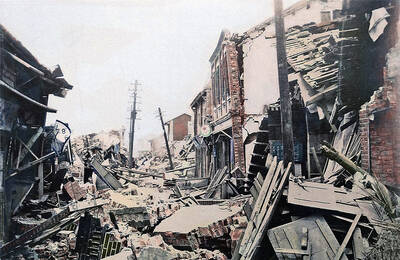
April 15 to April 21 Yang Kui (楊逵) was horrified as he drove past trucks, oxcarts and trolleys loaded with coffins on his way to Tuntzechiao (屯子腳), which he heard had been completely destroyed. The friend he came to check on was safe, but most residents were suffering in the town hit the hardest by the 7.1-magnitude Hsinchu-Taichung Earthquake on April 21, 1935. It remains the deadliest in Taiwan’s recorded history, claiming around 3,300 lives and injuring nearly 12,000. The disaster completely flattened roughly 18,000 houses and damaged countless more. The social activist and


 RSS
RSS