


Since Taipei County's Yingko Ceramics Museum opened in 2000 to promote ceramic art, the National Museum of History (
Calefaction and Diffusion (
The four artists, Yang Yuan-tai (
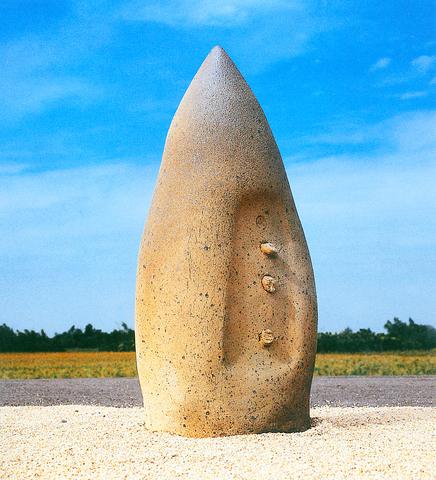
"Unrestrained by `exquisiteness' and `modesty' in traditional ceramics ... the four artists have in common a willing to create cross-disciplinary works and an open-mindedness," said Huang Hai-ming, installation artist and art critic.
The most eye-catching works may be Lo's installations and documents of his performances, some of which did not even involve ceramics.
Born in Chiayi, Lo has had a strong affection for land and earth since childhood, which was spent playing with clay. He later came to realize the vital connection between humans and earth. "After my grandmother had been dead for several years, my family went to her grave for "bone-picking." When the lid of the coffin was lifted, I saw only earth. My grandma had turned into earth. ... The same will happen to everyone. ... If you spit on the ground, you might be spitting on your own corpse from your last life," Lo said in a documentary about him, which is also on show.
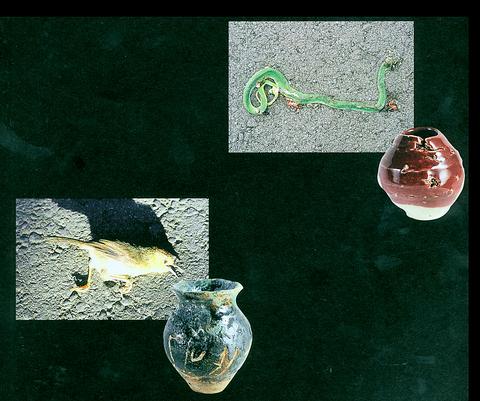
Restoration Project (
Concerned about Taiwan's environment, Lo made Land Survey (
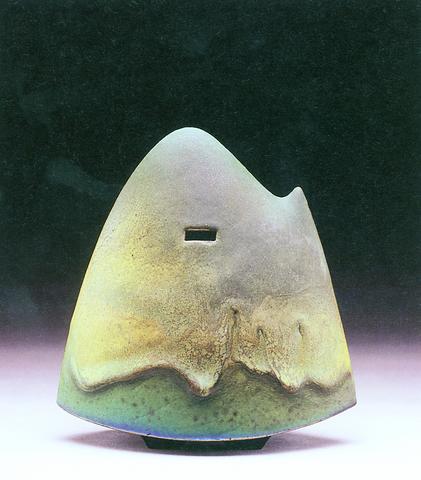
Treating ceramics objects as mini architectural pieces, Kuo leaves a small window-like square opening near the top of each work. Viewers can only wonder what or who remains hidden inside those "buildings."
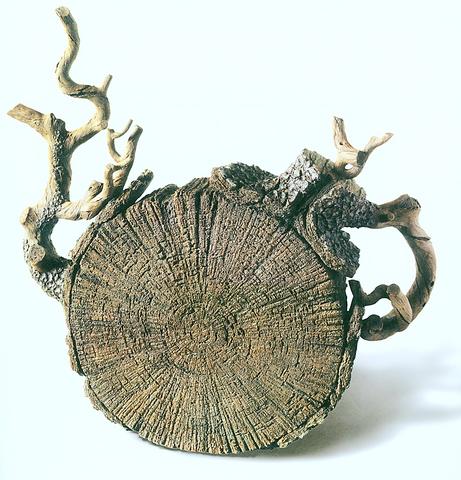
Ah Leon was a craftsman of traditional Yixing pottery. During his study trip to the US, it occurred to him that the new direction for Taiwanese ceramics is not to blindly emulate international ceramic techniques, but to express the country's characteristics. His imitation wooden pots and tofu, popular among collectors, are his effort to create something that appears genuinely Taiwanese.
Yang often presents his ceramic works as if they are sculptures. He would place them in the outdoors and take photos of them from angles that make them appear to be several meters tall. Although these works are shown not in photos, but placed as they are in the gallery, they still convey a sense of serenity and geometric harmony.
What: Calefaction and Diffusion -- Works by Four Ceramicists
Where: National Museum of History, 49, Nanhai Rd., Taipei (
When: Through Sept. 8

“Taiwan’s Opposition Leader Comes to US With a Message Straight Out of Beijing” read a May 31 headline in the Wall Street Journal. Top US administration officials and members of Congress almost certainly read the WSJ, and if there was a bullet point takeaway that people in Washington should absorb ahead of Chinese Nationalist Party (KMT) Chair Cheng Li-wun’s (鄭麗文) arrival in DC on June 9, that headline is it. The last few columns have discussed this very topic, and the timing is not coincidental. While those top officials likely do not read the Taipei Times, judging by the number
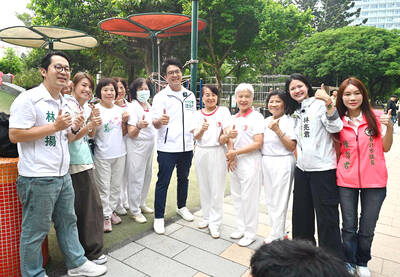
With weighty, anxiety-inducing geopolitical topics dominating the headlines, checking in on the wild and weird state of local politics can take some of the edge off. This November’s elections will determine who will be in charge of fixing potholes in your neighborhood, not the potholes in Taiwan’s complicated geopolitical space. Recently, after an online interview with a Taipei-based journalist, I commented that Taipei journalists never go further than the MRT can take them. He laughed and agreed. Naturally, the Taipei mayoral race is eating up much of the press attention. TAIPEI CITY Democratic Progressive Party (DPP) candidate Puma Shen (沈伯洋) has
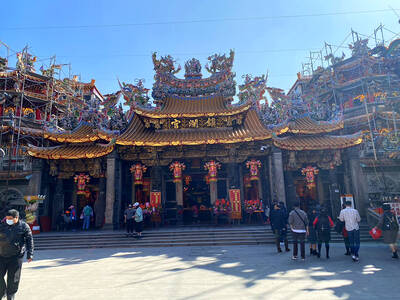
In December of 2008 Lee E-tin (李乙廷), a Miaoli county legislative hopeful, was convicted of vote-buying. Rather than buy votes retail, voter by voter, in the usual manner, Lee had done it wholesale, in a commendably efficient manner: he had visited local temples and made donations to gain their support. Because he did not normally make donations to temples, the court ruled he was attempting to improperly influence voter behavior. The case indicates how important temples are in influencing political life. Both judge and politician appeared to see them in the same way. Beijing sees them that way as well. Democratic Progressive
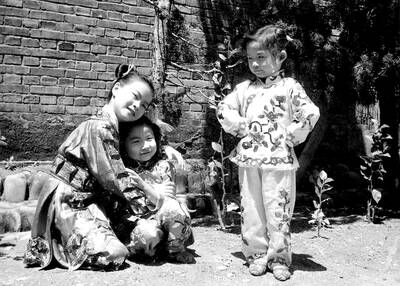
Audiences in Leicester, Cardiff, London and Sheffield will this month gather to watch a series of black-and-white Taiwanese-language films made more than 70 years ago. On the surface, these screenings commemorate the seventieth anniversary of taiyupian (台語片) — Taiwanese-language cinema. Yet the significance of these events extends far beyond nostalgia or film history. They represent a remarkable chapter in Taiwan’s ongoing effort to recover, preserve and reinterpret a cultural heritage that was once thought to have largely disappeared. The centerpiece of the program is the Ho Chi-ming (何基明) directed Xue Pinggui and Wang Baochuan (薛平貴與王寶釧), a film produced in 1955 and


 RSS
RSS