


There are plenty of factory sites marring the countryside around Tainan, but only the Chi Mei compund has a 4m-tall replica of Michelangelo's David in the courtyard at the entrance.
The statue at the gate of the sprawling industrial complex -- where dozens of base products that eventually are turned into items as varied as police-car sirens and TFT-LCD screens for notebook computers -- is the first exhibit at the wholly singular Chi Mei Museum (
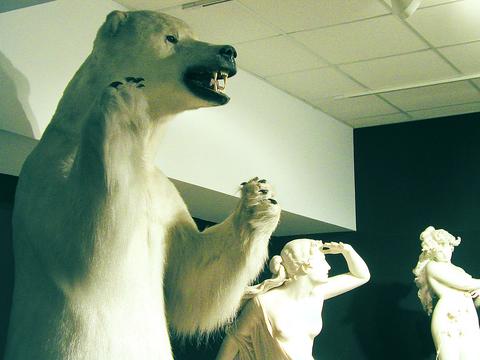
PHOTO: MAX WOODWORTH, TAIPEI TIMES
"The museum collects primarily classical Western paintings and sculpture. There are already institutions that exhibit modern art in Taiwan and if people want to see ancient Chinese artifacts, they can always go to the Palace Museum in Taipei. We try to offer something a bit different," said Pan Hsin-hsin, public relations manager of the museum. Another reason few Chinese articles are exhibited, she said, is that Chi Mei's director Hsu Wen-lung (
"Mr Hsu feels very strongly about Taiwan and doesn't want to parrot the things we were always taught growing up about China being the biggest and oldest and best civlization in the world. Here, he's trying to show people that other civilizations were doing great things often much earlier than Chinese people," Pan said.
Where exactly taxidermed polar bears fit into this principle may remain a mystery, but the museum certainly opens a different window to the world and its one that's worth seeing during a trip to Tainan.
Visitors begin by taking in the museum's significant collection of Western paintings and sculptures, which, while not first rate, contains works by European masters, such as El Greco, Leon Augustin Lhermitte, Claudel and Degas. With a few exemplary paintings per period, the exhibition covers about 600 years of Western art starting with the Renaissance and then moving through the Baroque, Rococo, Symbolists, Neo-Classicists and French Academists until the beginning of the Impressionists, while touching on the Dutch, English and Florentine schools of painting, among others.
The oldest painting on view is The Madonna of Humility, a 14th-century work by Paolo di Giovanni Fei. Because Renaissance works are jealously guarded by their countries of origin, purchases of such art are virtually impossible and prohibitively expensive, so its presence at the museum is a rare coup for a Taiwanese collection. Likewise, the 1605 Saint Martin and the Mendiant by El Greco, is a giant trophy that gives the museum's collection critical weight. Mr Hsu's personal preference for figurative art is especially apparent in the later works of the exhbition, such as Lhermitte's The Tavern Interior and William Adolphe Bouguereau's Madonna with the Christ Child and Saint John the Baptist, both of which are dated from the early 1880s, when Impressionism and explorations of abstraction were challenging classical painting. Corot's Batelier a la Pointe de l'Ile and Heri Lebasque's Baigneuse are as far as the museum goes into non-classical work, with the exception of a late-era Salvador Dali drawer sculpture.
"We concentrate mostly on 18th and 19th-century art because that's what Mr Hsu likes, but also because those are the works that are most available on the international art market. Anything older and the works are beyond our budget," Pan said.
Arguably the best part about the Chi Mei museum, however, is that along with the hundreds of classical Western paintings, sketches and sculptures, the institution also functions as a small-scale natural history museum.
The second floor of the museum, for example, begins with an eye-opening collection of antique musical instruments from around the world, including a 14th-century English harp, an Indian Tambura, an Appalachian dulcimer and even a vintage Fender six-string preci0sion bass. The museum's multi-million US dollar Stradivari violins, which are the gems of Hsu's instrument collection, are unfortunately kept in storage. When the Stradivaris aren't in storage they are being lent to Taiwanese violinists for special performances.
On the same floor around the corner from the instruments are hundreds of ancient daggers, swords, lances, clubs and machetes from places as far flung as Chad and Papua New Guinea. Included as well are hundreds of pistols and muskets, some of them dating back to the 16th century. Especially impressive, though, is the assortment of samurai gear and Ching-dynasty armor. Following the armor and weapons, one moves on to the fossils, where a 2m tusk from a 30,000-year-old Taiwanese elephant unearthed on Penghu has pride of place at the end of the small hall containing the remains of primitive lifeforms from millions of years ago.
From here, it's on to the taxidermed animals. In any museum, these exhibits are always a bit weird, as they position bitter foes of the animal kingdom like tigers and deer next to each other in frozen, placid poses. But the Chi Mei museum takes the strangeness to new levels by placing the taxidermed subjects among ancient armor and weapons -- a wall of over 100 North American ducks sits opposite a collection of chain mail. Despite the fact that none of the animals move, there are several surprises. Who would have guessed, for example, that the Formosan flying squirrel has a body about the size of a basketball and looks nothing like the cute garden variety squirrel?
On opposite corners of the same floor as the instruments, armor and animals visitors find an exhibit of the various items produced using Chi Mei materials and a section devoted to the great civilizations of antiquity. Lined up next to each other are an Egyptian sarcophagos and a Han dynasty jade burial suit, both of which would probably warrant their own rooms in many museums.
"We put those two pieces next to each other to show that the Egyptians were trying to preserve the dead well before the Chinese. And the Chinese jade suit, of course, didn't preserve anything, while some Egyptian mummies are virtually intact to this day," said Pan, alluding to the museum's aim to counterbalance or even undercut the predominance of Chinese culture in local education. The section includes an exquisite Indian temple doorway and a portion of a relief from Angkor Wat both placed next to similar items taken from Chinese sites.
The remaining space in the museum consists of smaller exhibitions with a similar hodgepodge of Western paintings, Asian and Western antique furiture and taxidermy. The animals are clearly the stars for visiting kids, who knock their heads against the glass in amazement at the sight of elephants, antelope, tigers and bears frozen next to each other. But the artwork is the main draw, especially in southern Taiwan where no other attempt at a comprehensive permanent exhibition of Western art exists.
Most curators at major art museums would view the Chi Mei Museum with bewilderment, but that may be its biggest strength -- it's free of the high-minded curatorial agendas that characterize most contemporary art exhibits and it has so much variety that it never gets boring. So, instead of feeling like one is going through a museum, it's more as if one is rummaging through their rich and well-travelled uncle's attic.

In late October of 1873 the government of Japan decided against sending a military expedition to Korea to force that nation to open trade relations. Across the government supporters of the expedition resigned immediately. The spectacle of revolt by disaffected samurai began to loom over Japanese politics. In January of 1874 disaffected samurai attacked a senior minister in Tokyo. A month later, a group of pro-Korea expedition and anti-foreign elements from Saga prefecture in Kyushu revolted, driven in part by high food prices stemming from poor harvests. Their leader, according to Edward Drea’s classic Japan’s Imperial Army, was a samurai
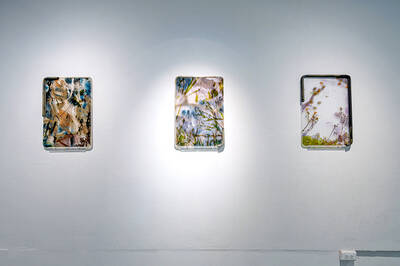
Located down a sideroad in old Wanhua District (萬華區), Waley Art (水谷藝術) has an established reputation for curating some of the more provocative indie art exhibitions in Taipei. And this month is no exception. Beyond the innocuous facade of a shophouse, the full three stories of the gallery space (including the basement) have been taken over by photographs, installation videos and abstract images courtesy of two creatives who hail from the opposite ends of the earth, Taiwan’s Hsu Yi-ting (許懿婷) and Germany’s Benjamin Janzen. “In 2019, I had an art residency in Europe,” Hsu says. “I met Benjamin in the lobby
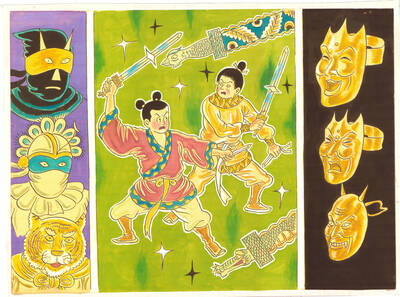
April 22 to April 28 The true identity of the mastermind behind the Demon Gang (魔鬼黨) was undoubtedly on the minds of countless schoolchildren in late 1958. In the days leading up to the big reveal, more than 10,000 guesses were sent to Ta Hwa Publishing Co (大華文化社) for a chance to win prizes. The smash success of the comic series Great Battle Against the Demon Gang (大戰魔鬼黨) came as a surprise to author Yeh Hung-chia (葉宏甲), who had long given up on his dream after being jailed for 10 months in 1947 over political cartoons. Protagonist

A fossil jawbone found by a British girl and her father on a beach in Somerset, England belongs to a gigantic marine reptile dating to 202 million years ago that appears to have been among the largest animals ever on Earth. Researchers said on Wednesday the bone, called a surangular, was from a type of ocean-going reptile called an ichthyosaur. Based on its dimensions compared to the same bone in closely related ichthyosaurs, the researchers estimated that the Triassic Period creature, which they named Ichthyotitan severnensis, was between 22-26 meters long. That would make it perhaps the largest-known marine reptile and would


 RSS
RSS