


Recent demonstrations outside the Legislative Yuan by residents of Orchid Island demanding the removal of nuclear waste barrels have once again propelled the often overlooked island to the forefront of the news.
Along with over 100,000 barrels of nuclear waste buried at the island's southernmost tip, Orchid Island, or Lanyu (
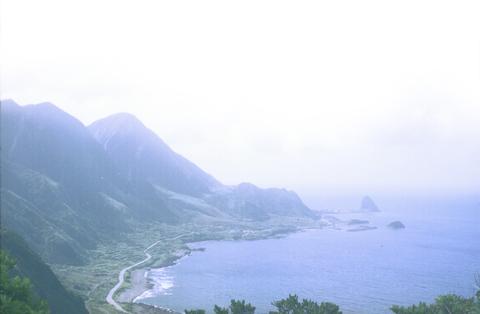
PHOTO: GAVIN PHIPPS, TAIPEI TIMES
While legislators and politicians continue to ponder the radioactive dilemma under the glare of the media spotlight, there remains a dearth of solutions to Lanyu's many other long-term problems -- many of which arose long before TaiPower shipped its first barrels of radioactive refuse to the 45.7km2 island in 1982.
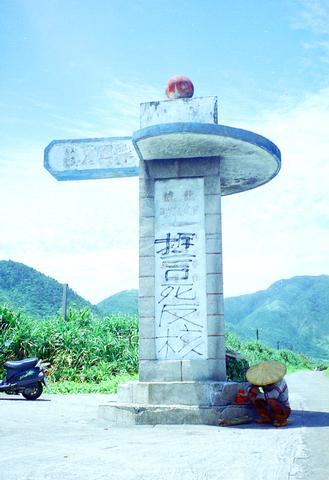
PHOTO: GAVIN PHIPPS, TAIPEI TIMES
Unlike the hands-off approach taken by the Japanese, under whom Lanyu became a research area for native flora and fauna, successive governments in Taiwan have meddled with the island's delicate equilibrium -- meddling that has usually resulted in politicians wishing they could simply sweep Lanyu under the carpet.
"It's always the same. Politicians come here, look around, say some nice words, gawk at the polluted waters and smile," said a rather irate Chou Yi-chung (
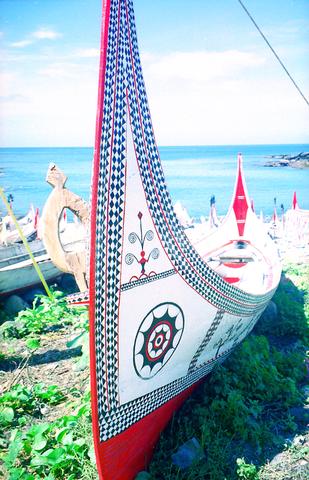
PHOTO: GAVIN PHIPPS, TAIPEI TIMES
With the exception of a naval salvo targeted at one of the island's statuesque off-shore rock formations -- an attack ordered by a shortsighted Japanese naval ensign who mistakenly took the rock for a US battleship -- the mayhem of World War Two passed by the people of Lanyu.
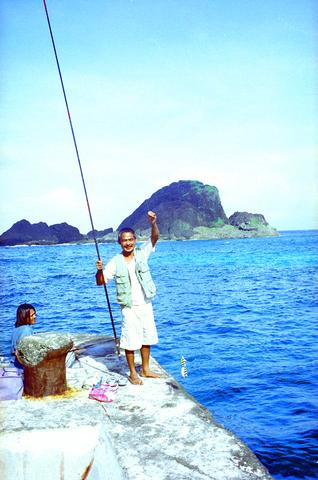
PHOTO: GAVIN PHIPPS, TAIPEI TIMES
The problems began quite shortly thereafter, however. Six years after Chiang Kai-shek's army fled to Taiwan, the KMT subjected the island's native population to a sinicization program. Scores of recently arrived mainlanders were shipped to Lanyu in a despotic attempt to wrest control of the island from its Yami population.
Needless to say, the idea proved incredibly unpopular with the locals who resented the government's assumption that interracial marriages would lead to peace, love and understanding. What the program led to instead was years of drunken brawls and racial hatred.
"When my father came here, there was a lot of resentment towards the program," recalled Chou Hai-an (周海安), a life-long Lanyu resident of mixed parentage and proprietor of one of the island's few restaurants.
"But when you think about it, recently arrived mainlanders who were sent to Lanyu such as my father had quite a lot in common with the native population in the sense that both were considered outcasts. After all that's why they were sent here."
Anti-Central Government sentiment increased in 1966, when the government passed a decree that ordered the islanders to dismantle their traditional underground homes and build concrete housing instead. The program lasted for over 20 years and it wasn't until 1980 that the Central Government reversed the decree and the Yami were once again free to choose their style of abode.
To coincide with the forced redevelopment program, the KMT decided to allow private citizens to visit the island and the very first camera-toting tourists arrived in 1967.
Lack of financial support and the pace at which the Central Government was demanding local residents redevelop led to shoddy construction work, however. To cut costs, builders used vast amounts of sand in the cement, which meant that large numbers of buildings collapsed very shortly after completion. Even today, the island is littered with half-finished, abandoned residential buildings.
Unfortunately the problem of shoddy workmanship continues even today. A large number of buildings built within the last five years were done so in a rather slap-shot manner and fell well below the standard deemed safe for habitation or commercial use.
One of the largest examples of this is the Lanyu Fine Arts Center (
"Obviously it was a good idea. The arts and handicraft mart would have been great for the village. It would have given people jobs, acted as a way to tell the outside world who we are. And tourists might possibly have come and spent some money there," explained Sinan Likdem (謝和英), the leader of the resident association on Orchid Island.
"But when it was finished, inspectors came and said it was poorly constructed. If there had been sufficient funds and a genuine act of government support, I'm sure it would have opened."
It's not only the island's buildings that have been plagued with problems. Sections of the island's single road are also in an appalling state of disrepair and look as if they will remain so for the foreseeable future.
"Parts of the road have become very dangerous. With increased traffic, I guess it's only a matter of time before there is a horrific accident," stated local artist, Sikang Chai (
While problems continue to plague many of Lanyu's civil construction projects, it is now illegal for non-island residents to purchase land or property on Lanyu. This is something many see as vital in ensuring that not only the island's culture remains intact, but that the land remains in the hands of its native population.
"It's pretty much impossible for outsiders to buy land here. The empty land that is safe to build on is usually owned by more than one person. Areas of about 600m by 600m can be owned by nine or 10 people," said Chou, who built both his and his parents' houses several years ago. "So it would hardly be kept secret if an outsider purchased land here. And then legal action could be taken."
While Chou Hai-an's parents enjoy the comforts of four concrete walls and a roof, not all of Lanyu's growing elderly population is as fortunate. As head of the residents' association, Sinan Likdem's tasks are becoming increasingly focused on the island's elderly residents.
"There are about 300 elderly people who need constant care on the island. Of these, roughly 20 have no immediate families here. We bring food, bathe them, cut their hair and clean their homes for them," Sinan said. "It's obviously quite saddening. We face an uphill battle as more young people leave the island and we don't get much of a budget from the government."
The falling number of youngsters opting to remain on Lanyu has also made a dent in the island's culture. Once a crucial part of the Yami calendar and prelude to the Yami harvest festival, the Flying Fish Rite (
The greater the number of flying fish caught, the greater a man's acceptance by the sea and his peers and his ability to support a family. All of which meant that the chap who actually caught the most fish was himself considered a pretty good catch by the the island's females.
Long ago, Yami men clad in loin-cloths and donning silver helmets and gold breastplates would smear the blood of a recently sacrificed chicken on the rocks and yell "return flying fish" at the tops of their lungs before heading out to sea in the early evening.
The men of Lanyu continue to craft the boats from 27 different pieces of wood cut from a live tree and venture out into the darkness to catch flying fish.
The eye-catching Yami thong, helmet and breastplate are no longer part of the regalia, however. Traditional garments have been replaced by sports wear in the form of short pants,T-shirts and baseball caps.
Not that it's any surprise that the dress code is somewhat different today, as many of today's fishermen are part-timers. Working for Taipower or any one of the handful of engineering companies based on the island during the day, they then take their boats out into the blackened waters at night to catch enough fish for their families.
Once taking to the seas in their famed hand-crafted and brightly painted wooden boats under the gaze of family and friends, the part-time fishermen nowadays paddle out under the glare of television crews and with a wallet freshly filled with crisp bills.
While Taipei Times politely declined to pay the NT$1,000 one elderly resident demanded for an interview, not all of the nation's media are so inclined. On a recent trip to the island, an ETTV (
Tourists are also often expected to fork-out a couple of hundred dollars for the pleasure of capturing locals on film. Those who don't cough-up the cash and snap away regardless run the risk of local ire, especially in villages located on the islands' less-developed east coast.
"On one hand, I can understand it. After all, the island is our home and not a zoo and people should respect that. But then as there is little opportunity for older people to earn money by charging a minimal fee for a picture they are in some sense simply trying to survive," said local librarian Ho Lan-ing (
Despite its mounting social problems, Orchid Island has managed to rid itself of one, often bloody, dilemma: that of drunken altercations with the military. Lanyu was considered such a backwater posting that the military ensured that only the most troublesome and natty draftees were stationed on the island.
"There were fights all the time. You'd see the soldiers getting drunk off base and knew there was going to be trouble, especially if a group of locals were drinking anywhere within earshot of them," Chou recalled.
"Local resentment got so bad that the troops finally refused to leave the bases on their own. Going out at night became a no-no if you were a soldier and didn't want to get beaten-up."
Animosity and resentment of the troops continued until 1980, when, having become virtual prisoners in their own bases, the soldiers were withdrawn from the island. Not that the short-lived Taiwan military presence was a total waste of time.
The scores of rundown and abandoned military installations that lay scattered along the island's coastal road now double as convenient shelters for the multitude of mountain goats that also call the island home.
Two years ago, the island's lack of military presence led to talk of autonomy for Lanyu and its native Yami peoples.
Following a decade of Yami lobbying for self-governance, the Presidential Office, under the leadership of then recently elected President Chen Shui-bien (
"There was talk of some kind of autonomy a couple of years ago, but like so many things here, nothing has come of it and we're still here waiting," Chou said. "I think it's a dream, but I could see the island run as an autonomous part of Taiwan in the future. We wouldn't be reliant on a Central Government to do things. So things would probably work properly, roads would get fixed and so on."
To date, little has come of the declaration signed by Chen on Lanyu in 2000. While the Central Government may have forgotten about it, many locals remember it very well.
"It's just another broken promise by the Central Government. They promised to deal with nuclear waste and that's still here. They promised to repair roads and houses and those problems are still evident," Chou said. "The declaration was just another idea thought up to keep the people of Lanyu quiet."
Although residents such as Chou welcome autonomy, some residents remain wary. Serious questions concerning the future of the island's children have left a large number of Lanyu's already much-maligned residents with yet another dilemma.
"I hold meetings with the children and their parents regularly and ask the question `In 10 years, where do you see Lanyu?'" said Hsu Chun-yuen (

In late October of 1873 the government of Japan decided against sending a military expedition to Korea to force that nation to open trade relations. Across the government supporters of the expedition resigned immediately. The spectacle of revolt by disaffected samurai began to loom over Japanese politics. In January of 1874 disaffected samurai attacked a senior minister in Tokyo. A month later, a group of pro-Korea expedition and anti-foreign elements from Saga prefecture in Kyushu revolted, driven in part by high food prices stemming from poor harvests. Their leader, according to Edward Drea’s classic Japan’s Imperial Army, was a samurai

Located down a sideroad in old Wanhua District (萬華區), Waley Art (水谷藝術) has an established reputation for curating some of the more provocative indie art exhibitions in Taipei. And this month is no exception. Beyond the innocuous facade of a shophouse, the full three stories of the gallery space (including the basement) have been taken over by photographs, installation videos and abstract images courtesy of two creatives who hail from the opposite ends of the earth, Taiwan’s Hsu Yi-ting (許懿婷) and Germany’s Benjamin Janzen. “In 2019, I had an art residency in Europe,” Hsu says. “I met Benjamin in the lobby
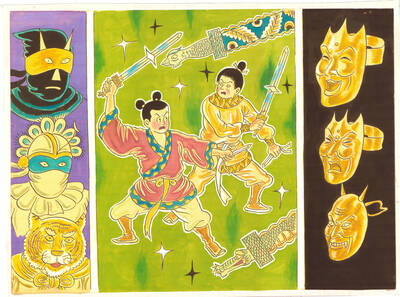
April 22 to April 28 The true identity of the mastermind behind the Demon Gang (魔鬼黨) was undoubtedly on the minds of countless schoolchildren in late 1958. In the days leading up to the big reveal, more than 10,000 guesses were sent to Ta Hwa Publishing Co (大華文化社) for a chance to win prizes. The smash success of the comic series Great Battle Against the Demon Gang (大戰魔鬼黨) came as a surprise to author Yeh Hung-chia (葉宏甲), who had long given up on his dream after being jailed for 10 months in 1947 over political cartoons. Protagonist

A fossil jawbone found by a British girl and her father on a beach in Somerset, England belongs to a gigantic marine reptile dating to 202 million years ago that appears to have been among the largest animals ever on Earth. Researchers said on Wednesday the bone, called a surangular, was from a type of ocean-going reptile called an ichthyosaur. Based on its dimensions compared to the same bone in closely related ichthyosaurs, the researchers estimated that the Triassic Period creature, which they named Ichthyotitan severnensis, was between 22-26 meters long. That would make it perhaps the largest-known marine reptile and would


 RSS
RSS