


The first thing you learn when working at Peter Morehead's Wind Valley Garden on Yangmingshan is the difference between grey water and black water.
Grey water is created by dishwashing, showers, clothes washing and so on, and it needs to be filtered through specific types of vegetation to break down its high nitrogen content.
Far more dangerous is black water, or raw sewage, which is full of dangerous, disease-causing bacteria. "This stuff'll kill you," he says.
On a tour of his garden, Morehead points to the PVC pipe that leads from the toilet in his trailer home to spill into the canal just outside. Because of the potential health hazards brought by raw sewage contaminating the water that in part irrigates his gardens, Morehead only rarely allows his wife or the volunteers on his farm to use the flush toilet.
Instead of a flush toilet, the Morehead household, and the occasional helpers from around the world who are pointed to his farm by the World-Wide Opportunities on Organic Farms (WWOOF) organization based in London, use a bucket placed under a comfy-looking homemade commode. What's left behind is covered in rice husks and, surprisingly, it doesn't stink at all. It's called a toilet composting system and eventually the feces and urine become fertilizer for trees.
The demonstration of the black water pipe serves to teach volunteers at his farm that, here at least, you are never far from what you are producing and what you will soon be consuming, so be careful what you put into the ecosystem. In this light, the composting toilet system seems like a pretty good idea.
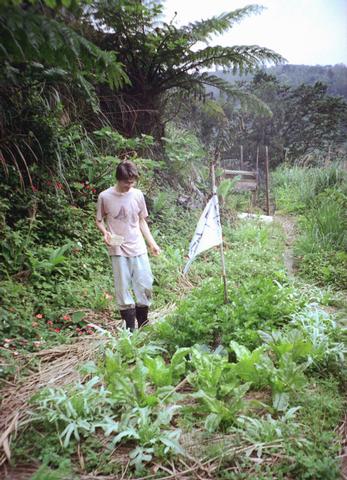
PHOTO: MAX WOODWORTH, TAIPEI TIMES
Back to the earth
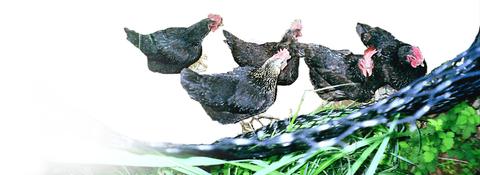
Wind Valley Garden sits on the lush mid-slopes of Yangmingshan in Pingdeng Li, where, in the 1970s, farmers got rich selling orchids to fanatical Japanese collectors who would pay millions for plants that wouldn't even flower. Sitting with legs crossed on his cluttered porch in a dirty, torn T-shirt, sweatpants and rubber boots, Morehead says with a mix of pity and derision, "Now, most of the farmers sit around doing nothing all day and their kids work in the city." He's looking to go in the opposite direction from the farmers' kids, from a suit-and-tie desk job to coaxing vegetables from the earth and keeping an eye on his six hens. His break with the urban world is not yet complete, however. He reluctantly works a part-time translation job to make ends meet. His Taiwanese wife also works an office job.
A resident of Taiwan for 10 years, Morehead started the farm two years ago to indulge a long-time interest in organic farming and to open the garden to people with similar interests. He rents the home and plot from a farmer who listed his land as a "citizens' farm" (
Though it's too small for subsistence farming -- he and his wife still buy staples like rice, tofu and wheat -- the plot provides all the vegetables for their strictly vegetarian diet with some left over to give to the neighbors. Depending on the season, he grows carrots, garlic, cabbage, lettuce, celery, sweet potatoes, tomatoes, sunflowers, tea, mint, guavas, bananas and papayas.
Given the modest scale of the farm, subsistence farming has been scrapped all together as a goal at Wind Valley. More important, Morehead says, is the purpose of educating people about the organic movement, which was why he joined WWOOF, a kind of cultural exchange and educational forum for people interested in organic farming.
WWOOF is a network of hundreds of farms in 77 countries on six continents that host volunteer workers. The deal is that visitors exchange six hours of work a day in the fields for room and board, which has made it a popular way to travel the world on a shoestring budget.
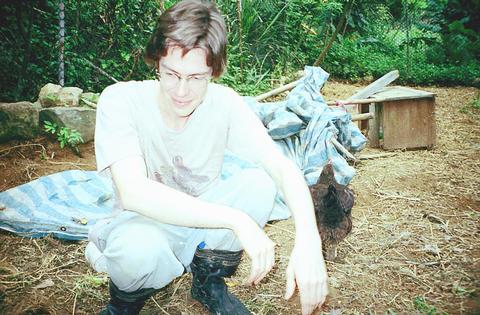
PHOTO: MAX WOODWORTH, TAIPEI TIMES
Wind Valley Garden is the first WWOOF farm in Taiwan and has so far attracted only six so-called WWOOFers from Germany, Japan, the US and Taiwan.
The organization has occasional problems with travelers who show up on farms purely for the free housing and meals, but the problem at Morehead's farm has tended to be inexperience -- both on the part of visitors and himself.
"Some of the WWOOFers aren't much help to be honest, but that's okay. As long as people come with the desire to learn about farming then I'm happy to have them around," he said.
On the day we met, however, it was just him on the farm. It's not a huge job tending to the crops, considering he's only planted on about 50㎡ of land, but the gardens still require regular attention. He's the first to admit that he also has a lot to learn when it comes to maintaining a successful farm.
A couple weeks ago, for example, a flock of birds descended on his cabbage patch and ate everything above ground. The other farmers in the valley, who Morehead said could seemingly anticipate the birds' arrival, had already set up flags to scare the birds away. He said he won't be duped again next year when the birds come back.
"There's a whole set of knowledge that people have lost from being so disconnected from the food production process. I'm re-learning that knowledge from scratch and passing on what I can to the volunteers," he said.
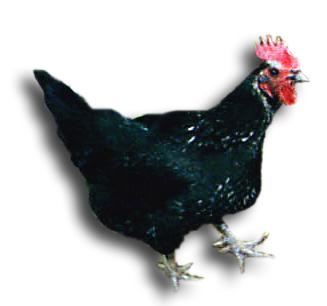
Another mistake he blames himself for is the mysterious death of his rooster. "I just don't know what happened to him. But when I found him, the hens looked really upset."
But on the whole, Morehead is satisfied with his achievements. "You can grow almost anything here it seems," he says.
Despite the apparent abundance, the garden does not have the idyllic aesthetic that an organic farm may evoke in some minds. First, there's the cozy but Spartan trailer with the leaky roof in the area set aside for volunteers and the dozens of discarded tires on the roof to help keep the house in one piece during typhoons. A pile of tires makes up a windbreak on one garden terrace. Then there are the pieces of plastic and other trash on the footpaths and in the bushes. But like the black-water pipe, the visible trash serves an educational purpose. "I don't believe in picking up all the garbage. Putting it out of sight doesn't mean it's disappeared, so if it's not harmful I'd rather leave it where it lays than shift the burden elsewhere." Morehead's hope is to build upon the infrastructure of the farm with the help of WWOOFers and eventually establish connections with other farmers in the area to trade different food items. This would fulfill his larger goal of ensuring that all his food is procured either from his garden or from local sources.
"The global food market is dangerous from the sanitation and food security standpoints and it ends up ruining the land. My point is to reduce the impact we have on the earth." Having instituted the composting toilet system, he's at least a huge step ahead of most people in this regard.
People interested in volunteering to stay at Wind Valley Garden or other organic farms can contact Peter Morehead at wooftaiwan@hotmail.com.

In late October of 1873 the government of Japan decided against sending a military expedition to Korea to force that nation to open trade relations. Across the government supporters of the expedition resigned immediately. The spectacle of revolt by disaffected samurai began to loom over Japanese politics. In January of 1874 disaffected samurai attacked a senior minister in Tokyo. A month later, a group of pro-Korea expedition and anti-foreign elements from Saga prefecture in Kyushu revolted, driven in part by high food prices stemming from poor harvests. Their leader, according to Edward Drea’s classic Japan’s Imperial Army, was a samurai

The following three paragraphs are just some of what the local Chinese-language press is reporting on breathlessly and following every twist and turn with the eagerness of a soap opera fan. For many English-language readers, it probably comes across as incomprehensibly opaque, so bear with me briefly dear reader: To the surprise of many, former pop singer and Democratic Progressive Party (DPP) ex-lawmaker Yu Tien (余天) of the Taiwan Normal Country Promotion Association (TNCPA) at the last minute dropped out of the running for committee chair of the DPP’s New Taipei City chapter, paving the way for DPP legislator Su

Located down a sideroad in old Wanhua District (萬華區), Waley Art (水谷藝術) has an established reputation for curating some of the more provocative indie art exhibitions in Taipei. And this month is no exception. Beyond the innocuous facade of a shophouse, the full three stories of the gallery space (including the basement) have been taken over by photographs, installation videos and abstract images courtesy of two creatives who hail from the opposite ends of the earth, Taiwan’s Hsu Yi-ting (許懿婷) and Germany’s Benjamin Janzen. “In 2019, I had an art residency in Europe,” Hsu says. “I met Benjamin in the lobby

April 22 to April 28 The true identity of the mastermind behind the Demon Gang (魔鬼黨) was undoubtedly on the minds of countless schoolchildren in late 1958. In the days leading up to the big reveal, more than 10,000 guesses were sent to Ta Hwa Publishing Co (大華文化社) for a chance to win prizes. The smash success of the comic series Great Battle Against the Demon Gang (大戰魔鬼黨) came as a surprise to author Yeh Hung-chia (葉宏甲), who had long given up on his dream after being jailed for 10 months in 1947 over political cartoons. Protagonist


 RSS
RSS