


Although the International Asia-Pacific Contemporary Ceramic Invitational Exhibition has been on show over the last month, it reached its high point this weekend with the arrival of many of the artists, who are drawn from eight countries in the Asia Pacific region. Each gave a series of seminars on various aspects of their art, which most agree is going through a crucial transitional period at the present time.
The Taipei County Yingko Ceramics Museum where the seminars were held is one of the largest institutions in the region dedicated to ceramics and pottery. The establishment of the museum, according to Wu Chin-feng (
The largest groups of artists come from Korea and Japan, who have a similar pottery tradition to that of Taiwan and in many cases face the same obstacles. An entrenched tradition of utilitarian pottery ware, most notably with Taiwan's handmade teapots, has tended to circumscribe the development of new ideas, said Chen Cheng-Hsun (
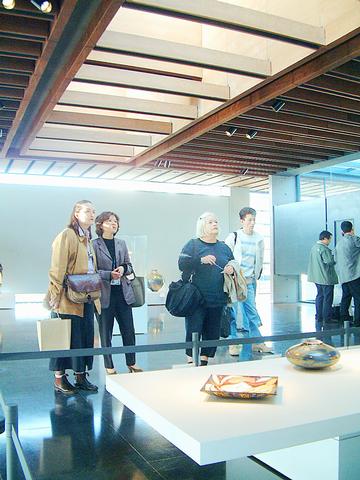
PHOTO COURTESY OF YINGKO CERAMICS MUSEUM
Ohi went on to point out that for him, ceramic vessels are not complete in themselves, but interact with their environment. For this reason, Ohi has extended his work to architecture and interior design, creating "installations" in which ceramic work is an integral part.
Much of the work that makes up the current invitational exhibition is very different from that on display throughout the museum in that they are clearly not functional. The first two floors of the museum are dedicated to traditional teapot and vases, along with displays of traditional clay working methods -- so the third floor, with works such as Onlie Ong's Cooking Series -- Stir Frying, a black iron wok containing a stir fry of nuts, bolts and other hardware, all made from clay but designed to look like the real thing, comes as something of a surprise.
Ong, who is from Taiwan, but now works out of his Pine Lodge Studio in New Zealand, said that he approaches his work primarily as an artist -- as opposed to a potter.
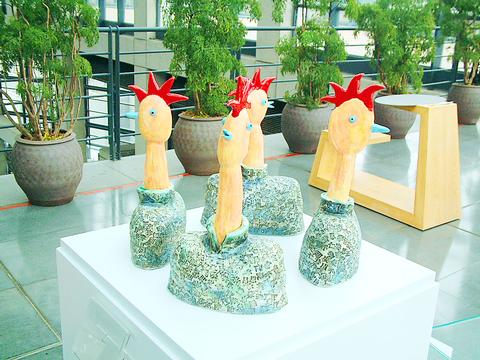
PHOTO COURTESY OF YCM
"I didn't begin studying pottery until I went to New Zealand," he said. "This gives me much more freedom that locally trained potters. I don't have to follow a tradition."
Works from his cooking series aim to express the immigrant experience. A bowl of barbed wire, which resembled fried noodles, are suggestive of how Asians are finding their own place in pastoral New Zealand. This follows a series of ceramic bananas, a visual representation of the joke about Chinese immigrants -- that they are yellow on the outside but white on the inside. "But I also make more utilitarian objects such as bowls and plates," admitted Ong, "because they sell much better."
But this exhibition was mostly about pushing ceramic art to the limits, and in this process, Taiwan hopes to play an increasingly big role. "Taiwan has a very big antenna," Ohi said, referring to the openness of Taiwan's potters to influences from around the world.
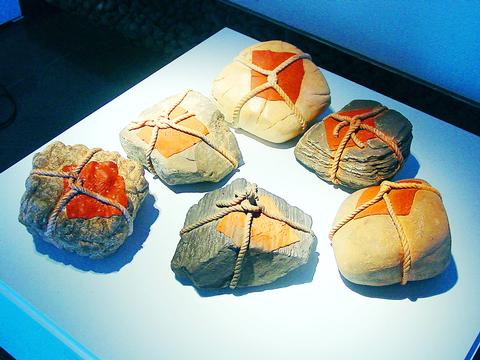
PHOTO COURTESY OF YCM
As the same time, he pointed out that the traditions of Chinese ceramics have been well preserved in Taiwan, and "ultimately, the source of Japanese, Korean and Taiwanese pottery all derive from China."
Park Sun Woo, a professor at the Department of Ceramics at the Seoul National University of Technology agreed, but echoed artists from Taiwan and Japan in finding a balance between the forces of internationalization and localization. "We want to preserve what is unique in the Korean tradition," he said "the elements of extreme simplicity and so on."
During the seminar, a question that arose more than once was a definition of the ceramic art as it pushes closer and closer to being an undifferentiated part of the contemporary art scene. While pottery, unlike other plastic arts, has a strong craft tradition that has brought it into the everyday life of people.
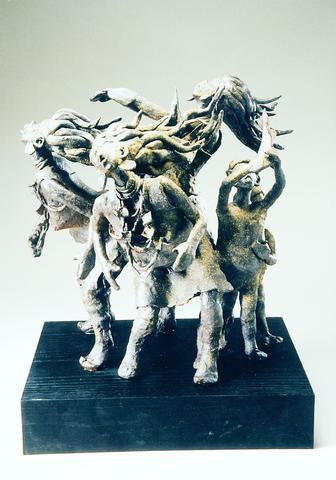
PHOTO COURTESY OF YCM
As it seeks to extend its boundaries, it comes up against questions of definition that would probably not be raised in association with traditional art materials such as bronze or marble.
"We have to make a new concept of the craft," said Ohi, and it is this role that he sees an institution such as the Yingko Ceramics Museum playing. From experimental works such as Chen Jing-liang's (
Asked why he set out on making his series of weird dancing tea pots, Ishijima said: "Well, I like tea pots, I wanted to give them more dynamism." With the interest this exhibition has created in the ceramic arts community in Taiwan, we can certainly expect more dynamism across the whole field of this art form.
The Yingko Ceramics Museum is open from 9:30am to 5pm Tuesday to Friday, closing at 8pm on Saturday and 6pm on Sunday. More information can be obtained at the museum's Web site at: http://www.ceramics.tpc.gov.tw. or by calling (02) 8677-4104.

In late October of 1873 the government of Japan decided against sending a military expedition to Korea to force that nation to open trade relations. Across the government supporters of the expedition resigned immediately. The spectacle of revolt by disaffected samurai began to loom over Japanese politics. In January of 1874 disaffected samurai attacked a senior minister in Tokyo. A month later, a group of pro-Korea expedition and anti-foreign elements from Saga prefecture in Kyushu revolted, driven in part by high food prices stemming from poor harvests. Their leader, according to Edward Drea’s classic Japan’s Imperial Army, was a samurai

Located down a sideroad in old Wanhua District (萬華區), Waley Art (水谷藝術) has an established reputation for curating some of the more provocative indie art exhibitions in Taipei. And this month is no exception. Beyond the innocuous facade of a shophouse, the full three stories of the gallery space (including the basement) have been taken over by photographs, installation videos and abstract images courtesy of two creatives who hail from the opposite ends of the earth, Taiwan’s Hsu Yi-ting (許懿婷) and Germany’s Benjamin Janzen. “In 2019, I had an art residency in Europe,” Hsu says. “I met Benjamin in the lobby

April 22 to April 28 The true identity of the mastermind behind the Demon Gang (魔鬼黨) was undoubtedly on the minds of countless schoolchildren in late 1958. In the days leading up to the big reveal, more than 10,000 guesses were sent to Ta Hwa Publishing Co (大華文化社) for a chance to win prizes. The smash success of the comic series Great Battle Against the Demon Gang (大戰魔鬼黨) came as a surprise to author Yeh Hung-chia (葉宏甲), who had long given up on his dream after being jailed for 10 months in 1947 over political cartoons. Protagonist

A fossil jawbone found by a British girl and her father on a beach in Somerset, England belongs to a gigantic marine reptile dating to 202 million years ago that appears to have been among the largest animals ever on Earth. Researchers said on Wednesday the bone, called a surangular, was from a type of ocean-going reptile called an ichthyosaur. Based on its dimensions compared to the same bone in closely related ichthyosaurs, the researchers estimated that the Triassic Period creature, which they named Ichthyotitan severnensis, was between 22-26 meters long. That would make it perhaps the largest-known marine reptile and would


 RSS
RSS