


Over the past decade, higher education in Taiwan has enjoyed rapid growth. Marked social and economic changes, along with the Ministry of Education's (MOE) adjustment of tuition fees and increase in research grants, as well as governmental recognition of private universities has seen both the number of universities and students skyrocket.
Whereas in 1988 Taiwan had a mere 84 institutes of higher learning, the number of colleges and universities now stands at 143.
Continuing with its support of the nation's higher education system, the MOE instituted the latest of its programs, the Key University Program, late last year. Designed to make the funding of universities by both governmental departments and the private sector more efficient, the program's long-term aim is to ensure that at least 10 of the nation's universities are of a world-class standard.
"Obviously Taiwan's universities are a lot younger than those in the US and UK. And because of this you could say that they are still developing in many ways," explained Li Chen-ching (
With the sweeping changes that have occurred in the nation's education system over the past decade and the abolishment of the Joint Entrance Examinations this year, Taiwan's higher education system should be in a healthy position in which to deal with entry into the WTO.
There are those within the education community, however, who feel the measures taken by the MOE are less than adequate. Scholars such as Ernie Ko (
"Reform of bureaucracy is important. The agency itself constantly faces internal struggles that occur between the 137 colleges and universities in Taiwan, the Department of Higher Education and Department of Vocational Education under the MOE respectively," stated Ko. "The MOE is not a division of labor, but conflicts of power and budget struggles."
Money matters
According to Ko the truth behind the debate surrounding the state of higher education is money. He feels that the building of alliances by universities pleases the MOE, but does little to benefit the students and faculties.
In preparation for WTO entry, the MOE endorsed four new regulations late last year.
While acknowledging that some of Taiwan's universities could well be put out of business because of falling student numbers, it is hoped that the new regulations will ensure the future of local education when the effects of WTO on the educational system become apparent over the next six months.
In line with WTO directives, the new regulations will make it easier for foreign nationals to establish bushibans (
The most sweeping of the changes in policy, and the one that has sparked heated debate, however, is that of the lifting of the regulation barring foreign universities from the US, Canada, Australia, Britain and other European nations establishing branches of their respective institutes in Taiwan.
"There are many in the educational system who believe the move will have a negative effect on local higher education, but I think that the WTO will have a good impact on Taiwan," said Chang Chiu-cheng (
"Obviously nobody knows at present how many will soon have headquarters here. But I'm expecting the number of foreign institutes, whether independently or in alliance with a local institute, to be quite high," explained Chang. "In order to counter the impact of these foreign universities, local institutes will finally be forced to improve. Either they do this or they will be forced to close as more and more students opt to study at universities overseas."
According to recent reports in the local press, one yet unnamed Australian university has already approached National Taiwan and Changda universities and the Massachusetts Institute of Technology has approached the National Taiwan and Chunghua universities in regards setting up on-campus representative offices and forging alliances.
While scholars such Chang are of the opinion that entry into the WTO will see a huge rise in the number foreign universities operating in Taiwan, the MOE is confident that the number of overseas universities setting up shop in Taiwan will remain relatively small.
"I very much doubt many foreign universities will actually set up campuses in Taiwan, as land is far too expensive," stated the director general. "We will see more and more alliances formed between local universities and overseas ones, but I certainly don't predict an invasion of foreign universities over the coming years." Not that those who opt to continue their higher education at foreign universities is a phenomenon new to Taiwan. Every year thousands of students travel abroad to gain MAs, MBAs and PhDs.
Last year over 27,000 students chose universities in Australia, New Zealand, the UK, Canada and the US over local ones in which to pursue their education. And it's not only western universities who are gaining. According to a report in the People's Daily (
China the greater threat
Scholars and bureaucrats agree that it will be sometime before China's universities begin to look for alliances in Taiwan. The increasing number of local students opting to go to China in order to gain educational qualifications, however, is viewed by some as a bigger threat to local higher education than that posed by western universities.
"Contrary to common speculation, the main challenge in the wake of Taiwan's entry to the WTO comes from the pressure of competition from across the Taiwan Strait rather than from US, EU or other counties," said Ko. "The primary reason behind this is the language barrier. Many of China's top universities are highly attractive to a vast majority of Taiwanese students who lack high TOEFL scores needed for universities in the west."
It's not only a matter of language, however, which is seeing increasing numbers of Taiwanese students opt for a higher education in China. Cost and political privileges also play an important role in the student's choice to study on the opposite side of the Taiwan Straits.
"If a Taiwanese student can pay a relatively lower price [tuition and fees] and get a degree on Chinese soil, why bother staying in Taiwan or studying in an expensive western university and paying a huge amount of money?" said Ko.
According to Ko, many students who lack the vocational skills needed to enroll at university in Taiwan's look to China's top universities, where admissions criterion is minimal, Ko feels that given time the numbers will increase, especially if cross-strait tensions are resolved.
Taiwan's many bushibans are also looking at ways in which to compete against larger, well-funded foreign universities.
"Obviously not all bushibans will be able to cope with the influx of foreign universities, and some will probably go out of business," said Emily Tsoung (
Regardless of the number of foreign universities that will set up headquarters and begin to enroll students directly from local university campuses, the actual effects of Taiwan's entry into the WTO on local education will not be known for quite some time. And while the MOE continues to paint a rosy picture of a healthy higher education system, there remain those who are skeptical of what the future could hold.
"WTO accession will not change things, good and bad, overnight," concluded Ko. "But it will magnify the weakness of existing problems within the educational system."

Last week Joseph Nye, the well-known China scholar, wrote on the Australian Strategic Policy Institute’s website about how war over Taiwan might be averted. He noted that years ago he was on a team that met with then-president Chen Shui-bian (陳水扁), “whose previous ‘unofficial’ visit to the US had caused a crisis in which China fired missiles into the sea and the US deployed carriers off the coast of Taiwan.” Yes, that’s right, mighty Chen caused that crisis all by himself. Neither the US nor the People’s Republic of China (PRC) exercised any agency. Nye then nostalgically invoked the comical specter
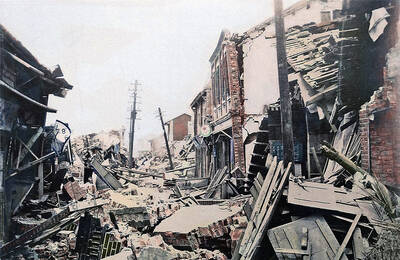
April 15 to April 21 Yang Kui (楊逵) was horrified as he drove past trucks, oxcarts and trolleys loaded with coffins on his way to Tuntzechiao (屯子腳), which he heard had been completely destroyed. The friend he came to check on was safe, but most residents were suffering in the town hit the hardest by the 7.1-magnitude Hsinchu-Taichung Earthquake on April 21, 1935. It remains the deadliest in Taiwan’s recorded history, claiming around 3,300 lives and injuring nearly 12,000. The disaster completely flattened roughly 18,000 houses and damaged countless more. The social activist and

Over the course of former President Ma Ying-jeou’s (馬英九) 11-day trip to China that included a meeting with Chinese Communist Party (CCP) leader Xi Jinping (習近平) a surprising number of people commented that the former president was now “irrelevant.” Upon reflection, it became apparent that these comments were coming from pro-Taiwan, pan-green supporters and they were expressing what they hoped was the case, rather than the reality. Ma’s ideology is so pro-China (read: deep blue) and controversial that many in his own Chinese Nationalist Party (KMT) hope he retires quickly, or at least refrains from speaking on some subjects. Regardless

Approaching her mid-30s, Xiong Yidan reckons that most of her friends are on to their second or even third babies. But Xiong has more than a dozen. There is Lucky, the street dog from Bangkok who jumped into a taxi with her and never left. There is Sophie and Ben, sibling geese, who honk from morning to night. Boop and Pan, both goats, are romantically involved. Dumpling the hedgehog enjoys a belly rub from time to time. The list goes on. Xiong nurtures her brood from her 8,000 square meter farm in Chiang Dao, a mountainous district in northern Thailand’s


 RSS
RSS