


Above the elevators inside the western entrance of the Taipei City Government's Shihlin District office, there is a very institutional-looking sign printed in both English and Japanese. It reads: "Information Service for Foreigners." But there is no floor number either on the sign or in the elevators, and in the utilitarian entryway there is no reception desk at which to ask directions.
The Information Service for Foreigners turns out to be at a long desk on the building's seventh floor, and hanging above it is a sign similar to that on the ground floor, only newer. An adjoining glassed-in conference room serves as a second facility, doubling as both a classroom and a lending library. Its book collection is sporadic -- among other things it contains at least 59 copies of Le Lys Dans la Vallee, a French novel by Honore Balzac. In total, there are two stacks of Japanese books, two stacks of French, two shelves of English and -- the most dog-eared of the lot -- two shelves of Vietnamese books, including Chinese textbooks for Vietnamese speakers.
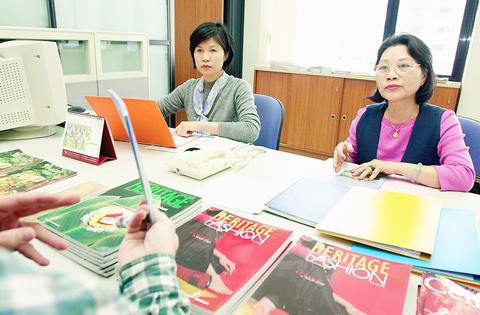
PHOTO: GEORGE TSORNG, TAIPEI TIMES
Other material resources consist of a rack of English language newspapers, two computers and rows of brochures. The brochures include everything from a tourist guide to the National Palace Museum to a 118-page manual entitled Vietnamese Wife: A Mother and Child's Living Handbook" (
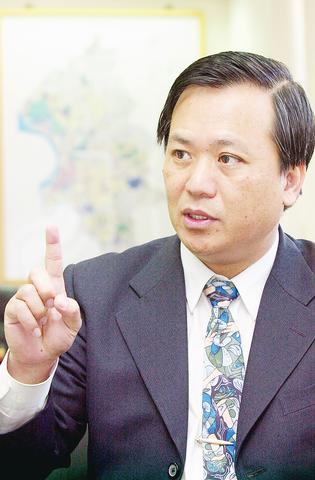
PHOTO: GEORGE TSORNG, TAIPEI TIMES
Shihlin's foreigners' help center was formally established on Feb. 20, and is Taipei City Government's first information center designed exclusively to cater to foreign residents. It is brand new, running on donations and volunteers, and only beginning to develop its programs.
It is also discovering that it is two different things at the same time. On one hand, the service is a goodwill gesture and communications link to a community of bourgeois Tienmu expatriates. On the other, it is a fledgling outreach program -- and one of Taipei City Government's first -- for Taiwan's relatively voiceless foreign populations, including Thais, Indonesians, Filipinos and especially Vietnamese brides.
Among the desk's more practical services is the opportunity to schedule a free consultation with a volunteer lawyer and have a second bilingual volunteer interpret at the meeting (such legal services were previously only available to Mandarin and Taiwanese speakers).
The Shihlin district office also distributes a few useful and little known English-language publications, including a short handbook of useful agencies and addresses in Shihlin, and a guidebook for diagnosing and reporting dangerous mountainside erosion or crumbling.
Mostly through its telephone lines, the service is also able to handle many other kinds of questions. If a volunteer speaking a certain language is not available at the time of a call, referrals can be made to other volunteers. This will likely happen with most European languages, as well as Vietnamese and Indonesian.
Programs that are largely social in nature include a tuition-free introductory Mandarin class (Mondays 9:30-11:30am) and a Wednesday morning coffee and tea club (same hours).
The volunteers at the desk, mostly middle-aged housewives, can be very eager to help. Upon seeing me, a foreigner, two new volunteers, who found out about the program in recent Chinese newspaper reports, didn't hesitate to ask what exactly they should do that would help the most. I told them that most North American or European foreigners had enough resources, skills or friends to solve most of their problems by themselves.
Other volunteers with skills in English, French or other European languages who've been at the desk a while, like Ho, say that most foreigners ask about extending their visas. She's also handled issues as diverse as noise complaints and reporting stray dogs.
Such bureaucratic headaches tend to pale in comparison to the problems encountered by volunteer Ruan Yen-juan (阮豔娟), a native of Vietnam who's been living in Taiwan for eight years (she's married to a Taiwanese man, but the match was not arranged through any agency). She speaks of Vietnamese brides who are mistreated or even beaten by their husbands, who have no social outlets or means of contacting their families, and who are much younger than their socially inept husbands.
"About 10 percent will flee back to Vietnam," she said, "and about 80 percent of the men who marry them wouldn't have any chance of finding a Taiwanese wife."
Currently, there are an estimated 60,000 Vietnamese brides in Taiwan. Most were introduced to their local husbands through bride camps or brokers, who have been reported to take matchmaking fees ranging from NT$10,000 to NT$300,000. Part of the matchmaking fee customarily goes to the bride's family in Vietnam.
The Shihlin district office created a class for Vietnamese brides two years ago, with the first session taking place between Sept. 5 and Nov. 17, 2000. A second session followed from March to May of the following year. Teachers consisted mostly of volunteers, and subject matter covered basic Mandarin, some general counseling and some instruction in handicrafts. Between 30 and 40 women enrolled in each session, including two from Indonesia and one each from the Philippines and Thailand. The next class will begin in August or September of this year.
"As much as anything, the class also served a social function, giving the women a chance to meet and make friends," said Sun Wen-pei (孫文珮), a Shihlin district employee who works with the foreigners' programs.
Like the foreign brides services then, Shihlin's more general foreigners' service' have been incubating for some time. The Shihlin district office began offering English-language information services for two years through bilingual staffers.
The man behind these initiatives is Jason Yeh (
"Shihlin is unique in its foreign community, which dates back to the Vietnam War era. There are about 8,000 foreigners in Shihlin, especially in Tienmu, and though there may be more foreigners in other [Taipei] districts, like Ta-an, Shihlin has several foreign schools, like the American school, the Japanese school and the European school, and is home to many families and long term residents," said Yeh.
Yeh, who has never lived or studied abroad, had to deal with friction between locals and foreigners soon after taking his current post in 1999. An incident occurred in which a lichang came to blows with a Taipei American School (TAS) student who was painting graffiti. In June of that year, Yeh brought the lichang, the student, the TAS principal and other members of both communities together for a meeting that cooled the tensions. A year later, the first bilingual information services were incorporated into Shihlin's district office.
The course for foreign brides came about as Yeh became aware of the rapidly growing trend. "There were so many of them, and many had children, so obviously these people were part of Taiwan and needed services," he said.
After Shihlin initiated the Vietnamese brides course, other Taipei City districts have followed suit. In 2001, Ta-an, Wanhua, Sungshan and Chungshan all established their own foreign brides' courses. Shihlin's bilingual information service has caught on elsewhere as well, though no other district has yet devoted an entire desk to it.
But in Shihlin as elsewhere, all these programs are supported by volunteers and donations rather than public funds. The recently established Information Service for Foreigners was put together with a couple of old computers, a spare corner of the Shihlin district office's 7th floor and good intentions.
"The city government hasn't given us any budget yet, but Mayor Ma Ying-jeou (
Shihlin's Information Service for Foreigners is open weekdays from 9:30 to 11:30am and 2:30 to 4:30pm, and is staffed by Vietnamese-speaking volunteers on Fridays. It is located on the seventh floor of the Shihlin district office, at 439 Chungcheng Rd. (
SOURCE: TAIPEI FOREIGN AFFAIRS POLICE

Last week Joseph Nye, the well-known China scholar, wrote on the Australian Strategic Policy Institute’s website about how war over Taiwan might be averted. He noted that years ago he was on a team that met with then-president Chen Shui-bian (陳水扁), “whose previous ‘unofficial’ visit to the US had caused a crisis in which China fired missiles into the sea and the US deployed carriers off the coast of Taiwan.” Yes, that’s right, mighty Chen caused that crisis all by himself. Neither the US nor the People’s Republic of China (PRC) exercised any agency. Nye then nostalgically invoked the comical specter

Relations between Taiwan and the Czech Republic have flourished in recent years. However, not everyone is pleased about the growing friendship between the two countries. Last month, an incident involving a Chinese diplomat tailing the car of vice president-elect Hsiao Bi-khim (蕭美琴) in Prague, drew public attention to the People’s Republic of China’s (PRC) operations to undermine Taiwan overseas. The trip was not Hsiao’s first visit to the Central European country. It was meant to be low-key, a chance to meet with local academics and politicians, until her police escort noticed a car was tailing her through the Czech capital. The

April 15 to April 21 Yang Kui (楊逵) was horrified as he drove past trucks, oxcarts and trolleys loaded with coffins on his way to Tuntzechiao (屯子腳), which he heard had been completely destroyed. The friend he came to check on was safe, but most residents were suffering in the town hit the hardest by the 7.1-magnitude Hsinchu-Taichung Earthquake on April 21, 1935. It remains the deadliest in Taiwan’s recorded history, claiming around 3,300 lives and injuring nearly 12,000. The disaster completely flattened roughly 18,000 houses and damaged countless more. The social activist and

Over the course of former President Ma Ying-jeou’s (馬英九) 11-day trip to China that included a meeting with Chinese Communist Party (CCP) leader Xi Jinping (習近平) a surprising number of people commented that the former president was now “irrelevant.” Upon reflection, it became apparent that these comments were coming from pro-Taiwan, pan-green supporters and they were expressing what they hoped was the case, rather than the reality. Ma’s ideology is so pro-China (read: deep blue) and controversial that many in his own Chinese Nationalist Party (KMT) hope he retires quickly, or at least refrains from speaking on some subjects. Regardless


 RSS
RSS