


For most people in Taiwan, fish in glass tanks have only a handful of uses.
Restaurateurs like to display them at the fronts of dining rooms to serve as visual menus. The average family or office, meanwhile, pays hefty consultation fees to have them installed according to the rules of feng shui, which, in the simplest terms, is supposed to bring in more money.
The National Museum of Marine Biology and Aquarium (國立海洋生物博物館), which opened in February last year in Checheng, Pingtung County, will probably not impact any of that, but it's at least purporting to have a more educational and eco-conscious use for the fish tank.
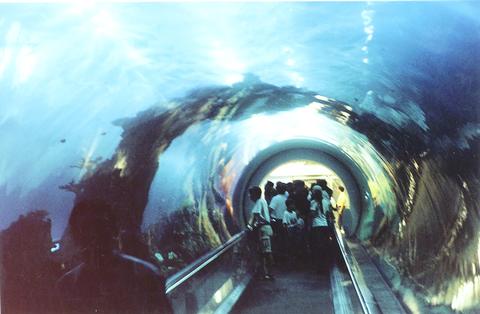
PHOTO: DAVID FRAZIER, TAIPEI TIMES
Billed as "the largest aquarium in Asia" and "the first aquarium in Taiwan," the marine life museum now consists of two major halls to showcase the aquatic plants and animals of Taiwan, as well as research facilities designed to study them.
The aquarium is located near Kenting, the country's prime beach resort on the Hungchuen peninsula at the southern tip of the island. The clear, tropical waters and the reefs buffeting the peninsula make the region one of Taiwan's choice diving spots.
For anyone interested in scuba diving or snorkeling in the area, the aquarium is a good way to acquaint oneself with the local marine life, especially dangerous fish like moray eels, lion fish and stone fish, which are hard to spot and highly poisonous to the touch.
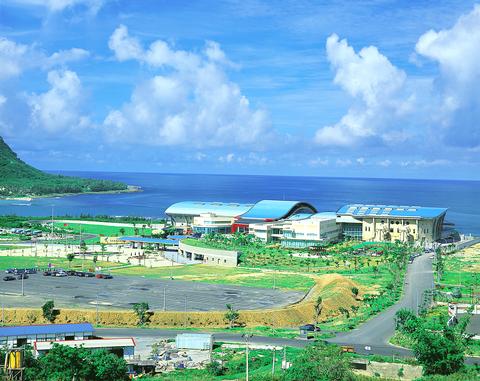
PHOTO COURTESY OF NMMBA
A tour of the aquarium starts in Hall One, "Waters of Taiwan," which moves from the fresh water fish of Taiwan's lakes and streams to the fish of estuaries and near-coastal areas and then on to ocean life, culminating in a 3.7 million-liter tank where Scandinavian women give fish-feeding performances several times a day.
Most surprising are the healthy fresh-water specimens, especially the hefty carp and trout in tanks representing Taiwan's mountain reservoirs.
Tour guide Peng Hsu-hsia (彭淑霞) explained that "fish which live in reservoirs tend to get pretty fat, because there's lots of food and they don't get much exercise."
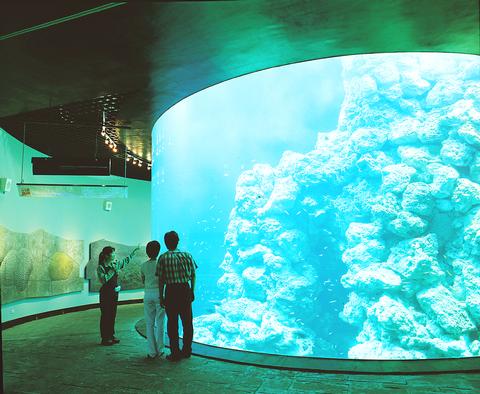
PHOTO COURTESY OF NMMBA
Hall Two, "Coral Kingdom," is devoted to the reefs around Taiwan. The building's design simulates the experience of submerging into the reef by leading visitors down a gradually sloping floor into the tank. This hall is best known for a 5.6 million-liter tank that is traversed by 81m of underwater tunnels, bringing one through a pristine seascape of natural table coral and tropical fish too numerous to name.
Reefs and coral life are a major focal area for study by the scientists and researchers working with and through the aquarium. Among other projects, researchers at a nearby dive site, Maobitou, are involved in photographing and documenting conditions at several areas of the reef that have been tagged with small plaques. Many of Taiwan's reefs are disappearing due to a combination of causes, including hordes of divers walking over coral and killing it, sedimentation, in which muddied water starves coral of sunlight, and nutrification, in which ecosystem imbalances allow algae to breed unchecked, depriving coral of water-borne nutrients.
On the Hengchuen peninsula, one culprit for reef death is the Second Nuclear Power Plant, which disgorges its heated runoff onto adjacent reefs, one of which is located immediately next to the popular tourist beach of Nanwan.

PHOTO COURTESY OF NMMBA
The power plant is located about 10km away from the aquarium, and aquarium researchers, like those at Maobitou, are actually using the power plant's destructive effects to gather knowledge they hope will help save reefs in other parts of the world. By charting the accelerated coral bleaching process in the power plant-heated waters, they hope to form a gauge to assess reef damage, especially for many parts of Southeast Asia, where water temperatures have slowly risen in recent years.
Aquarium staff have also performed other useful tasks. They've looked into damage from the oil slick dropped earlier this year by the wrecked Greek freighter, Amorgos, and investigated an instance of deformed fish spotted in the nuclear power station's run-off.
Though only as inspiring as any zoo or aquarium could possibly be, the National Museum of Marine Biology and Aquarium definitely affords a few glimpses of the undersea world that are hard to come by, even for scuba divers.
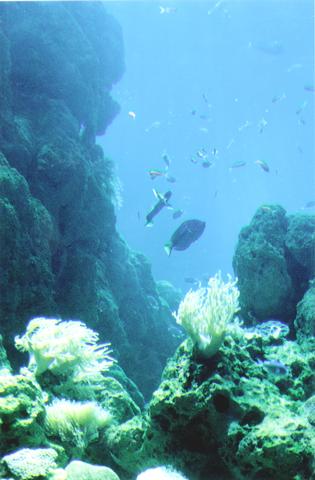
PHOTO: DAVID FRAZIER, TAIPEI TIMES
Take for example the shark tank in Hall Two, in which about 60 lemon sharks, white tip sharks and black tip sharks swirl around visitors. On our recent tour, as the tour guide Peng and I leisurely strolled through a tunnel penetrating the sharks' 3 million-gallon tank, we noticed a man in the water with an air hose, a suction device and a scrub pad. It was his job to clean the walls, and we felt kind of sorry for him -- partially because of the sharks, but also because he had a long way to go.
What: National Museum of Marine Biology and Aquarium
Where: Pingtung County, Checheng township, Houwan Tsuen, 2 Houwan Rd. (
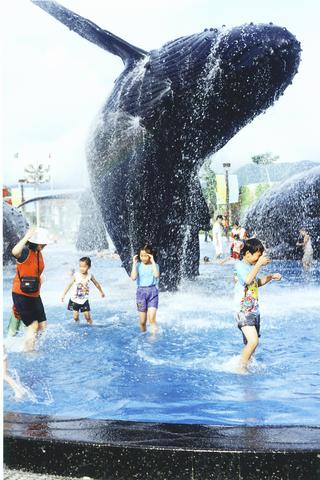
PHOTO: DAVID FRAZIER, TAIPEI TIMES
Other: Tel: (08) 882-5678. Admission: NT$300, children under 110cm tall enter free. For more information on the museum, check: http://www.nmmba.gov.tw

In late October of 1873 the government of Japan decided against sending a military expedition to Korea to force that nation to open trade relations. Across the government supporters of the expedition resigned immediately. The spectacle of revolt by disaffected samurai began to loom over Japanese politics. In January of 1874 disaffected samurai attacked a senior minister in Tokyo. A month later, a group of pro-Korea expedition and anti-foreign elements from Saga prefecture in Kyushu revolted, driven in part by high food prices stemming from poor harvests. Their leader, according to Edward Drea’s classic Japan’s Imperial Army, was a samurai
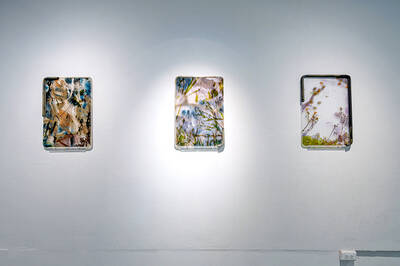
Located down a sideroad in old Wanhua District (萬華區), Waley Art (水谷藝術) has an established reputation for curating some of the more provocative indie art exhibitions in Taipei. And this month is no exception. Beyond the innocuous facade of a shophouse, the full three stories of the gallery space (including the basement) have been taken over by photographs, installation videos and abstract images courtesy of two creatives who hail from the opposite ends of the earth, Taiwan’s Hsu Yi-ting (許懿婷) and Germany’s Benjamin Janzen. “In 2019, I had an art residency in Europe,” Hsu says. “I met Benjamin in the lobby

April 22 to April 28 The true identity of the mastermind behind the Demon Gang (魔鬼黨) was undoubtedly on the minds of countless schoolchildren in late 1958. In the days leading up to the big reveal, more than 10,000 guesses were sent to Ta Hwa Publishing Co (大華文化社) for a chance to win prizes. The smash success of the comic series Great Battle Against the Demon Gang (大戰魔鬼黨) came as a surprise to author Yeh Hung-chia (葉宏甲), who had long given up on his dream after being jailed for 10 months in 1947 over political cartoons. Protagonist

A fossil jawbone found by a British girl and her father on a beach in Somerset, England belongs to a gigantic marine reptile dating to 202 million years ago that appears to have been among the largest animals ever on Earth. Researchers said on Wednesday the bone, called a surangular, was from a type of ocean-going reptile called an ichthyosaur. Based on its dimensions compared to the same bone in closely related ichthyosaurs, the researchers estimated that the Triassic Period creature, which they named Ichthyotitan severnensis, was between 22-26 meters long. That would make it perhaps the largest-known marine reptile and would


 RSS
RSS