


Taiwanese author Yang Kui (
Years later he would wryly remark that he "is the best-rewarded writer in the history of Taiwan, averaging a five-day jail term per word."
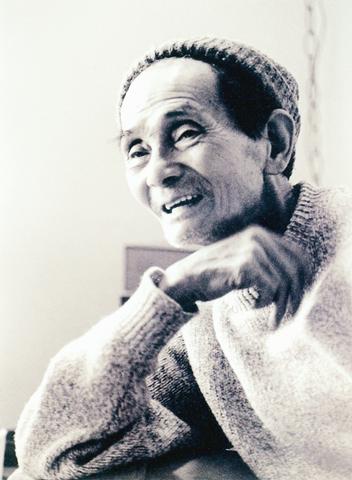
PHOTO COURTESY OF THE NATIONAL CULTURAL HERITAGE PRESERVATION RE
According to the prominent Hakka writer Chung Chau-cheng (
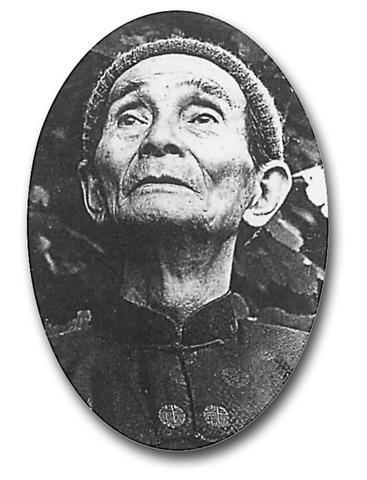
Chung said Yang not only expressed his opposition to repressive Japanese colonial rule, but was also motivated by a strong sense of class-consciousness, which greatly enlightened writers of subsequent generations.
Born into a tinsmith's family in Tainan, Yang witnessed the 1915 Tapani Massacre by the Japanese (
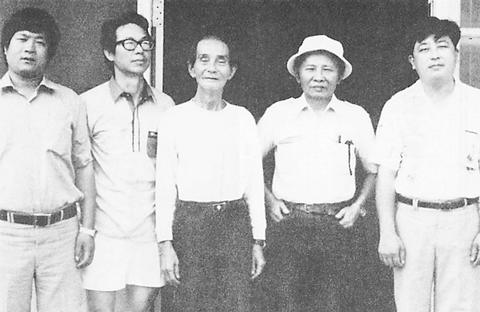
PHOTO: COURTESY OF AVANT GRADE PUBLISHING CO
As a teenager, Yang was interested in Japanese, Russian and Western realist literature, such as Victor Hugo's Les Miserables, and became engrossed in their themes of humanism.
He fled to Japan in 1924 to escape an arranged marriage and there continued his studies. While in Japan, Yang was deeply impressed by the mainstream development of socialism.
"Yang was a true believer in Marxism, but not dogmatic. He used his literary works to deal with class and racial issues of his time, vividly expressing his stern opposition to colonialism and imperialism," said Chen Fang-ming (
In Japan, Yang worked his way through college as a newspaper boy and a part-time cement worker -- experiences that would later provide the backdrops to his novels. He was arrested for the first time on a charge of participating in a demonstration, but spent only three days in jail.
In 1927, at the request of farmers' organizations, Yang returned to Taiwan to join forces with them in promoting farmers' movements. Beginning from this time, Yang and his wife Yeh Tao (
Yang was honored in 1934 as the first Taiwanese writer to receive the Literary Criticism Award with his book The Newspaper Boy (
The Newspaper Boy, written in 1932 in Japanese, tells the story of Taiwanese newspaper boys' miserable lives and exploitation at the hands of a Japanese newspaper owner, who is eventually brought down when the workers go on strike for better pay and working conditions. The novel not only was an open rebuke of capitalism, but also centered on class struggle and conflict.
"The confrontation [presented in Yang's work] was not an oversimplified story of disadvantaged Taiwanese and advantaged Japanese. The story was complicated by human nature," said Yang's granddaughter, Yang Tsui (
Yang devoted his youth to farmers' movements in the 1930s and took charge in the movements' organization, earning praise as a pioneer of so-called "committed literature" (參與的文學) in Taiwan, a genre which usually depicts the poverty and misery of the poor and disenfranchised. Yang's strong opposition to capitalism even led him to name his first son Yang Tzu-beng (楊資崩), the son's given name translating as "the collapse of capitalism."
"Yang was not all talk and no action. He used his novels to correct the erroneous history forced on people by their rulers, and, moreover, he exerted his leadership on farmers' organizations," said Lin Juei-min (林瑞明), professor of Taiwanese literature at National Cheng Kung University.
Yang's legacy is simultaneously one of a social activist and of a man of letters.
"Yang's importance in the social movement outweighed that of his literary achievement," said writer Tseng Ching-wen (
Other critics, however, see a literary giant in Yang's writings.
Chen of Chengchi University cites, for example, Yang's masterpiece In Bud (
Yang continued to be as outspoken and radical under KMT rule as he was under Japanese colonial rule, Chen said. He introduced works by China's leftist writer Lu Xun (魯迅) to Taiwan, was highly critical of the KMT's policy to promote Mandarin and even encouraged young people in Taiwan to organize self-defense corps to fight the KMT, all of which could have earned him a death sentence.
To silence him, the KMT tried locking him up. But even that did not work. During his 12-year imprisonment on Green Island (綠島), which began in 1949, Yang wrote letters home, literary works on the jail wall and critiques dubbed "roses that cannot be squelched" (壓不扁的玫瑰).
Yang finished his days at his own Tonghai Garden (
"Yang was a very quiet person. He could read at his desk without uttering a word all day," said Lin, who spent a year with Yang.
Yang's granddaughter described the writer as a typical Taiwanese grandfather, who was at times childlike. "He was a very innocent, romantic and optimistic person, who insisted on distancing himself from power," she said, summing up the man's three driving motivations in life as knowledge, labor and social movements.
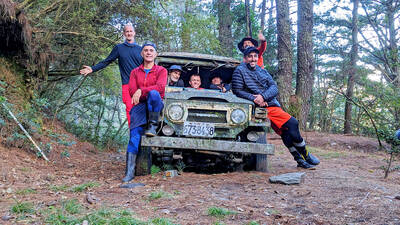
The year was 1991. A Toyota Land Cruiser set out on a 67km journey up the Junda Forest Road (郡大林道) toward an old loggers’ camp, at which point the hikers inside would get out and begin their ascent of Jade Mountain (玉山). Little did they know, they would be the last group of hikers to ever enjoy this shortcut into the mountains. An approaching typhoon soon wiped out the road behind them, trapping the vehicle on the mountain and forever changing the approach to Jade Mountain. THE CONTEMPORARY ROUTE Nowadays, the approach to Jade Mountain from the north side takes an

Last week Joseph Nye, the well-known China scholar, wrote on the Australian Strategic Policy Institute’s website about how war over Taiwan might be averted. He noted that years ago he was on a team that met with then-president Chen Shui-bian (陳水扁), “whose previous ‘unofficial’ visit to the US had caused a crisis in which China fired missiles into the sea and the US deployed carriers off the coast of Taiwan.” Yes, that’s right, mighty Chen caused that crisis all by himself. Neither the US nor the People’s Republic of China (PRC) exercised any agency. Nye then nostalgically invoked the comical specter

Relations between Taiwan and the Czech Republic have flourished in recent years. However, not everyone is pleased about the growing friendship between the two countries. Last month, an incident involving a Chinese diplomat tailing the car of vice president-elect Hsiao Bi-khim (蕭美琴) in Prague, drew public attention to the People’s Republic of China’s (PRC) operations to undermine Taiwan overseas. The trip was not Hsiao’s first visit to the Central European country. It was meant to be low-key, a chance to meet with local academics and politicians, until her police escort noticed a car was tailing her through the Czech capital. The
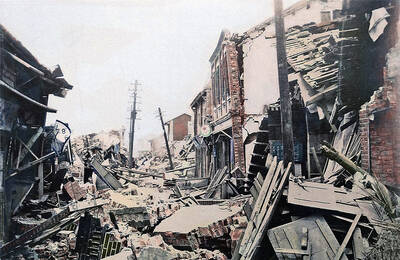
April 15 to April 21 Yang Kui (楊逵) was horrified as he drove past trucks, oxcarts and trolleys loaded with coffins on his way to Tuntzechiao (屯子腳), which he heard had been completely destroyed. The friend he came to check on was safe, but most residents were suffering in the town hit the hardest by the 7.1-magnitude Hsinchu-Taichung Earthquake on April 21, 1935. It remains the deadliest in Taiwan’s recorded history, claiming around 3,300 lives and injuring nearly 12,000. The disaster completely flattened roughly 18,000 houses and damaged countless more. The social activist and


 RSS
RSS