


Driving along the windswept Northern Coastal Highway, between the seafood haven of Audi (
But the area, in which the township of Kungliao falls, has become notorious as the site of the Fourth Nuclear Power Plant (核四).
Yenliao is located within the Northeast Coast National Scenic Area Administration (
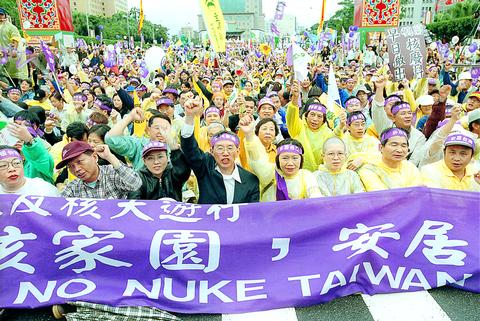
PHOTO: CHIANG YING-YING, TAIPEI TIMES
"It is unfortunate that the geological factors that make this area beautiful [the massive outcrops of volcanic rock] also make it ideal for the location of a nuclear plant," said Tseng Kuo-chi (曾國基), secretary of the scenic area administration. "The first two nuclear plants are located on the Kinshan (金山) and Wanlin (萬里) coastline. The third plant is in Kenting," Tseng said with an embarrassed shrug. These are all areas rich in tourism resources.
Looking up from the Yenliao Beach Park (鹽寮海濱公園), the tall cranes, now abandoned, at least temporarily, make a strange backdrop to what Lo Che-chi (羅哲紀) hopes will be the future of tourism on Taiwan's northeast coast.
Lo is the director of Today Tomorrow (
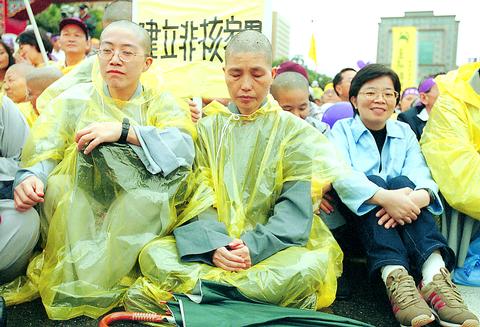
PHOTO: CHIANG YING-YING, TAIPEI TIMES
In the design of the resort, "we do not intend to encourage people to bathe in the sea water," Lo said. With this in mind, he felt confident that whether the Fourth Nuclear Power Plant goes ahead or not, the beach park will be able to attract tourists. "Most Taiwanese don't like beaches anyway," he said, "especially when they have a lovely environment like this with shade and bathing pools."
"In any case, if we judge from other places [such as Nanwan in Kenting, which is located next to the Third Nuclear Power Plant], the completion of the plant will not affect tourist numbers here."
As for the people who actually live in Kungliao, they have mixed feelings about what the development of the northeast coast is likely to bring. Wu Shu-chin (吳淑真) of the Haihsianchiao Seafood Restaurant in nearby Audi laments the loss of business from people connected with the power plant construction project.
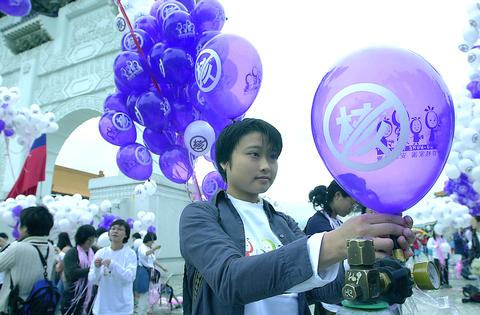
PHOTO: CHIANG YING-YING, TAIPEI TIMES
"With more money and more opportunities, the construction brought many young people back to Yanliao," Wu said. "And the subsidies [provided by Taipower for people in the region] mean that our children could receive a better education." For Wu, the Fourth Nuclear Power Plant represented economic opportunity for a poor and underdeveloped area. "I don't think more than a third of the local people are anti-nuclear," she said. "Better education will give our children a better future."
Others see this attitude as fundamentally shortsighted.A local laborer working on the nearby construction of a sports park sponsored by the Kungliao Township Administration Office (
But going back to the past is notoriously difficult, and according to Huang Wen-hsiung (黃文雄), head of the construction section of the administration office, while the power plant project has had little impact on the livelihood of local residents, tourism might prove to be a more destructive force to local lifestyles.
"Many local people resent the scenic area administration. By closing off sections of the coast for paying customers, local people who used to swim and fish in this area are driven away," he said.
While the danger brought to the environment in this section of the northeast coast by the construction of the Fourth Nuclear Power Plant may now be in abeyance, the threat of ClubMed-style development along the coast might pose a greater threat.
Asked if the massive structure of the completed power plant could be damaging to tourism, Tseng said "most Taiwanese are not very sensitive to scenic impact."
"The greatest difficulty with tourism in this area is Mother Nature," he added. Seasonal rains and the northeast wind cause a huge fluctuation in tourist numbers. "This kind of seasonal fluctuation is very destructive to tourism development," he said.
Lo agreed, saying that only if facilities are created to cater for year-round visitors -- in the case of the Yenliao Beach Park, this means an artificial environment sheltered from the sea by windbreaks 10m high -- can the quality of tourism in the area be increased.
But for local residents, this brings little consolation. Whatever benefits either the nuclear power plant or tourism may offer, Mother Nature seems to be in danger of being firmly put into second place.

Last week Joseph Nye, the well-known China scholar, wrote on the Australian Strategic Policy Institute’s website about how war over Taiwan might be averted. He noted that years ago he was on a team that met with then-president Chen Shui-bian (陳水扁), “whose previous ‘unofficial’ visit to the US had caused a crisis in which China fired missiles into the sea and the US deployed carriers off the coast of Taiwan.” Yes, that’s right, mighty Chen caused that crisis all by himself. Neither the US nor the People’s Republic of China (PRC) exercised any agency. Nye then nostalgically invoked the comical specter
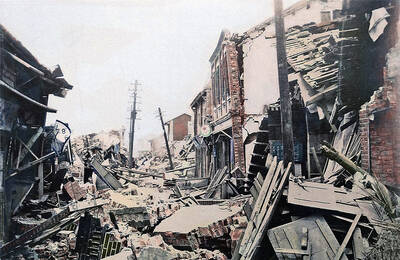
April 15 to April 21 Yang Kui (楊逵) was horrified as he drove past trucks, oxcarts and trolleys loaded with coffins on his way to Tuntzechiao (屯子腳), which he heard had been completely destroyed. The friend he came to check on was safe, but most residents were suffering in the town hit the hardest by the 7.1-magnitude Hsinchu-Taichung Earthquake on April 21, 1935. It remains the deadliest in Taiwan’s recorded history, claiming around 3,300 lives and injuring nearly 12,000. The disaster completely flattened roughly 18,000 houses and damaged countless more. The social activist and

Over the course of former President Ma Ying-jeou’s (馬英九) 11-day trip to China that included a meeting with Chinese Communist Party (CCP) leader Xi Jinping (習近平) a surprising number of people commented that the former president was now “irrelevant.” Upon reflection, it became apparent that these comments were coming from pro-Taiwan, pan-green supporters and they were expressing what they hoped was the case, rather than the reality. Ma’s ideology is so pro-China (read: deep blue) and controversial that many in his own Chinese Nationalist Party (KMT) hope he retires quickly, or at least refrains from speaking on some subjects. Regardless

Approaching her mid-30s, Xiong Yidan reckons that most of her friends are on to their second or even third babies. But Xiong has more than a dozen. There is Lucky, the street dog from Bangkok who jumped into a taxi with her and never left. There is Sophie and Ben, sibling geese, who honk from morning to night. Boop and Pan, both goats, are romantically involved. Dumpling the hedgehog enjoys a belly rub from time to time. The list goes on. Xiong nurtures her brood from her 8,000 square meter farm in Chiang Dao, a mountainous district in northern Thailand’s


 RSS
RSS