


It is there in the new 3D version of Titanic, as it was in James Cameron’s original film: a modified version of Picasso’s painting Les Demoiselles d’Avignon aboard the ship as it sinks.
Of course, that 1907 masterpiece was never lost in the North Atlantic. It has been at the New York Museum of Modern Art (MOMA) for decades — which is precisely the reason the Picasso estate, which owns the copyright to the image, refused Cameron’s original request to include it in his 1997 movie.
However, Cameron used it anyway.
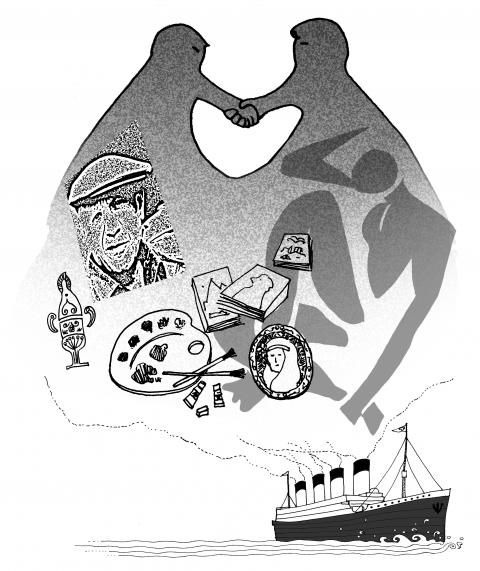
After the Artists Rights Society, a company that guards intellectual property rights for more than 50,000 visual artists and their estates, including Picasso’s, complained, Cameron agreed to pay a fee for the right to use the image.
With the re-release of Titanic, the society wants Cameron to pay again, asserting that the 3D version is a new work not covered under the previous agreement.
“I don’t expect we’ll have any difficulty,” said Theodore Feder, president of the society, who contacted Cameron last week.
Filmmakers are not the only ones who sometimes run afoul of artists’ copyright law. In recent weeks, the Google Art Project, which just expanded its online collection of images to more than 30,000 works from 151 museums, agreed to remove 21 images it had posted because of copyright challenges.
Artists’ copyright is frequently misunderstood. Even if a painting (or drawing or photograph) has been sold to a collector or a museum, the artist or their heirs retain control of the original image for 70 years after the artist’s death.
Think of a novel. You may own a book, but you do not own the writer’s words; they remain the intellectual property of the author for a time.
So while MOMA owns the actual canvas of Les Demoiselles, the family of Picasso, who died in 1973, still owns the image — and under existing law, the estate will continue to own the copyright until 2043.
If someone wants to reproduce the painting — on a Web site, a calendar, a T-shirt, or in a film — it is the estate that must give its permission, not the museum. That is why, despite the expansion, the Google Art Project still does not contain a single Picasso.
Indeed, few 20th-century artists are included in the project’s digital collection because copyright owners have not yet given permission.
“We don’t want to prevent Google from showing the work, but they won’t enter into negotiations with us,” Feder said.
The Art Project’s position is that it is the responsibility of each museum to get copyright permission.
“Google is placing the burden and onus on the museum, which is unfair to them and unfair to the artists,” Feder said.
Robert Panzer, executive director of VAGA, another company that represents the copyright interests of artists, said that Google was legally responsible for securing the permissions.
“It’s a game that they should try to make it someone else’s responsibility,” said Panzer, whose group represents more than 7,000 artists worldwide.
The Toledo Museum of Art in Ohio recently asked the Google Art Project to remove Dancer Resting (1940), by Henri Matisse, as well as 20 other images from its collection that are under copyright.
“There had been some confusion on all sides,” director of communications for the Toledo museum Kelly Garrow said.
“We want those works on the Art Project, but there needs to be some type of agreement to make that happen,” he added.
Panzer, whose group is currently reviewing all the work posted on the Art Project, said the underlying question was what Google’s business plans are in the long term.
“We have to make sure that the artists’ interests from an aesthetic point of view and a commercial point of view are protected,” Panzer said.
Amit Sood, head of the Google Art Project, said it had decided early on to focus on its partnerships with museums.
“We have been approached by commercial organizations who wanted to sell us content, but we chose to work directly with the museums,” Sood said.
“We believe they are in the best position to assess rights status and we are happy to work with them to address any concerns,” he added.
Groups representing authors and publishers have been trying for years to come to an agreement with Google over its plan to digitize every book published. However, after a federal judge threw out a proposed settlement last year citing copyright and monopoly concerns, no agreement is in sight.
“Every artist is going to have a different view of it. Some will think it’s the greatest thing in the world and others will be horrified, just as the writers were, and just as musicians have been,” said Raymond Dowd, a lawyer who has represented both sides on copyright questions, about the Google Art Project.
Copyright law covers everything from reproductions in books to those used on keychains.
“We try to acquire as much information as we can about a project, and then we go to the estate,” Feder said.
His organization, like VAGA, takes a percentage of the fee, which varies depending on the use.
Sometimes artists or estates want input. In last year’s film Tower Heist, for example, the estate of Dan Flavin sent an expert to oversee the construction of a Flavin light installation that was recreated on the set.
Often, celebrated masterpieces end up as nothing more than background scenery. That Alexander Calder you may have noticed in The Muppets, the Charles Roka in The Girl With the Dragon Tattoo or the Noguchi in Friends With Benefits were all used with the permission of the Artists Rights Society. Paul Klee’s Mask of Fear, for instance, will make its film debut later this year in Cloud Atlas with Tom Hanks, Halle Berry and Natalie Portman.
Some news media outlets, including the New York Times, have agreements with the companies that set the terms under which they can make use of copyrighted images from the artists the companies represent.
In about 40 percent of its cases, the society ends up trying to prevent the use of an image, Feder said. Multimillion-dollar movie productions can present a challenge, however. Given the money involved, filmmakers are sometimes willing to risk the expense of a lawsuit and penalties after the movie’s release.
For example, when making Basquiat, the 1996 biographical film about the painter Jean-Michel Basquiat, the film’s director, Julian Schnabel, ignored the objections of the artist’s father and created paintings in Basquiat’s style for his movie, Feder said. Using these sorts of “derivative” images is also prohibited by copyright law, but Schnabel used them anyway, he said. In the end, Basquiat declined to sue.
Other filmmakers have tried to comply with family requests. Ismail Merchant and James Ivory sent the Picasso family a script of their 1996 film, Surviving Picasso, and then flew to Paris to make their case in person. However, the estate was unhappy that Picasso was portrayed as an inconsiderate womanizer, so it refused to grant its permission. Instead, to recreate the aesthetic atmosphere, the filmmakers used work by Picasso’s contemporaries, Matisse and Braque.
Feder said that when he saw Titanic 3D, he noticed one revision he appreciated: A fleeting shot of Les Demoiselles going underwater had been replaced by Edgar Degas’ work L’Etoile — which was also never on the ship but is at least a painting already in the public domain.
From the Iran war and nuclear weapons to tariffs and artificial intelligence, the agenda for this week’s Beijing summit between US President Donald Trump and Chinese President Xi Jinping (習近平) is packed. Xi would almost certainly bring up Taiwan, if only to demonstrate his inflexibility on the matter. However, no one needs to meet with Xi face-to-face to understand his stance. A visit to the National Museum of China in Beijing — in particular, the “Road to Rejuvenation” exhibition, which chronicles the rise and rule of the Chinese Communist Party — might be even more revealing. Xi took the members
The Chinese Nationalist Party (KMT) and the Taiwan People’s Party (TPP) on Friday used their legislative majority to push their version of a special defense budget bill to fund the purchase of US military equipment, with the combined spending capped at NT$780 billion (US$24.78 billion). The bill, which fell short of the Executive Yuan’s NT$1.25 trillion request, was passed by a 59-0 margin with 48 abstentions in the 113-seat legislature. KMT Chairwoman Cheng Li-wun (鄭麗文), who reportedly met with TPP Chairman Huang Kuo-chang (黃國昌) for a private meeting before holding a joint post-vote news conference, was said to have mobilized her
The inter-Korean relationship, long defined by national division, offers the clearest mirror within East Asia for cross-strait relations. Yet even there, reunification language is breaking down. The South Korean government disclosed on Wednesday last week that North Korea’s constitutional revision in March had deleted references to reunification and added a territorial clause defining its border with South Korea. South Korea is also seriously debating whether national reunification with North Korea is still necessary. On April 27, South Korean President Lee Jae-myung marked the eighth anniversary of the Panmunjom Declaration, the 2018 inter-Korean agreement in which the two Koreas pledged to
As artificial intelligence (AI) becomes increasingly widespread in workplaces, some people stand to benefit from the technology while others face lower wages and fewer job opportunities. However, from a longer-term perspective, as AI is applied more extensively to business operations, the personnel issue is not just about changes in job opportunities, but also about a structural mismatch between skills and demand. This is precisely the most pressing issue in the current labor market. Tai Wei-chun (戴偉峻), director-general of the Institute of Artificial Intelligence Innovation at the Institute for Information Industry, said in a recent interview with the Chinese-language Liberty Times


 RSS
RSS