


It’s 1pm on a Thursday and Dianne Bates, 40, juggles three screens. She listens to a few songs on her iPod, then taps out a quick e-mail on her iPhone and turns her attention to the high-definition television.
Just another day at the gym.
As Bates multitasks, she is also churning her legs in fast loops on an elliptical machine in a downtown fitness center. She is in good company. In gyms and elsewhere, people use cellphones and other electronic devices to get work done — and as a reliable antidote to boredom.
Cellphones, which in the past few years have become full-fledged computers with high-speed Internet connections, let people relieve the tedium of exercising, the grocery store line, stoplights or lulls in the dinner conversation.
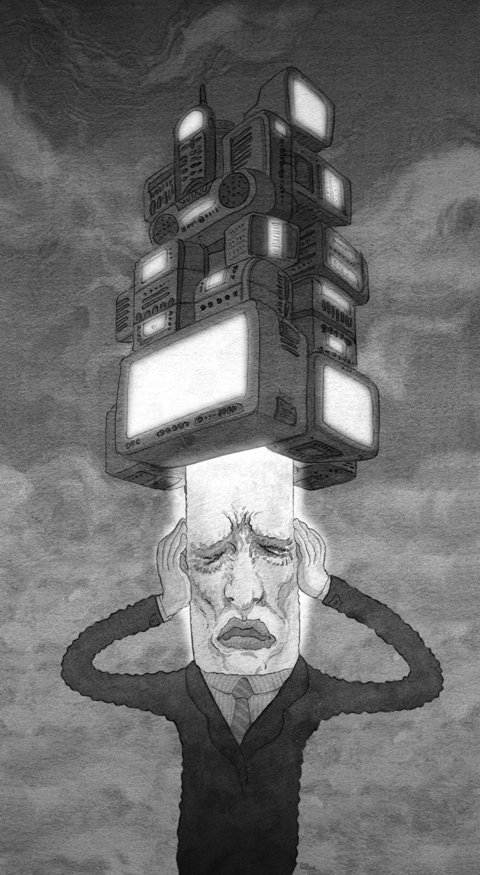
The technology makes the tiniest windows of time entertaining and potentially productive. However, scientists point to an unanticipated side-effect: When people keep their brains busy with digital input, they are forfeiting down time that could allow them to better learn and remember information or come up with new ideas.
Bates, for example, might be clearer-headed if she went for a run outside, away from her devices, research suggests.
At the University of California, San Francisco, scientists have found that when rats have a new experience, their brains show new patterns of activity. However, only when the rats take a break from their exploration do they process those patterns in a way that seems to create a persistent memory of the experience.
The researchers suspect that the findings also apply to how humans learn.
“Almost certainly, down time lets the brain go over experiences it’s had, solidify them and turn them into permanent long-term memories,” said Loren Frank, assistant professor in the department of physiology at the university, where he specializes in learning and memory.
He said he believed that when the brain was constantly stimulated, “you prevent this learning process.”
At the University of Michigan, a study found that people learned significantly better after a walk in nature than after a walk in a dense urban environment, suggesting that processing a barrage of information leaves people fatigued.
Even though people feel entertained, even relaxed, when they multitask while exercising, or pass a moment at the bus stop by catching a quick video clip, they might be taxing their brains, scientists say.
“People think they’re refreshing themselves, but they’re fatiguing themselves,” said Marc Berman, a University of Michigan neuroscientist.
Regardless, there is now a whole industry of mobile software developers competing to help people scratch the entertainment itch. Flurry, a company that tracks the use of apps, has found that mobile games are typically played for 6.3 minutes, but that many are played for much shorter intervals. One popular game that involves stacking blocks gets played for 2.2 minutes on average.
Today’s game makers are trying to fill small bits of free time, said Sebastien de Halleux, a co-founder of PlayFish, a game company owned by the industry giant Electronic Arts.
“Instead of having long relaxing breaks, like taking two hours for lunch, we have a lot of these micro-moments,” he said.
Game makers like Electronic Arts, he added, “have reinvented the game experience to fit into micro-moments.”
Many business people, of course, have good reason to be constantly checking their phones, but this can take a mental toll. Henry Chen, 26, a self-employed auto mechanic in San Francisco, has mixed feelings about his BlackBerry habits.
“I check it a lot, whenever there is down time,” Chen said.
Moments earlier, he was texting with a friend while he stood in line at a bagel shop; he stopped only when the woman behind the counter interrupted him to ask for his order.
Chen, who recently started his business, doesn’t want to miss a potential customer. Yet he said that since he upgraded his phone a year ago to a feature-rich BlackBerry, he can feel stressed out by what he described as internal pressure to constantly stay in contact.
“It’s become a demand. Not necessarily a demand of the customer, but a demand of my head,” he said. “I told my girlfriend that I’m more tired since I got this thing.”
In the parking lot outside the bagel shop, others were filling up moments with their phones. While Eddie Umadhay, 59, a construction inspector, sat in his car waiting for his wife to grocery shop, he deleted old e-mails while listening to news on the radio. On a bench outside a coffee house, Ossie Gabriel, 44, a nurse practitioner, waited for a friend and checked e-mail “to kill time.”
Crossing the street from a grocery store to his car, David Alvarado pushed his two-year-old daughter in a cart filled with shopping bags, his phone pressed to his ear.
He was talking to a colleague about work scheduling, noting that he wanted to steal a moment to make the call between paying for the groceries and driving.
“I wanted to take advantage of the little gap,” said Alvarado, 30, a facilities manager at a community center.
For many such people, the little digital asides come on top of heavy use of computers during the day. Take Bates, the exercising multitasker at the expansive Bakar Fitness and Recreation Center. She wakes up and peeks at her iPhone before she gets out of bed. At her job in advertising, she spends all day in front of her laptop.
However, far from wanting a break from screens when she exercises, she says she couldn’t possibly spend 55 minutes on the elliptical machine without “lots of things to do.”
This includes relentless channel surfing.
“I switch constantly,” she said. “I can’t stand commercials. I have to flip around unless I’m watching Project Runway or something I’m really into.”
Some researchers say that whatever downside there is to not resting the brain, it pales in comparison to the benefits technology can bring in motivating people to sweat.
“Exercise needs to be part of our lives in the sedentary world we’re immersed in. Anything that helps us move is beneficial,” said John Ratey, associate clinical professor of psychiatry at the Harvard Medical School and author of Spark: The Revolutionary New Science of Exercise and the Brain.
However, all things being equal, Ratey said, he would prefer to see people do their workouts away from their devices.
“There is more bang for your buck doing it outside, for your mood and working memory,” he said
Of the 70 cardio machines on the main floor at Bakar Fitness, 67 have televisions attached. Most of them also have iPod docks and displays and a few have games.
A few months ago, the cable TV went out and some patrons were apoplectic.
“It was an uproar. People said: ‘That’s what we’re paying for,’” said Leeane Jensen, 28, the fitness manager.
At least one exerciser has a different take. Two stories up from the main floor, Peter Colley, 23, churns away on one of the several dozen elliptical machines without a TV. Instead, they are bathed in sunlight, looking out onto the pool and palm trees.
“I look at the wind on the trees. I watch the swimmers go back and forth,” Colley said. “I usually come here to clear my head.”
Recently, China launched another diplomatic offensive against Taiwan, improperly linking its “one China principle” with UN General Assembly Resolution 2758 to constrain Taiwan’s diplomatic space. After Taiwan’s presidential election on Jan. 13, China persuaded Nauru to sever diplomatic ties with Taiwan. Nauru cited Resolution 2758 in its declaration of the diplomatic break. Subsequently, during the WHO Executive Board meeting that month, Beijing rallied countries including Venezuela, Zimbabwe, Belarus, Egypt, Nicaragua, Sri Lanka, Laos, Russia, Syria and Pakistan to reiterate the “one China principle” in their statements, and assert that “Resolution 2758 has settled the status of Taiwan” to hinder Taiwan’s
Singaporean Prime Minister Lee Hsien Loong’s (李顯龍) decision to step down after 19 years and hand power to his deputy, Lawrence Wong (黃循財), on May 15 was expected — though, perhaps, not so soon. Most political analysts had been eyeing an end-of-year handover, to ensure more time for Wong to study and shadow the role, ahead of general elections that must be called by November next year. Wong — who is currently both deputy prime minister and minister of finance — would need a combination of fresh ideas, wisdom and experience as he writes the nation’s next chapter. The world that
The past few months have seen tremendous strides in India’s journey to develop a vibrant semiconductor and electronics ecosystem. The nation’s established prowess in information technology (IT) has earned it much-needed revenue and prestige across the globe. Now, through the convergence of engineering talent, supportive government policies, an expanding market and technologically adaptive entrepreneurship, India is striving to become part of global electronics and semiconductor supply chains. Indian Prime Minister Narendra Modi’s Vision of “Make in India” and “Design in India” has been the guiding force behind the government’s incentive schemes that span skilling, design, fabrication, assembly, testing and packaging, and
As former president Ma Ying-jeou (馬英九) wrapped up his visit to the People’s Republic of China, he received his share of attention. Certainly, the trip must be seen within the full context of Ma’s life, that is, his eight-year presidency, the Sunflower movement and his failed Economic Cooperation Framework Agreement, as well as his eight years as Taipei mayor with its posturing, accusations of money laundering, and ups and downs. Through all that, basic questions stand out: “What drives Ma? What is his end game?” Having observed and commented on Ma for decades, it is all ironically reminiscent of former US president Harry


 RSS
RSS