


The world’s first global treaty to combat climate change, the Kyoto Protocol, was agreed in December 1997 after exhausting, all-night negotiations in Japan that saw arguments, desperate telephone calls back to leaders in capital cities and inspired diplomacy.
“A more bizarre way of reaching agreement to tackle global warming cannot be imagined. Half of those involved were asleep on the floor, unaware that history was being made,” the Guardian reported.
The final text of the agreement was still in the form of the conference chairman’s scribbled notes as the politicians flew home.
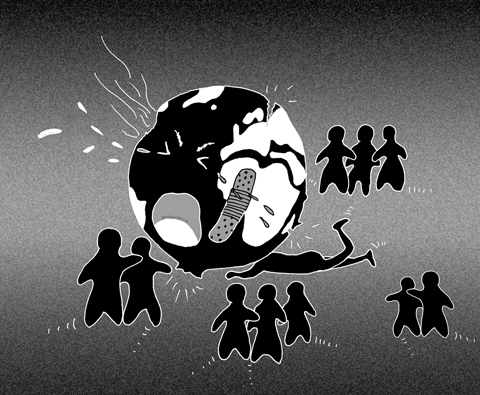
Fast-forward a dozen years and the world is once again grappling with the need to find a way to reduce the emission of greenhouse gases that scientists are now confident drive climate change, and could raise the Earth’s temperature to catastrophic levels within our lifetimes.
The stakes are higher than ever. Reports and studies over the intervening years have spelt out the likely cost of failure: floods, droughts, famines and refugees.
Nothing is certain, but — and this is a fact conveniently overlooked by climate skeptics — although climate change may not turn out to be as bad as everyone says, it could be an awful lot worse. The only way to know for sure is to wait and see, by which time it will be too late.
Voluntary action, by people or countries, is unlikely to be enough. Energy companies may brand their gigantic sales of oil and gas with green-washing images of windmills, but they continue to sell oil and gas. Airlines see the shrinking world largely through dollar signs.
Fast developing countries such as China and India sit on vast stocks of coal that are already driving a second industrial revolution and forcing their emissions above those of the older polluters in the west. Forests offer a financial lifeline to millions who live in squalor in Indonesia, Brazil and elsewhere, but only if they can be chopped down and shipped away, releasing huge clouds of carbon dioxide.
And at the top of the carbon food chain sits the Western consumer, with his or her weekends in Prague, all-year-round asparagus, plasma TVs and reluctance to pay more for the energy our lifestyles rely on.
The magnitude of the task involved in throwing a noose around that lot was what convinced world leaders they needed agreements like Kyoto. Firm targets to reduce greenhouse gases would surely force governments to introduce policies to steer their people away from their extravagantly polluting lifestyles and livelihoods.
How they did it would be up to them, as long as the numbers added up.
As many people in Kyoto suspected at the time, the reality has been very different. At the demand of the US, the Kyoto rules were tweaked to allow rich countries to buy their way out of their targets, a move that gave birth to the multibillion dollar carbon trading industry.
Then, having smuggled this slow-puncture into the world’s efforts to reduce emissions, former US president George W. Bush walked away from Kyoto altogether in protest at it only setting targets for rich countries.
From that moment, Kyoto was destined for the dustbin as a serious means to tackle climate change, and the world began to focus on bringing the US back on board.
The December meeting that spawned Kyoto was one of a series of annual UN climate conferences. The circus has since passed through Buenos Aires, Bonn, The Hague, Marrakech, New Delhi, Milan, Montreal, Nairobi, Bali and Poznan. And the pressure to produce a meaningful successor agreement has grown.
The first phase of Kyoto expires in 2012 and two years ago the world set itself a deadline to agree something to follow. That deadline expires in six weeks.
Next month Copenhagen will host the highest profile, best attended, most widely publicized, eagerly awaited and closely scrutinized UN climate talks so far. Could this be the moment the world finally gets to grips with climate change? With US President Barack Obama having pledged to engage the US properly, hopes have been high that Copenhagen will unite the world.
Like Kyoto, any deal agreed at Copenhagen would not decide policy. It would not ban flights, or push nuclear power, or force people to go back to living in mud huts. A Copenhagen treaty would set new targets for overall pollution levels, and again rely on governments to meet them.
Britain has already set some of the strictest carbon targets in the world. Whatever happens next month, British politicians have already decided they must spend the next few decades promoting renewable energy, electric vehicles and central heating based on methane from rotting food waste.
But, in the words of one online skeptic: What’s the point of Britain doing anything while China is building a new coal power station every week? (It’s actually two a week). This is where Copenhagen is critical. The world has changed since Kyoto and climate change threatens rich and poor countries alike.
To reduce global emissions China, the US and their kin must take action: Global climate change needs global attention. Copenhagen offers a chance to forge a new agreement with all the major players.
Then there is the science. Few insiders still believe it is possible, but in theory a Copenhagen treaty could offer the world its last chance to limit global warming to 2ºC above pre-industrial levels, which the EU defines as dangerous.
For this to happen, the world’s scientists think global carbon emissions must start to fall rapidly during the next decade. This demands severe and legally binding targets for all developed countries and significant voluntary cuts by the rest. Those are two of the goals that the British government has set for Copenhagen.
The third is to find a way of channeling billions of dollars from rich to poor countries, both as a moral acknowledgement that climate change is still largely the fault of the developed world, and to offer pragmatic assistance to those who will be most directly affected by changing weather patterns.
Many senior figures have already played down expectations. They say Obama needs more time to soften opposition at home. China will not move without the US, and so the whole process will be bogged down by the tension that wrecked Kyoto.
Copenhagen can only produce a political agreement, a framework. The real work will have to follow next year.
Others point out that Kyoto took several years to finalize, so there is no need to worry, no real need to squeeze everything into the pivotal last days of the talks.
Lord Smith, the chairman of the UK’s Environment Agency, this week labeled the Copenhagen talks only as a “crucial start” in the fight against climate change.
In fact, next month’s summit may not even be at the end of the beginning.
Green campaigners insist anything is still possible. Kyoto, they point out, was saved from collapse at the 11th hour, while the Bali talks in 2007 were rescued when US opposition wilted in the pressure cooker of the conference chamber.
Perhaps Obama could yet save the day. What truly matters is that at the end of Copenhagen a global deal, if not signed, sealed and delivered, remains on the table.
As the Guardian noted in 1997: “Kyoto has kept the climate change [fight] alive. The only way targets can go from here is up.”

Could Asia be on the verge of a new wave of nuclear proliferation? A look back at the early history of the North Atlantic Treaty Organization (NATO), which recently celebrated its 75th anniversary, illuminates some reasons for concern in the Indo-Pacific today. US Secretary of Defense Lloyd Austin recently described NATO as “the most powerful and successful alliance in history,” but the organization’s early years were not without challenges. At its inception, the signing of the North Atlantic Treaty marked a sea change in American strategic thinking. The United States had been intent on withdrawing from Europe in the years following
My wife and I spent the week in the interior of Taiwan where Shuyuan spent her childhood. In that town there is a street that functions as an open farmer’s market. Walk along that street, as Shuyuan did yesterday, and it is next to impossible to come home empty-handed. Some mangoes that looked vaguely like others we had seen around here ended up on our table. Shuyuan told how she had bought them from a little old farmer woman from the countryside who said the mangoes were from a very old tree she had on her property. The big surprise
The issue of China’s overcapacity has drawn greater global attention recently, with US Secretary of the Treasury Janet Yellen urging Beijing to address its excess production in key industries during her visit to China last week. Meanwhile in Brussels, European Commission President Ursula von der Leyen last week said that Europe must have a tough talk with China on its perceived overcapacity and unfair trade practices. The remarks by Yellen and Von der Leyen come as China’s economy is undergoing a painful transition. Beijing is trying to steer the world’s second-largest economy out of a COVID-19 slump, the property crisis and
Former president Ma Ying-jeou’s (馬英九) trip to China provides a pertinent reminder of why Taiwanese protested so vociferously against attempts to force through the cross-strait service trade agreement in 2014 and why, since Ma’s presidential election win in 2012, they have not voted in another Chinese Nationalist Party (KMT) candidate. While the nation narrowly avoided tragedy — the treaty would have put Taiwan on the path toward the demobilization of its democracy, which Courtney Donovan Smith wrote about in the Taipei Times in “With the Sunflower movement Taiwan dodged a bullet” — Ma’s political swansong in China, which included fawning dithyrambs


 RSS
RSS