


Immigration files containing a wealth of information collected by US border agents, some of it dating from the late 19th century, will be open to the public soon and permanently preserved, providing intriguing nuggets about famous immigrants and visitors such as Alfred Hitchcock and Salvador Dali.
But to millions of Americans, the real treasure will be clues about their own families’ histories in the photographs, letters, interrogation transcripts and recordings that reflect the intense scrutiny faced by those trying to enter the US during an era when it waged two world wars and adopted increasingly restrictive immigration policies.
Under an agreement signed this year, the files, on some 53 million people, will be gradually turned over by the Department of Homeland Security to the National Archives and Records Administration, beginning next year. The material, accounting for what officials describe as the largest addition of individual immigration records in the archives’ history, will be indexed and made available to anyone.
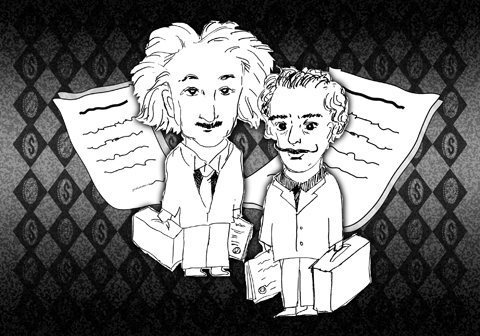
At present, members of the public typically gain access to the documents, known as the Alien Files, by submitting a Freedom of Information Act request. But that is a cumbersome process and can take months to produce documents — and even then only photocopies, not originals. Jeanie Low, a private consultant to family historians, says this deters amateur genealogists unfamiliar with navigating government bureaucracy.
That is how Thelma Lai Chang obtained the 103-page file detailing immigration officials’ interviews with her father, who immigrated from China as a 12-year-old in 1922. Under the Chinese Exclusion Act, most Chinese were then barred from entering the US, and her father used a fake identity, claiming to be the son of a family already in the country.
“I cried, because these are real documents,” said Chang, who keeps a copy of her father’s Alien File in her desk drawer at her San Francisco home. “All these years, my dad used to talk about how he came, and this is proof to me of what he went through. I mean, all these questions for a little kid.”
The decision to preserve the files is a victory for historical and immigrant groups that had been concerned because federal regulations permitted the government to destroy them once they were 75 years old.
The files contain a trove of information for historians of all fields. The file on Dali, for example, the Spanish surrealist who fled to the US at the onset of World War II, contains more than 40 pages of travel documents.
But the material will be particularly significant to the descendants of persecuted immigrants like Jews who fled Europe before World War II.
“For so many of us, this is all that exists,” said Rodger Rosenberg, whose great-grandparents escaped pogroms in Eastern Europe at the turn of the century. “So much was lost.”
The public demand for access to government records like these has been fueled by Web sites, including Ancestry.com and Footnote.com, which have made it easier for people to do research even if they have no formal genealogical background.
“Before, it was just microfilm, constantly microfilm, going through hours of microfilm,” said Adele Macher of Baltimore, who has been researching her family’s Italian roots for 17 years. Once started, the research becomes almost an addiction, Macher said as she pored over her great-aunt’s Alien File, obtained under the Freedom of Information Act.
“This is like really putting a puzzle together,” she said, “and every piece that you find you want to find the next piece and the next piece and the next piece.”
Perhaps most exciting to researchers is that the files, which they will be able to see at the regional archives in San Bruno, California, and Kansas City, Missouri, contain the original documents. Some include artifacts like wallets, 45-rpm records and detailed maps that prospective immigrants drew by hand at the border to prove claims about where they came from.
“The bottom line is that you want as many original documents as possible,” said Schelly Talalay Dardashti, who writes Tracing the Tribe, a Jewish genealogy blog. “Each time something is written down, there is a chance of something getting screwed up. Each time a document is transcribed, mistakes will be made.”
Still, for many among a generation of immigrants who dodged the Chinese Exclusion Act by inventing their heritage or spinning elaborate tales of lost documentation, the accessibility is alarming. The exclusion act was repealed in 1943, but fears of deportation ran rampant in the 1950s, when, in the wake of the Chinese Revolution, McCarthyism tore Chinese immigrant families and communities apart.
Scarred by a period of what they recall as institutionalized racism, many aging immigrants refuse to discuss the Alien Files. They are afraid, they say, that lies told by young immigrants so many years ago and recorded in the files then could result in deportation now.
But officials of the Homeland Security Department say the files will be used for historical purposes, not law enforcement. Further, records will not be released until the immigrant in question has died or turned 100, and the names of the living will be redacted.
The files and immigration agents “have always been seen as the enemy,” said Jennie Lew, spokeswoman for a coalition that pushed for the new agreement. “We’re trying to make this the silver lining of years of discrimination.”
Could Asia be on the verge of a new wave of nuclear proliferation? A look back at the early history of the North Atlantic Treaty Organization (NATO), which recently celebrated its 75th anniversary, illuminates some reasons for concern in the Indo-Pacific today. US Secretary of Defense Lloyd Austin recently described NATO as “the most powerful and successful alliance in history,” but the organization’s early years were not without challenges. At its inception, the signing of the North Atlantic Treaty marked a sea change in American strategic thinking. The United States had been intent on withdrawing from Europe in the years following
My wife and I spent the week in the interior of Taiwan where Shuyuan spent her childhood. In that town there is a street that functions as an open farmer’s market. Walk along that street, as Shuyuan did yesterday, and it is next to impossible to come home empty-handed. Some mangoes that looked vaguely like others we had seen around here ended up on our table. Shuyuan told how she had bought them from a little old farmer woman from the countryside who said the mangoes were from a very old tree she had on her property. The big surprise
The issue of China’s overcapacity has drawn greater global attention recently, with US Secretary of the Treasury Janet Yellen urging Beijing to address its excess production in key industries during her visit to China last week. Meanwhile in Brussels, European Commission President Ursula von der Leyen last week said that Europe must have a tough talk with China on its perceived overcapacity and unfair trade practices. The remarks by Yellen and Von der Leyen come as China’s economy is undergoing a painful transition. Beijing is trying to steer the world’s second-largest economy out of a COVID-19 slump, the property crisis and
As former president Ma Ying-jeou (馬英九) wrapped up his visit to the People’s Republic of China, he received his share of attention. Certainly, the trip must be seen within the full context of Ma’s life, that is, his eight-year presidency, the Sunflower movement and his failed Economic Cooperation Framework Agreement, as well as his eight years as Taipei mayor with its posturing, accusations of money laundering, and ups and downs. Through all that, basic questions stand out: “What drives Ma? What is his end game?” Having observed and commented on Ma for decades, it is all ironically reminiscent of former US president Harry


 RSS
RSS