


It was an unashamed display of military force, involving tanks, fighter jets and more than 3,000 soldiers. Last week China and Russia held their biggest joint military exercises ever — their battalions streaking across the plateaus and shimmering plains of Jilin Province.
The exercises come as Moscow and Beijing prepare to celebrate an important moment in history: 60 years of diplomatic relations. After long periods of frigidity during the Cold War, the two countries now claim to be enjoying an unprecedented strategic partnership.
But the military maneuvers — named Peace Operation 2009 — were not just about showing off, unleashing rockets at imaginary terrorist enemies or threatening the US. Instead, their aim was to send an unambiguous message to the Muslim populations of China and Russia: No dissent will be tolerated.
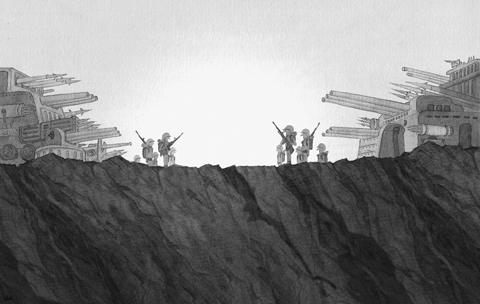
Both countries are now facing simmering Muslim uprisings. In China’s case, this comes from Uighurs, whose revolt in the western territory of Xinjiang this summer has been brutally suppressed. Russia, meanwhile, is facing an insurgency of its own in the north Caucasus republics of Ingushetia, Chechnya and Dagestan.
But while China and Russia have much in common, including a mutual fear of separatism and Islamic radicalism, there are also significant differences. Despite last week’s exercises, and a visit to Russia by Chinese President Hu Jintao (胡錦濤) in June, politicians in Moscow harbor a deep-seated fear of China, and Chinese encroachment in particular.
Russian TV recently claimed that Beijing has drawn up a secret plan. According to this top-secret blueprint, China is determined to grab back Russia’s remote, but vast, far eastern region. China’s strategy includes persuading migrants to settle in Russia, marry local women and steal or co-opt local businesses.
Russia’s far east has always been the most strategically vulnerable part of Moscow’s fissiparous imperium, in what is the world’s biggest country. Some 6,100km and an eight-hour flight from Moscow, the far east is home to just 6.5 million Russian citizens.
Next door, across the Amur river in northeastern China, there are 107 million Chinese. Given this demographic imbalance, there is a primordial fear in the Russian imagination that China will eventually try to steal back the Europe-sized far east of Russia — a region rich in mineral resources, trees, coal and fish.
The salmon alone are an attractive target. A quarter of the world’s Pacific salmon spawn in the volcanic Kamchatka Peninsula. According to the Russian TV scenario, Beijing is furtively plotting to undo the Russian colonization of the Pacific coastal region, started in the 18th century by tsarist-era adventurers. The area’s original inhabitants were Chinese. These early nomads eked out a meager living while dodging the tigers that still haunt the Sikhote-Alin mountains.
In reality, the relationship is far more fascinating than the baseless fears of Russia’s nationalists. Over the past decade the number of Chinese migrants working in Russia’s far east has actually fallen. In Moscow, the authorities have recently shut down the capital’s enormous Cherkizovsky market, turfing thousands of Chinese out of a job. The huge bazaar was home to Chinese traders selling billions of dollars in gray-sector goods. (According to China’s Xinhua agency, losses from Wenzhou in Zhejiang Province alone amounted to more than US$800 million after Russian police confiscated their stocks.) Some 150 Chinese workers have been deported since the market was closed on June 29.
Most experts believe China’s strategic goals do not include Russia’s far east or primitive territorial expansion. Instead, Beijing’s priorities lie elsewhere. They include development, unification with Taiwan and internal stability, which experts suggest is more of a priority than ever following last month’s ethnic riots against Han Chinese in Xinjiang.
According to Bobo Lo, a lecturer on Chinese-Russian relations at the Centre for European Reform, Beijing’s real challenge to Moscow is rather different. He argues that the rise of China will lead to the “steady marginalization of Russia from regional and global decision-making.” The Chinese do not want to invade Russia militarily because, he says, they would lose.
Any loss of influence would alarm the Kremlin, which still sees itself as a major global power. Over the past nine years, under president and then prime minister Vladimir Putin, Russia has worked hard to recover its superpower status.
However, few outside Moscow doubt that the main challenge to the US’ increasingly wobbly global and economic hegemony comes not from Putin’s Moscow but Hu’s Beijing.
In the meantime, informal ties between China and Russia are blossoming. During the summer, after the ice encrusting the Amur river melts, Russian tourists travel to China from the attractive Russian town of Khabarovsk. Their destination is the gleaming town of Fuyuan, reached by hydrofoil.
On Saturday, cruising down the Amur, Captain Alexander Udenka pointed out the border between China and Russia. On the river’s right bank is China and a series of low green mountains and Fuyuan’s newly built high-rises. Out on the river, Chinese fishermen zip around in speedboats, looking for the giant but elusive Amur sturgeon.
Over on the left bank, meanwhile, is Russia. Here there is no sign of human activity. The sandy bays are empty. There are not even any watchtowers — merely a shimmering green embankment of dense willows and oaks, as well as Manchurian nut trees and Japanese cherries — all apparently further evidence of far eastern Russia’s lack of people.
“In 1969, China and Russia fought a war over one of these river islands,” Udenka explains, sitting in his captain’s cabin and steering in the middle of the river.
“It was a small war. Now there are good relations between Russia and China. We trust each other,” he adds in broken Chinese.
A decade ago Fuyuan was little more than a village with a few pigs. Now it is a brash town, offering goods at less than half the price in Russia. During the season several hundred Russian tourists visit every day, staying on cheap two-day packages and haggling with Chinese locals who have rapidly mastered the Russian language.
Everything conceivable is on sale in Fuyuan — fur coats, computers, mobile telephones, socks and even sex toys. After trudging round the market for several hours, most Russians relax with a massage or get their hair highlighted. Others tuck into a tasty lunch of silver carp caught from the Amur, or pork dumplings.
“I still haven’t managed to get the hang of chopsticks,” Igor, a 23-year-old Russian tourist confessed.
Igor showed off his new purchases — a black cowboy hat, a fake Armani jacket, Gillette Mach 3 razors and a bottle of aftershave with an English logo, “Love Affairs.”
Asked why he had decided to buy a cowboy hat, Igor replied: “I got drunk last night.”
Local Russians can travel to Fuyuan without a visa. This suits Fuyuan’s traders, many of whom have moved from elsewhere in China.
“I like Russians. They are pretty indiscriminate. They just grab everything and run,” said Li Wing, 42, who owns a sex shop in Fuyuan.
Fuyuan ends abruptly. Its shopping center peters out at a decorative Chinese gate. From here, there is a stunning view of the Amur river and Russia. Up in the woods, among the pine trees, there is evidence of the environmental cost that new Chinese towns such as Fuyuan are wreaking: heaps of rubbish, plastic bags and a dead owl.
The problem of what to do with the far east has long exercised Moscow’s leadership. The Soviet Union offered generous subsidies to cajole workers and young couples to start a new life here. They got higher salaries, career opportunities and apartments. There were also cheap airfares back to European Russia. The incentives were needed given the region’s harsh climate — scorching summers and freezing winters, with January temperatures regularly falling below minus 30oC.
After the demise of the Soviet Union this system collapsed. With a ticket to Moscow now costing US$840 return, a new generation has grown up with weaker ties to the capital. Instead of visiting St Petersburg, local Russians are more likely to holiday in China — traveling by bus to the Chinese seaside resort of Dalian and other destinations in China’s northeast.
Gradually, Asiatic Russians are getting to know their neighbors better. Farther down the Amur in the border town of Blagoveshchensk, Russian pensioners have even started buying up apartments on the Chinese side of the river.
Other young Russians head west. Since the early 1990s the Russian far east’s population has plunged by 1.6 million. This exodus is a source of increasing worry for the Kremlin. On Friday, Putin traveled to Khabarovsk to unveil a new pipeline stretching from the Russian island of Sakhalin to Khabarovsk and the far eastern port of Vladivostok. The pipeline will take gas to China, Japan and South Korea — part of an attempt to stimulate the region’s economy.
In June, during his trip to Russia, Hu attended a summit of the Shanghai Co-operation Organization and held talks in Moscow with Russian President Dmitry Medvedev, which led to the signing of a massive oil deal. He also had tea with Putin. The deal reinforced China’s growing economic influence in the region, and its emergence as a competitor with Russia for Central Asia’s energy reserves.
In Khabarovsk, meanwhile, few locals see much prospect of the far east breaking away from Moscow. Despite improved understanding between China and Russia, the cultures remain too different (the Chinese see the Russians as Western-centric). In Khabarovsk, the last stop on the Trans-Siberian Railway before Vladivostok, nobody is talking about secessionism.
“I’ve had a few relationships with Russian girls. But I’ll end up marrying a Chinese one,” says Tsi Ke, 25, who has lived for the past decade in Khabarovsk. Tsi owns a thriving Chinese restaurant, where blonde Russian waitresses wear Chinese dresses. “In China we believe a wife should stay at home a lot and be like a daughter to your own parents. For us, marriage isn’t just between two people, but between two families.”
A more pressing problem for the Kremlin is the growing estrangement between Russia’s western and eastern halves. Resentment of Moscow and its far-away bureaucrats is rising. There have been grassroots protests in Khabarovsk and in Vladivostok after Moscow raised duties on second-hand Japanese cars late last year, killing off a major regional business. Anti-Kremlin protests are continuing.
In May, Medvedev dropped into Khabarovsk for an EU-Russia summit. The venue — 10 hours’ flight from Brussels — was apparently chosen by Russia to punish the EU’s pampered representatives, several of whom fell asleep during sessions.
Medvedev flatteringly described the far east as his “favorite part” of Russia, and expressed sympathy with students too broke to travel to Moscow. This summer, the Kremlin has introduced a scheme offering discounted tickets to the under-23s.
It remains to be seen whether the scheme will make much difference. In reality, though, successive governments in Moscow have done little to develop the far east — making the region susceptible to civic unrest and discontent. The region suffers from “long-term neglect by Moscow” and “appalling corruption and misgovernment at regional level,” Bobo Lo says.
Despite last week’s show of unity during military maneuvers, the relationship between Beijing and Moscow is no longer one of equals. Russia may see China as an important strategic counterweight to the US — with whom it is currently in conflict over a range of issues, including the planned US missile defense shield in central Europe.
But the Chinese know that it is they, and not Putin’s Russia, who are destined to become the world’s newest superpower. And according to Bobo Lo, China is not interested in allowing strategic accommodation with Moscow to disrupt Beijing’s more important partnership with Washington.
“Washington is still the world’s only indispensable partner,” he says.

Could Asia be on the verge of a new wave of nuclear proliferation? A look back at the early history of the North Atlantic Treaty Organization (NATO), which recently celebrated its 75th anniversary, illuminates some reasons for concern in the Indo-Pacific today. US Secretary of Defense Lloyd Austin recently described NATO as “the most powerful and successful alliance in history,” but the organization’s early years were not without challenges. At its inception, the signing of the North Atlantic Treaty marked a sea change in American strategic thinking. The United States had been intent on withdrawing from Europe in the years following
My wife and I spent the week in the interior of Taiwan where Shuyuan spent her childhood. In that town there is a street that functions as an open farmer’s market. Walk along that street, as Shuyuan did yesterday, and it is next to impossible to come home empty-handed. Some mangoes that looked vaguely like others we had seen around here ended up on our table. Shuyuan told how she had bought them from a little old farmer woman from the countryside who said the mangoes were from a very old tree she had on her property. The big surprise
The issue of China’s overcapacity has drawn greater global attention recently, with US Secretary of the Treasury Janet Yellen urging Beijing to address its excess production in key industries during her visit to China last week. Meanwhile in Brussels, European Commission President Ursula von der Leyen last week said that Europe must have a tough talk with China on its perceived overcapacity and unfair trade practices. The remarks by Yellen and Von der Leyen come as China’s economy is undergoing a painful transition. Beijing is trying to steer the world’s second-largest economy out of a COVID-19 slump, the property crisis and
As former president Ma Ying-jeou (馬英九) wrapped up his visit to the People’s Republic of China, he received his share of attention. Certainly, the trip must be seen within the full context of Ma’s life, that is, his eight-year presidency, the Sunflower movement and his failed Economic Cooperation Framework Agreement, as well as his eight years as Taipei mayor with its posturing, accusations of money laundering, and ups and downs. Through all that, basic questions stand out: “What drives Ma? What is his end game?” Having observed and commented on Ma for decades, it is all ironically reminiscent of former US president Harry


 RSS
RSS