


Fossils recently discovered in Myanmar could prove that the common ancestors of humans, monkeys and apes evolved from primates in Asia, rather than Africa, researchers contend in a study released on Wednesday.
However, other scientists said that the finding, while significant, won’t end the debate over the origin of anthropoids — the primate grouping that includes ancient species as well as modern humans.
The pieces of 38 million-year-old jawbones and teeth found near Bagan in central Myanmar in 2005 show typical characteristics of primates, said Chris Beard, a paleontologist at the Carnegie Museum of Natural History in Pittsburgh and a member of the team that found the fossils.
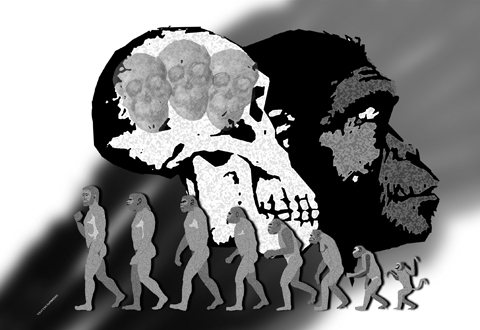
“When we found it, we knew we had a new type of primate and basically what kind of primate it was,” Beard said in a telephone interview from Pittsburgh, Pennsylvania. “It turns out that jaws and teeth are very diagnostic ... They are almost like fingerprints for fossils like this.”
The findings were published in the Proceedings of The Royal Society B, a London-based peer-reviewed journal.
Beard and his team from France, Thailand and Myanmar concluded that the fossils — which they dubbed Ganlea megacanina — came from 10 to 15 individuals of a new species that belonged to an extinct family of Asian anthropoid primates known as Amphipithecidae.
Wear and tear found on the canine teeth suggest the tree-dwelling, monkey-like creatures with long tails used their teeth to crack open tropical fruit to get to the pulp and seeds — behavior similar to modern South American saki monkeys that inhabit the Amazon basin, Beard said.
“Not only does Ganlea look like an anthropoid, but it was acting like an anthropoid 38 million years ago by having this feeding ecology that was quite specialized,” Beard said.
His team determined that the fossil was 38 million years old, making it several million years older than any anthropoid found in Africa and the second-oldest discovered in Asia.
In 1994, Beard and his Chinese colleagues found fossilized foot bones of the anthropoid Eosimias — one of the worlds smallest primates — which lived between 40 million and 45 million years ago and roamed ancient rain forest on the eastern coast of China.
Beard said the age of both fossils was the evidence he needed to challenge contentions that anthropoid primates had evolved in Africa, where Lucy, a 3.2 million-year-old fossil, was discovered in 1974.
“This new fossil Ganlea definitely helps us argue — and we think the argument is pretty close to settled now — that when you go back this far in time, the common ancestor of monkeys, apes and humans was definitely in Asia, not in Africa,” Beard said.
In May, researchers unveiled a nearly intact skeleton of a 47 million-year-old primate — found in Germany and dubbed “Ida” — that they said provides a glimpse into how our distant ancestors may have looked.
“We wouldn’t claim Ganlea is [the] missing link, but we know Ganlea is much more closely related to our ancestors than Ida ever was — even though, unfortunately, we don’t have complete skeleton like they did for Ida,” he said.
Jorn Hurum, who brought Ida to the University of Oslo Natural History Museum, said that it was too early to draw conclusions from the Myanmar fossils because only jawbones and teeth were found.
“These fragments are still too few and far between,” Hurum said. “This is the kind of scientific debate that will continue until more complete skeletons like Ida has been found, and this may take several hundred years.”
John Fleagle, a Stony Brook University paleontologist, said the discovery of Ganlea is important because it shows how several different primates found in Myanmar are related and provides interesting suggestions about a unique dietary specialization.
But he said the Myanmar fossils do little to prove whether anthropoids evolved in Asia or Africa — or even whether Ganlea was an anthropoid or an early relative of lemurs.
“This doesn’t add anything new about whether anthropoids came from Africa or Asia or the broader evolutionary relationships of these particular primates,” Fleagle said.
“The definitive features that would resolve it in people’s mind would be in the skull,” he said. “Without a skull to demonstrate the distinctive anthropoid features of the eye and ear regions, scientists will still continue to debate whether the dental similarities just indicate similar diets or are the result of a common heritage.”
Beard isn’t letting the criticism slow him down. He and his team expect to return to Myanmar in November to continue searching for more fossils and exploring how anthropoids evolved in Asia and then migrated to Africa.
“The question is when and how did this big evolutionary shift occur from Asia to Africa,” Beard said. “That is something we are trying to establish. We have a team working in Myanmar which has ideas of places to go in Africa to try and pick up [the] thread there.”
Recently, China launched another diplomatic offensive against Taiwan, improperly linking its “one China principle” with UN General Assembly Resolution 2758 to constrain Taiwan’s diplomatic space. After Taiwan’s presidential election on Jan. 13, China persuaded Nauru to sever diplomatic ties with Taiwan. Nauru cited Resolution 2758 in its declaration of the diplomatic break. Subsequently, during the WHO Executive Board meeting that month, Beijing rallied countries including Venezuela, Zimbabwe, Belarus, Egypt, Nicaragua, Sri Lanka, Laos, Russia, Syria and Pakistan to reiterate the “one China principle” in their statements, and assert that “Resolution 2758 has settled the status of Taiwan” to hinder Taiwan’s
Singaporean Prime Minister Lee Hsien Loong’s (李顯龍) decision to step down after 19 years and hand power to his deputy, Lawrence Wong (黃循財), on May 15 was expected — though, perhaps, not so soon. Most political analysts had been eyeing an end-of-year handover, to ensure more time for Wong to study and shadow the role, ahead of general elections that must be called by November next year. Wong — who is currently both deputy prime minister and minister of finance — would need a combination of fresh ideas, wisdom and experience as he writes the nation’s next chapter. The world that
The past few months have seen tremendous strides in India’s journey to develop a vibrant semiconductor and electronics ecosystem. The nation’s established prowess in information technology (IT) has earned it much-needed revenue and prestige across the globe. Now, through the convergence of engineering talent, supportive government policies, an expanding market and technologically adaptive entrepreneurship, India is striving to become part of global electronics and semiconductor supply chains. Indian Prime Minister Narendra Modi’s Vision of “Make in India” and “Design in India” has been the guiding force behind the government’s incentive schemes that span skilling, design, fabrication, assembly, testing and packaging, and
As former president Ma Ying-jeou (馬英九) wrapped up his visit to the People’s Republic of China, he received his share of attention. Certainly, the trip must be seen within the full context of Ma’s life, that is, his eight-year presidency, the Sunflower movement and his failed Economic Cooperation Framework Agreement, as well as his eight years as Taipei mayor with its posturing, accusations of money laundering, and ups and downs. Through all that, basic questions stand out: “What drives Ma? What is his end game?” Having observed and commented on Ma for decades, it is all ironically reminiscent of former US president Harry


 RSS
RSS