


As Iran’s ruling ayatollahs tell it, the main strike force plotting to end Islamic rule in their country is not on the streets of Tehran but on the upper floors of a celebrated Art Deco building in central London.
The propagators of an “all-out war” against the Islamic republic, as Iran’s state-run news agency has called them, are a group of 140 men and women who work at the BBC’s Broadcasting House, a stone’s throw from the shopping mecca of Oxford Street in London. Mainly expatriate Iranians, they staff the BBC’s Persian-language television service, on air for only six months and reaching a daily audience of between 6 million and 8 million Iranians — a powerful fraction of TV watchers in Iran, with its population of 70 million.
The audience estimate, BBC insiders say, came from a leaked document prepared by Iran’s state-run broadcasting service, which warned before the current upheaval of the threat from the new channel.
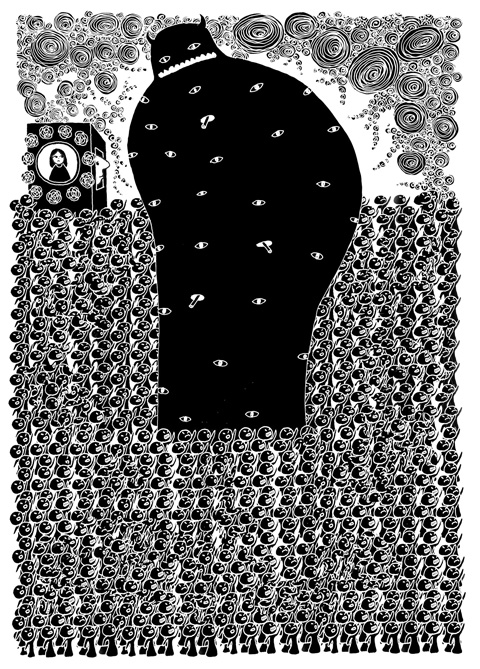
PTV, as those in the London newsroom call it, is at the heart of a new kind of revolution that has played out in Tehran, where a disputed presidential election two weeks ago sent tens of thousands of protesters into the streets claiming ballot fraud in the re-election of the hard-line incumbent, Mahmoud Ahmadinejad.
In the protests, an archaic political system has been shaken by the use of powerful new weapons: foreign-based satellite television channels like the BBC’s that beam into Iran, social networking tools like Twitter and sites like Facebook that act as running diaries on the upheaval and as forums for coordinating protest, and cell phone videos that have captured the confrontation in Tehran for worldwide audiences, perhaps most important in Iran itself.
“It’s a totally different country now because of the new media,” said Sina Motallebi, who oversees interactive elements of the BBC channel’s coverage in the London newsroom.
Motallebi, more than most, understands the new technologies’ power — and the Iranian government’s determination to suppress them. In 2003, as Iran’s most famous anti-government blogger, he was imprisoned in Tehran’s notorious Evin prison, along with murderers, rapists and other criminals. Many others working at the BBC channel gained their first experience working on opposition newspapers and blogs in Tehran.
The government has singled out several foreign news broadcasters for what it calls biased coverage: CNN, broadcasting in English, as well as the Voice of America and the BBC, which broadcast in Iran in Persian, the country’s national language.
But the BBC’S Persian channel has been cast as the main threat, partly, BBC officials say, because Britain’s colonial past has earned it a special place in Iran’s official demonography. Hamid Reza Moqaddamfar, chief of the state-run Fars news agency, has described the channel’s coverage as “psychological warfare,” and said its mission was “spreading lies and rumors and distorting facts.”
A pro-Ahmadinejad newspaper, Vatan Emrouz, even claimed that Jon Leyne, the BBC’s Tehran correspondent, expelled from Iran on June 21, paid “a thug” to kill Neda Agha-Soltan, the young woman who became a martyr to the protesters after she was shot dead during the demonstrations.
State-run television has interviewed protesters who said the Persian channel influenced them to take to the streets. One woman said the channel inspired her and her son to go out armed with hand grenades. Another woman said the channel’s report that the riot police had attacked protesters prompted her to go to the streets, where she said she had found that it was the protesters, not the police, who were “beating up people.”
The allegations prompt weary smiles among the staff in London.
“I wouldn’t be doing my job effectively if we were fomenting anything of a political nature,” said Rob Beynon, the BBC channel’s acting director, recruited two years ago to set up the channel and train Iranian and Afghan staff members who will eventually take control.
Although foreign-language radio and television broadcasts from the BBC’s World Service are financed by Britain’s Foreign Office, a practice that developed in the country’s days of empire, they are subject, like all BBC operations, to the corporation’s charter and its stipulation of political independence and impartiality. The Persian channel, which is also beamed to Persian speakers in Afghanistan and Tajikistan, has an annual budget of US$25 million.
Beynon, a 51-year-old Cambridge graduate, said evenhandedness became especially important during the upheaval in Iran. That has meant interviewing Ahmadinejad supporters whenever possible, a task made more difficult by a government ban on officials’ talking to the channel, he said. Often, the government view is taken from official news agencies or pro-government newspapers.
A typical 30-minute newscast last week was dominated by political developments in Tehran, although there were breaks for a report on a new US bombing policy in Afghanistan, sports and the weather forecast for Iran and Afghanistan. Many of the Iran-based stories were accompanied by cell phone videos e-mailed to the channel from Tehran.
Experts on Iran who have monitored the channel’s programming on the Internet say it has succeeded in a difficult task, giving a tempered account of developments that have been deeply divisive among Iranians. In that respect, they say, the new TV channel has made a better start than the BBC’s Persian-language shortwave radio broadcasts, started in 1941, which the BBC has conceded were used to promote British strategic interests in Iran during World War II.
“They are very cautious, reminding viewers of what they can confirm and what they can’t and of who their sources are,” said Ali Ansari, a professor of Iranian studies at the University of St Andrews in Scotland, whose father was a diplomat under the shah, Mohammed Reza Pahlavi.
“And they don’t allow people to use their broadcasts to slander their opponents, which is more than you can say for the state broadcasting network in Iran. The paradox is that it’s precisely because they are seen as objective and impartial by Iranians that they come under such severe attack,” he said.
With the rush of events in Iran, the channel has increased daily programming from eight hours to 11, signing off at 1am Tehran time. Roxanna Shapour, the channel’s spokeswoman, cited a cascade of interactive contacts with Iranians at the height of the protests: up to 10,000 e-mail messages a day, and an average of six video clips a minute arriving from people capturing the protests.
The channel’s Web site www.bbcpersian.com, registered 3 million hits the day after the election.
Like other foreign broadcasters, the BBC beams its programs to rooftop satellite dishes atop thousands of buildings across Iran. In itself, this is a defiance of the ruling ayatollahs, who long ago banned the dishes as un-Islamic. But they have abandoned enforcement as impractical and politically risky, given the wide popularity of foreign television.
Instead, the government has made fresh attempts at jamming the Persian channel’s signal, starting as vote-counting began on the night of the election. So far, the efforts have mostly failed, with BBC engineers moving the signal to two additional satellites that are more difficult to jam, they said.
BBC reporters have been kicked out of Iran, one by one, like those at other Western news organizations. The Persian channel has not been permitted to assign correspondents of its own to Tehran, and the main English-language BBC TV and radio network has barred its Tehran-based reporters from appearing on the Persian channel, in an attempt to shield them from the Tehran government’s hostility to the new channel.
John Simpson, the BBC’s best-known foreign correspondent, said he was given a hero’s greeting on the streets of Tehran when people learned he was from the BBC, not because people recognized him but because of enthusiasm for the Persian channel.
For years, Simpson said in a radio report on his return from Tehran, Iran’s Islamic rulers have believed the BBC was part of a wider British attempt to manipulate events in the country.
“The big irony, of course, is that, thanks to the Persian-language TV service, the BBC does have huge influence in Iran again, just like the hard-liners in Iran have always said it did,” he said.
Recently, China launched another diplomatic offensive against Taiwan, improperly linking its “one China principle” with UN General Assembly Resolution 2758 to constrain Taiwan’s diplomatic space. After Taiwan’s presidential election on Jan. 13, China persuaded Nauru to sever diplomatic ties with Taiwan. Nauru cited Resolution 2758 in its declaration of the diplomatic break. Subsequently, during the WHO Executive Board meeting that month, Beijing rallied countries including Venezuela, Zimbabwe, Belarus, Egypt, Nicaragua, Sri Lanka, Laos, Russia, Syria and Pakistan to reiterate the “one China principle” in their statements, and assert that “Resolution 2758 has settled the status of Taiwan” to hinder Taiwan’s
Singaporean Prime Minister Lee Hsien Loong’s (李顯龍) decision to step down after 19 years and hand power to his deputy, Lawrence Wong (黃循財), on May 15 was expected — though, perhaps, not so soon. Most political analysts had been eyeing an end-of-year handover, to ensure more time for Wong to study and shadow the role, ahead of general elections that must be called by November next year. Wong — who is currently both deputy prime minister and minister of finance — would need a combination of fresh ideas, wisdom and experience as he writes the nation’s next chapter. The world that
The past few months have seen tremendous strides in India’s journey to develop a vibrant semiconductor and electronics ecosystem. The nation’s established prowess in information technology (IT) has earned it much-needed revenue and prestige across the globe. Now, through the convergence of engineering talent, supportive government policies, an expanding market and technologically adaptive entrepreneurship, India is striving to become part of global electronics and semiconductor supply chains. Indian Prime Minister Narendra Modi’s Vision of “Make in India” and “Design in India” has been the guiding force behind the government’s incentive schemes that span skilling, design, fabrication, assembly, testing and packaging, and
Can US dialogue and cooperation with the communist dictatorship in Beijing help avert a Taiwan Strait crisis? Or is US President Joe Biden playing into Chinese President Xi Jinping’s (習近平) hands? With America preoccupied with the wars in Europe and the Middle East, Biden is seeking better relations with Xi’s regime. The goal is to responsibly manage US-China competition and prevent unintended conflict, thereby hoping to create greater space for the two countries to work together in areas where their interests align. The existing wars have already stretched US military resources thin, and the last thing Biden wants is yet another war.


 RSS
RSS