


The Taj Mahal, one of the world's architectural masterpieces, welcomes about 2.5 million visitors each year -- provided they don't try to buy tickets with US dollars. India's most popular shrine announced last month that it would stop accepting the US currency and take only rupees, hurling yet another insult at the once mighty greenback.
The dollar, which has been snubbed by everybody from government officials in Kuwait and South Korea to top-earning Brazilian supermodel Gisele Bundchen, may not recover its luster. Economists say the currency, which has declined in five of the past six years against the euro, is caught in a downdraft as investors pour into Asia, prompting a tectonic shift in economic power from the US.
"Can it be turned around? Probably not totally," says Riordan Roett, a professor of political science at Johns Hopkins University in Baltimore, Maryland. "The century of Asia has arrived, and the US and its European allies will need to adjust to that."
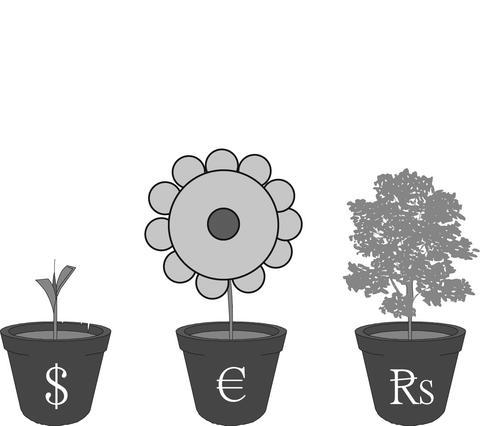
In Asia, an investment boom has boosted local currencies. China's roaring economy has grown an average of 10.4 percent in the past four years, fueled by record exports and a flood of foreign funds. That's pushed up the yuan since the government ended the currency's peg to the dollar in July 2005. As of Wednesday, the yuan -- managed against a basket of currencies -- climbed 12 percent against the dollar.
The Indian economy has grown at its fastest pace in the past four years since independence in 1947. That's helped to lift the rupee 12 percent against the US currency this year through Wednesday.
Dollar bulls say the currency, which rose to its highest in seven weeks against the euro on Wednesday, could rally further next year. They cite this year's fiscal US budget deficit, which fell to US$162.8 billion compared with US$412.8 billion three years earlier. And the current account deficit narrowed to US$178.5 billion in the third quarter after reaching a record US$217.3 billion in the period last year.
Deutsche Bank AG, the world's largest currency trader, predicts the dollar next year will rise about 2 percent more versus the euro, a currency shared by 15 nations as of next month.
Longer-term, the slowing US economy -- hurt by a banking and consumer credit meltdown that's only getting worse -- will weigh heavily on the dollar. Since August, the Federal Reserve has cut interest rates three times to 4.25 percent this month and traders in federal funds futures see about an even chance the rate will be 3.75 percent by May.
The Fed's moves, coupled with the European Central Bank's threat this month to raise rates, have tilted the odds against the US currency. This year, it fell 8 percent against the euro and 2 percent versus the British pound through Wednesday.
Asian and Persian Gulf nations are concerned that the flight from the dollar is feeding on itself and may spur a crisis of confidence.
Kuwait abandoned a dollar peg in May due to its weak buying power. South Korea's central bank last month urged shipbuilders to issue invoices in won, the country's currency, and take out more hedging policies to guard against the weakened dollar.
Peter Kenen, a professor of international finance at Princeton University, raises the possibility that the dollar's role as the world's dominant reserve currency may be coming to an end. The dollar's share of central banks' currency portfolios slid to 64.8 percent in this year's second quarter from 71 percent in 1999, the year the euro debuted, the IMF says.
Cash-rich governments, mostly in Asia and the Middle East, may shift as much as US$1.2 trillion in dollar holdings to other currencies in the next five years, Merrill Lynch & Co economists say.
"The dollar will not recover completely its dominant role in the system, although it may well share that role with the euro and even the pound," says Kenen, a former Treasury adviser. "What some of us thought could happen in the distant future may be upon us now."
Lester Thurow, a professor of economics at Massachusetts Institute of Technology, disputes the assertion that the dollar has lost its clout. Historical trends of developing nations suggest China's economic output and per-capita income may not catch up to the US's for about a century.
"A reserve currency needs to be the currency of a world power," Thurow says. "China may pass the US, but not until 2100."
China, with US$1.46 trillion in foreign exchange reserves, is a wild card. Its financial leaders are combing the world's markets for investments that pay more than the return of about 4 percent on 10-year US Treasury bonds.
Chinese investors reduced their holdings of U.S. Treasuries by 8 percent to US$388.1 billion in October from a peak in March. Then, early this month, China's Ministry of Commerce gave a boost to the dollar, saying it would encourage more businesses to buy US assets.
Morgan Stanley, the second-largest US securities firm, on Wednesday said it received a US$5 billion infusion from the state-controlled China Investment Corp. The firm lost US$3.56 billion in the fourth quarter amid the subprime mortgage market collapse.
Economists debate whether the administration of US President George W. Bush wants the dollar to appreciate. After US trading partners in Europe and Japan criticized the currency's decline, US Treasury Secretary Henry Paulson last month stepped up his rhetoric about the economy's long-term growth prospects to instill confidence in the dollar, says Jens Nordvig, an economist at Goldman Sachs Group Inc in New York.
With the weak dollar spurring US exports -- one of the few bright spots in the economy -- some economists don't take Paulson at his word.
"The Bush administration is not sincere in saying it wants a strong dollar," says Nobel laureate Paul Samuelson, a professor emeritus at MIT. "The long-run trend for the dollar is very likely to be downward."
The currency will be barred from more places than the Taj Mahal in the event Samuelson is right.

Could Asia be on the verge of a new wave of nuclear proliferation? A look back at the early history of the North Atlantic Treaty Organization (NATO), which recently celebrated its 75th anniversary, illuminates some reasons for concern in the Indo-Pacific today. US Secretary of Defense Lloyd Austin recently described NATO as “the most powerful and successful alliance in history,” but the organization’s early years were not without challenges. At its inception, the signing of the North Atlantic Treaty marked a sea change in American strategic thinking. The United States had been intent on withdrawing from Europe in the years following
My wife and I spent the week in the interior of Taiwan where Shuyuan spent her childhood. In that town there is a street that functions as an open farmer’s market. Walk along that street, as Shuyuan did yesterday, and it is next to impossible to come home empty-handed. Some mangoes that looked vaguely like others we had seen around here ended up on our table. Shuyuan told how she had bought them from a little old farmer woman from the countryside who said the mangoes were from a very old tree she had on her property. The big surprise
Ursula K. le Guin in The Ones Who Walked Away from Omelas proposed a thought experiment of a utopian city whose existence depended on one child held captive in a dungeon. When taken to extremes, Le Guin suggests, utilitarian logic violates some of our deepest moral intuitions. Even the greatest social goods — peace, harmony and prosperity — are not worth the sacrifice of an innocent person. Former president Chen Shui-bian (陳水扁), since leaving office, has lived an odyssey that has brought him to lows like Le Guin’s dungeon. From late 2008 to 2015 he was imprisoned, much of this
The issue of China’s overcapacity has drawn greater global attention recently, with US Secretary of the Treasury Janet Yellen urging Beijing to address its excess production in key industries during her visit to China last week. Meanwhile in Brussels, European Commission President Ursula von der Leyen last week said that Europe must have a tough talk with China on its perceived overcapacity and unfair trade practices. The remarks by Yellen and Von der Leyen come as China’s economy is undergoing a painful transition. Beijing is trying to steer the world’s second-largest economy out of a COVID-19 slump, the property crisis and


 RSS
RSS