


Extreme drought, ferocious bushfires and urban development are killing Australia's koalas and could push the species towards extinction within a decade, environmentalists are warning.
Alarms about the demise of the iconic and peculiar animal, which sleeps about 20 hours per day and eats only the leaves of the eucalyptus tree, have been raised before.
But Deborah Tabart, chief executive officer of the Australia Koala Foundation, believes the animal's plight is as bad as she has seen it in her 20 years as a koala advocate.
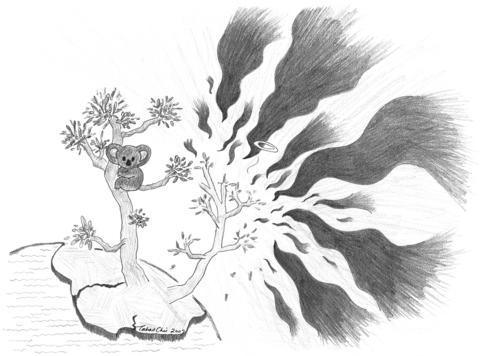
"In southeast Queensland we had them listed as a vulnerable species which could go to extinction within 10 years. That could now be seven years," she said. "The koala's future is obviously bleak."
Southeastern Queensland has the strongest koala populations in the vast country, meaning extinction in this area spells disaster for the future of the species, Tabart said.
The biggest threat is the loss of habitat as a result of road building and development on Australia's eastern coast -- traditional koala country. The joke, Tabart said, is that koalas enjoy good real estate and are often pushed out of their habitat by farming or development.
"I've driven pretty much the whole country and I just see environmental vandalism and destruction everywhere I go," she said. "It's a very sorry tale. There are [koala] management problems all over the country."
Massive bushfires which raged in the country's south for weeks during the Australian summer, burning a million hectares of land, would also have killed thousands of koalas.
Meanwhile there is the worst drought in a century, genetic mutations from decades of inbreeding in some populations, and the widespread incidence of chlamydia, a type of venereal disease which affects fertility, to further cut koala numbers.
Moreover, the animals are often fatally attacked by pet dogs.
"In southeast Queensland the koalas are just in people's backyards and the dogs just munch on them," Tabart said.
Confusing the issue is the lack of data on the number of koalas in the wild. Figures range from 100,000 animals to several million. What is known is that there were once millions of them ranged along eastern Australia.
The hunting and slaughter for their furs in the 1920s eradicated the species in the state of South Australia and pushed Victorian populations close to extinction.
Public outrage over the killing of the big-eyed "bears" put an end to the practice but Victorian stocks were unfortunately later replenished with in-bred animals, leading to a lack of genetic diversity in that state.
As a result, genetic problems such as missing testicles and deformed "pin" heads have emerged in Victorian koalas, said University of Queensland academic Frank Carrick.
Carrick, who leads a koala study project at the university, estimates the national population of the marsupial at about 1 million. And while he doesn't believe the animal will be extinct within a decade, he acknowledges that numbers are contracting.
"Though we don't really have an accurate figure on how many koalas there are in Australia right now, we do know one thing -- that it's going down. Because we keep chopping down trees and their food source," he said.
Carrick said it will take 40 to 50 years for the koala to sufficiently recover from the impact of the latest Victorian bushfires, drought and development.
"Exactly how small do we want the population to be before we push the panic button?" he said.
Dan Lunney, a senior research scientist with the New South Wales (NSW) state Department of Environment and Conservation, said koalas cover roughly the same territory as they did 20 years ago.
In some areas -- Victoria state and Kangaroo Island in South Australia -- koala numbers are growing. But in New South Wales, which tracks the east coast of Australia, the koala is a recognized threatened species.
"That means if nothing is done about it the population will continue to decline," he said. "The issue is not how many there are; but it's whether they are declining or not."
Lunney said while the Victoria bushfires would have killed large numbers of animals, as long as some koalas survived and sufficient bush regrowth is maintained, the population will recover.
"Koalas can take a fair bit. That's why we've still got them," he said. "But they do have a threshold at which they can't continue."
Lunney said populations were at most risk of dying out in areas where new houses were being built, putting them at risk of death by cars and dogs.
"Koalas in the NSW coastal areas are the most vulnerable because that's where the human population is increasing," he said.
"As the human population increases on the North Coast, the cost is coming out in the survival of koalas. Road kill -- it's a common way to see wildlife," Lunney said.
Drought, fire and flood have always been part of the Australian environment, "but when your habitat is fragmented, all these things are exacerbated," said Erna Walraven, senior curator at Sydney's Taronga Zoo.
Walraven sees the koala as a flagship species, with the health of their populations serving as an indicator of the wider health of the wildlife of the bush, including bandicoots and wallabies.
"My view is that there are a range of animals under that five, six, seven kilogram range that really [are] quite vulnerable to increased development and land clearing on the coast," she said. "I think that the koala is in there with a big suite of other species, native Australian icons, that are under threat."
Recently, China launched another diplomatic offensive against Taiwan, improperly linking its “one China principle” with UN General Assembly Resolution 2758 to constrain Taiwan’s diplomatic space. After Taiwan’s presidential election on Jan. 13, China persuaded Nauru to sever diplomatic ties with Taiwan. Nauru cited Resolution 2758 in its declaration of the diplomatic break. Subsequently, during the WHO Executive Board meeting that month, Beijing rallied countries including Venezuela, Zimbabwe, Belarus, Egypt, Nicaragua, Sri Lanka, Laos, Russia, Syria and Pakistan to reiterate the “one China principle” in their statements, and assert that “Resolution 2758 has settled the status of Taiwan” to hinder Taiwan’s
Singaporean Prime Minister Lee Hsien Loong’s (李顯龍) decision to step down after 19 years and hand power to his deputy, Lawrence Wong (黃循財), on May 15 was expected — though, perhaps, not so soon. Most political analysts had been eyeing an end-of-year handover, to ensure more time for Wong to study and shadow the role, ahead of general elections that must be called by November next year. Wong — who is currently both deputy prime minister and minister of finance — would need a combination of fresh ideas, wisdom and experience as he writes the nation’s next chapter. The world that
The past few months have seen tremendous strides in India’s journey to develop a vibrant semiconductor and electronics ecosystem. The nation’s established prowess in information technology (IT) has earned it much-needed revenue and prestige across the globe. Now, through the convergence of engineering talent, supportive government policies, an expanding market and technologically adaptive entrepreneurship, India is striving to become part of global electronics and semiconductor supply chains. Indian Prime Minister Narendra Modi’s Vision of “Make in India” and “Design in India” has been the guiding force behind the government’s incentive schemes that span skilling, design, fabrication, assembly, testing and packaging, and

Can US dialogue and cooperation with the communist dictatorship in Beijing help avert a Taiwan Strait crisis? Or is US President Joe Biden playing into Chinese President Xi Jinping’s (習近平) hands? With America preoccupied with the wars in Europe and the Middle East, Biden is seeking better relations with Xi’s regime. The goal is to responsibly manage US-China competition and prevent unintended conflict, thereby hoping to create greater space for the two countries to work together in areas where their interests align. The existing wars have already stretched US military resources thin, and the last thing Biden wants is yet another war.


 RSS
RSS