


A large and growing number of countries are reversing the longstanding trend toward destruction of their forests, a surprising new analysis has found.
"From the new data it seems possible that we could reverse a global trend that many people thought was irreversible," said Pekka Kauppi of the University of Helsinki in Finland, a lead author of the study, which appeared on Tuesday in the Proceedings of the National Academy of Sciences.
The report, by a team of researchers in Europe, the US and Asia, is a ray of hope at a time of ominous environmental warnings about global warming caused by man-made carbon emissions. Forests can act as pollution sinks, easing the emissions' effects to some degree.
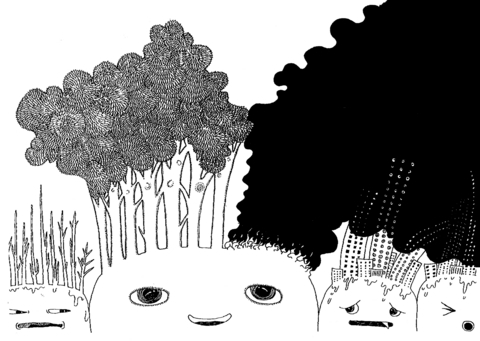
The scientists say their study suggests that environmental damage can be reversed with a combination of policy and luck. Twenty years ago most scientists believed that deforestation was an inexorable result of industrialization and that the planet would soon be virtually denuded of trees.
"This is the first time we have documented that many countries have turned the corner, that gradually forests are coming back," said one of the authors, Jesse Ausubel of the Rockefeller University in New York, who added that he personally had expected to live in a "skinhead" earth by 2050.
But some experts reacted with caution to the results. The lack of good data on forests in many parts of the world meant that it was hard to be confident about the study's "positive indications of an important change," said Peter Holmgren, chief of forest resources development at the UN Food and Agriculture Organization in Rome.
He noted that much of the data for the new study was provided by governments themselves, which he says do not do a good job of measuring forests, or was done by aerial surveillance, which is notoriously unreliable.
"There are trends that these guys have observed that seem true, but it's difficult to state for certain," Holmgren said. "Is there a global paradigm change? We really don't know yet."
He called for countries to undertake systematic forest inventories.
The report on Tuesday acknowledges that in a few countries, notably Brazil and Indonesia, the destruction of forests remains a serious and worsening problem. Because of the continuing cutting in those countries, the global trend is still negative.
Yet the researchers, using new analytical techniques, calculated that in the last 15 years, in 22 of the 50 countries with the most forests, they had actually expanded and that many other countries were poised to make the transition from deforestation to reforestation in the coming decades.
The reversal is partly a result of social changes that occur as countries develop and become wealthier, the study said. For example, as rural dwellers move to the cities there are fewer people in the countryside to cut down trees for uses like heating and building.
But in nations like China, India and Turkey the shift also involved a strong measure of public policy, including tree planting campaigns, restrictions on clear-cutting and more efficient agricultural practices, which means that less land needs to be cleared for growing food.
"On a global level, deforestation will be reversed if we maintain this trend, which has involved a lot of different factors: a shift to highly productive agriculture in some places, as well as people like you and me reading newspapers on the Internet so that forest is not destroyed," Ausubel said.
The researchers analyzed new information from the Food and Agriculture Organization on the world's forests for 1990 and last year, as well as the contents of national databases.
Instead of merely estimating the area of forest in each part of the world, they developed new research tools that took into account the volume of timber, the amount of biomass, the density of forest areas and the carbon-capturing capacity of local trees.
A vast majority of the more developed countries had more forest area and denser forests last year than in 1990. In the US and Western Europe the transition began decades ago, but it has increased rapidly in the last 15 years, the researchers found.
More encouraging, the authors said, was the fact that countries like Vietnam and Turkey seem to have reversed the trend, as have giants like India and China.
But Holmgren cautioned that there were still many problems in many parts of the world, where overcutting and poor forest management are rampant.
He added that the evidence for a reversal of deforestation remained weak in many nations. He noted, for example, that while China had planted huge swaths of forest, it was unclear if these were sustainable.
"Are people in northern Thailand moving off of marginal farmland and going to Bangkok so the land can revert to forest?" he asked. "It's a scenario, but I'm not sure we really know that."
Recently, China launched another diplomatic offensive against Taiwan, improperly linking its “one China principle” with UN General Assembly Resolution 2758 to constrain Taiwan’s diplomatic space. After Taiwan’s presidential election on Jan. 13, China persuaded Nauru to sever diplomatic ties with Taiwan. Nauru cited Resolution 2758 in its declaration of the diplomatic break. Subsequently, during the WHO Executive Board meeting that month, Beijing rallied countries including Venezuela, Zimbabwe, Belarus, Egypt, Nicaragua, Sri Lanka, Laos, Russia, Syria and Pakistan to reiterate the “one China principle” in their statements, and assert that “Resolution 2758 has settled the status of Taiwan” to hinder Taiwan’s
Singaporean Prime Minister Lee Hsien Loong’s (李顯龍) decision to step down after 19 years and hand power to his deputy, Lawrence Wong (黃循財), on May 15 was expected — though, perhaps, not so soon. Most political analysts had been eyeing an end-of-year handover, to ensure more time for Wong to study and shadow the role, ahead of general elections that must be called by November next year. Wong — who is currently both deputy prime minister and minister of finance — would need a combination of fresh ideas, wisdom and experience as he writes the nation’s next chapter. The world that

Can US dialogue and cooperation with the communist dictatorship in Beijing help avert a Taiwan Strait crisis? Or is US President Joe Biden playing into Chinese President Xi Jinping’s (習近平) hands? With America preoccupied with the wars in Europe and the Middle East, Biden is seeking better relations with Xi’s regime. The goal is to responsibly manage US-China competition and prevent unintended conflict, thereby hoping to create greater space for the two countries to work together in areas where their interests align. The existing wars have already stretched US military resources thin, and the last thing Biden wants is yet another war.
Since the Russian invasion of Ukraine in February 2022, people have been asking if Taiwan is the next Ukraine. At a G7 meeting of national leaders in January, Japanese Prime Minister Fumio Kishida warned that Taiwan “could be the next Ukraine” if Chinese aggression is not checked. NATO Secretary-General Jens Stoltenberg has said that if Russia is not defeated, then “today, it’s Ukraine, tomorrow it can be Taiwan.” China does not like this rhetoric. Its diplomats ask people to stop saying “Ukraine today, Taiwan tomorrow.” However, the rhetoric and stated ambition of Chinese President Xi Jinping (習近平) on Taiwan shows strong parallels with


 RSS
RSS